


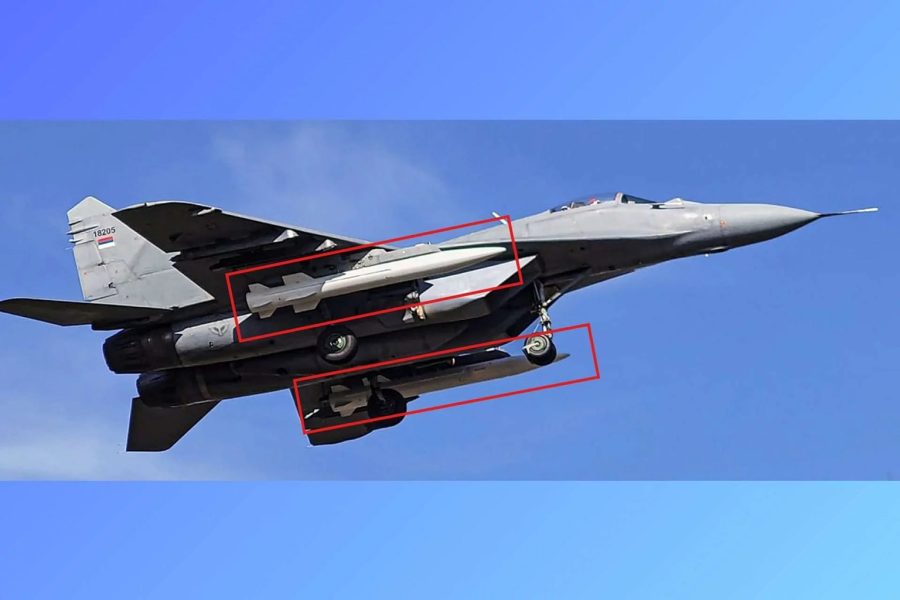
BELGRADE, July 12 (BV) – Serbia has integrated Chinese-made CM-400AKG air-to-surface missiles onto its upgraded MiG-29 fighter aircraft, significantly expanding its long-range precision strike capabilities and adding a new dimension to the military balance in Southeast Europe.
President Aleksandar Vučić confirmed in March that Serbia had purchased a “significant number” of the missiles and that the country’s Soviet-designed MiG-29 fleet had been modified to deploy the weapon system.
The move makes Serbia the first European country and only the second known foreign operator, after Pakistan, to field the Chinese missile. The value of the deal has not been disclosed.
Photographs published in Serbian media show MiG-29 aircraft carrying the missiles beneath their wings. Defence analysts say the integration was achieved through a dedicated Chinese interface, avoiding the costly replacement of the aircraft’s original Soviet-era avionics.
The upgrade transforms the MiG-29 from a fighter primarily designed for air defence into a platform capable of conducting long-range strikes against land and maritime targets.
Long-range precision strike
The CM-400AKG, produced by China’s state-owned CASIC, is a supersonic air-to-surface missile designed to attack high-value targets including command centres, radar stations, naval vessels and critical infrastructure.
It can carry either a 150-kg high-explosive fragmentation warhead or a 200-kg penetrator warhead intended for hardened targets.
Its reported range varies widely. Most international defence assessments estimate between 100 and 250 km, while Serbian and Pakistani sources claim it can reach up to 400 km depending on launch altitude and aircraft speed.
The missile follows a semi-ballistic flight profile and accelerates to several times the speed of sound during its terminal phase, reducing the target’s reaction time and complicating interception by air defence systems.
Although often described as “hypersonic” in promotional material and some media reports, defence experts generally classify it as a high-supersonic semi-ballistic missile rather than a true hypersonic glide weapon.
The missile combines inertial and satellite navigation and, depending on the variant, may use infrared, television or passive radar seekers for terminal guidance.
Bridge capability before Rafale
Serbia has gradually modernised its MiG-29 fleet, including aircraft acquired from Russia and Belarus.
The integration of the Chinese missile provides the aircraft with a new operational role while Belgrade awaits delivery of 12 French Rafale fighters, which are expected to replace the MiGs progressively before the end of the decade.
The new capability enables Serbian aircraft to launch stand-off attacks from outside the engagement range of many air defence systems.
However, military analysts note that the effectiveness of such weapons depends heavily on accurate intelligence, surveillance and target designation. Long range alone does not guarantee successful strikes without reliable targeting data.
Regional implications
Croatia, a NATO and European Union member, has criticised Serbia’s acquisition as a development that could contribute to an arms race in the Western Balkans.
Belgrade rejects such criticism, saying the modernisation is intended solely to strengthen deterrence and protect national airspace.
Serbia maintains military neutrality while cooperating with NATO through the Partnership for Peace programme. At the same time, it continues close defence ties with Russia and China while pursuing European Union membership.
Its military inventory reflects that balancing policy, combining Russian aircraft, Chinese air defence systems and drones with Western acquisitions, including French Rafale fighters.
While the CM-400AKG does not challenge NATO’s overall technological and numerical superiority, it provides Serbia with a capability it previously lacked: the ability to conduct high-speed precision strikes from long distances. In the densely interconnected airspace of the Balkans, defence analysts say that is a development neighbouring countries and NATO are likely to monitor closely.