


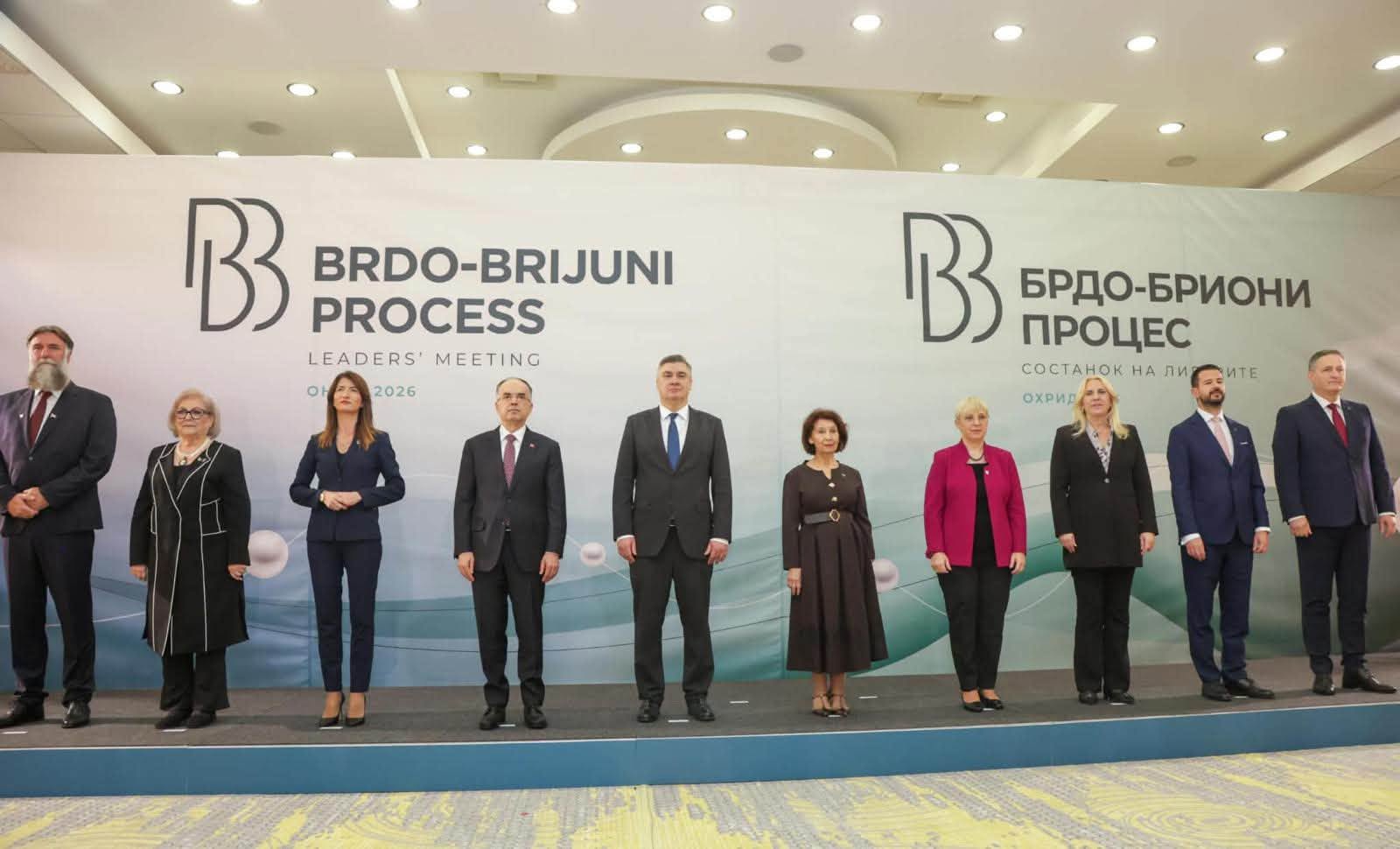
Serbia’s acting president Aleksandar Čupić declined to sign the Brdo-Brijuni summit declaration despite reportedly supporting its principles, while North Macedonia renewed calls to prevent bilateral disputes from obstructing European integration.
OHRID, North Macedonia, Nov. 27, 2026 (BalkanView) — Western Balkan leaders called for faster European Union enlargement based on reforms and clearly defined membership criteria on Friday, but their summit in Ohrid ended without Serbia’s signature on a joint declaration or a concrete timetable for accession.
Serbia’s acting President Aleksandar Čupić was the only participant who did not sign the declaration, arguing that his temporary presidential mandate did not give him sufficient legitimacy to do so, North Macedonian President Gordana Siljanovska-Davkova said.
According to Siljanovska-Davkova, Čupić nevertheless expressed agreement with all the principles contained in the document.
The summit of the Brdo-Brijuni Process was hosted by Siljanovska-Davkova and co-organised by Slovenian President Nataša Pirc Musar and Croatian President Zoran Milanović.
Representatives of Albania, Bosnia and Herzegovina, Kosovo, Montenegro and Serbia also attended.
The meeting came two days after the EU–Western Balkans summit in Brussels, which Serbia did not attend and whose final declaration it did not endorse.
Serbia’s new leadership faces its first regional diplomatic test
Čupić, who also serves as speaker of Serbia’s parliament, made his first international appearance as acting president at the Ohrid summit.
Serbia is undergoing a political transition following the victory of the Student List in the October 25 parliamentary elections and the subsequent resignation of Aleksandar Vučić.
Presidential elections have been scheduled for December 27.
Čupić said he expected a new Serbian government to be formed within a reasonable period, after which its programme and priorities would be presented.
He said Serbia’s future foreign policy should be balanced, consistent and predictable, with regional cooperation based on mutual respect and shared interests.
Despite withholding his signature from the declaration, Čupić described his discussions with regional leaders as friendly and constructive, saying the Ohrid meeting had established a new quality of communication among neighbouring countries.
Siljanovska-Davkova welcomed his participation, describing it as an indication that Serbia’s emerging leadership attached importance to regional dialogue.
Čupić calls on Bulgaria to help its neighbours
Asked about the dispute between North Macedonia and Bulgaria, Čupić avoided taking sides but suggested that Sofia should play a constructive role in supporting the region’s European integration.
“I think perhaps Bulgaria also has a place here, since it is already an EU member, to help as well,” Čupić said.
He pointed to Slovenia and Croatia as examples of EU member states sharing their experience and supporting candidate countries through the Brdo-Brijuni Process.
Following bilateral talks with Siljanovska-Davkova, Čupić said the two leaders had discussed regional cooperation and the importance of involving young people in political processes.
Siljanovska-Davkova said North Macedonia and Serbia had no outstanding bilateral disputes that could obstruct cooperation and expressed hope that relations would improve further following Serbia’s political transition.
Skopje demands an end to bilateral obstacles
North Macedonia used the summit to renew its calls for accession decisions to be based on European membership criteria rather than bilateral disagreements, particularly those concerning national identity.
“We have a serious problem with bilateral issues, and specifically with bilateral issues that are not related to the Copenhagen criteria,” Siljanovska-Davkova told reporters.
She called for reducing the influence of bilateral disputes on the enlargement process, particularly when they concern identity-related questions.
Although the joint declaration does not explicitly mention Bulgaria, the dispute between Skopje and Sofia featured prominently in questions at the closing press conference.
Siljanovska-Davkova said she had not asked Croatia or Slovenia to take North Macedonia’s side in the dispute but welcomed their continued support for the country’s European integration.
She also described the progress made by Montenegro and Albania towards EU membership as beneficial to the entire region.
“Their progress is also our progress,” she said.
North Macedonia’s accession process remains subject to the negotiating framework agreed in 2022, which requires constitutional amendments before the country can advance to the next stage of negotiations.
The Ohrid declaration does not change those conditions or establish a mechanism preventing EU member states from raising bilateral issues during accession negotiations.
Enlargement as a European security imperative
Siljanovska-Davkova argued that the integration of the Western Balkans should be viewed in the context of Europe’s wider geopolitical and security interests.
“Enlargement is not merely a question of expansion; it is a security imperative,” she said.
She warned that excluding the Western Balkans from European integration could leave a geopolitical vacuum.
“Without the so-called Western Balkans, the EU will leave a geopolitical vacuum, and in politics there is never a vacuum,” she said.
The North Macedonian president welcomed gradual integration into European policies and institutions but stressed that such arrangements should not become a substitute for full EU membership.
Slovenian President Pirc Musar also called for faster enlargement and greater political commitment from Brussels.
“I am convinced that there is no strong Europe without EU enlargement. Unfortunately, EU enlargement is still too slow,” she said.
Pirc Musar described the Ohrid meeting as one of the most constructive gatherings of the Brdo-Brijuni Process, highlighting dialogue and mutual respect among participants.
Milanović warns against excessive EU centralisation
Croatian President Milanović reaffirmed his support for the European integration of all Western Balkan countries but expressed reservations about transforming the EU into a more centralised geopolitical power.
He argued that economic and trade cooperation remained among the Union’s principal strengths, while transferring additional political authority to the European level could increase the influence of individual member states over others.
His remarks highlighted differences over the future institutional structure of the European Union, even among countries supporting further enlargement.
Milanović nevertheless described the atmosphere at the Ohrid summit as constructive and supported continued regional dialogue.
Regional leaders demand greater European investment
The joint declaration calls for accelerated investment in transport, energy and digital infrastructure across the Western Balkans.
Participants argued that the region should be included in European infrastructure planning and economic integration rather than treated as a group of third countries awaiting membership.
They also reaffirmed the importance of the EU Growth Plan as a mechanism for financing reforms and economic development, urging regional governments to make full use of available European resources.
Youth employment and demographic challenges were another focus of the summit.
Pirc Musar proposed that public employment services across the region develop a joint plan to improve employment opportunities for young people.
Siljanovska-Davkova called for young people to participate directly in future meetings of the Brdo-Brijuni Process.
Čupić, meanwhile, highlighted the region’s shared cultural and historical heritage, referring to figures including Goce Delchev, Petar Petrović Njegoš, France Prešeren, Ivo Andrić, Miroslav Krleža and Ismail Kadare as examples of the cultural achievements connecting Balkan societies.
He urged neighbouring countries to build on their shared interests and create conditions that encourage young people to remain in the region.
Two summits, two declarations without Serbia’s endorsement
The Ohrid meeting followed Wednesday’s EU–Western Balkans summit in Brussels, where European leaders reaffirmed their commitment to enlargement while demanding credible reforms, good neighbourly relations and foreign policy alignment.
Serbia did not align with the Brussels Declaration. Two days later, its acting president attended the Ohrid summit but withheld his signature from the regional declaration, citing the limitations of his temporary mandate, according to Siljanovska-Davkova.
The two meetings took place during Serbia’s transition towards a new government and the election of a new president.
While Čupić’s participation in Ohrid marked renewed engagement in regional dialogue, the incoming Serbian leadership has yet to present its full foreign policy programme.
Political support, but no accession deadline
The Ohrid declaration reaffirmed support for timely and full EU membership for Western Balkan countries, with progress assessed according to individual achievements, implemented reforms and previously established criteria.
It called for accession decisions to respect the Copenhagen criteria, European law, relevant international agreements and the rule of law.
However, the summit produced neither a specific membership deadline nor a new institutional mechanism to address bilateral blockages.
For North Macedonia, the existing accession conditions remain unchanged. For Serbia, the formation of a new government and December’s presidential election represent the next milestones in its political transition.
The Ohrid summit ended with renewed political support for enlargement and regional cooperation, but without Serbia’s signature on the joint declaration.