


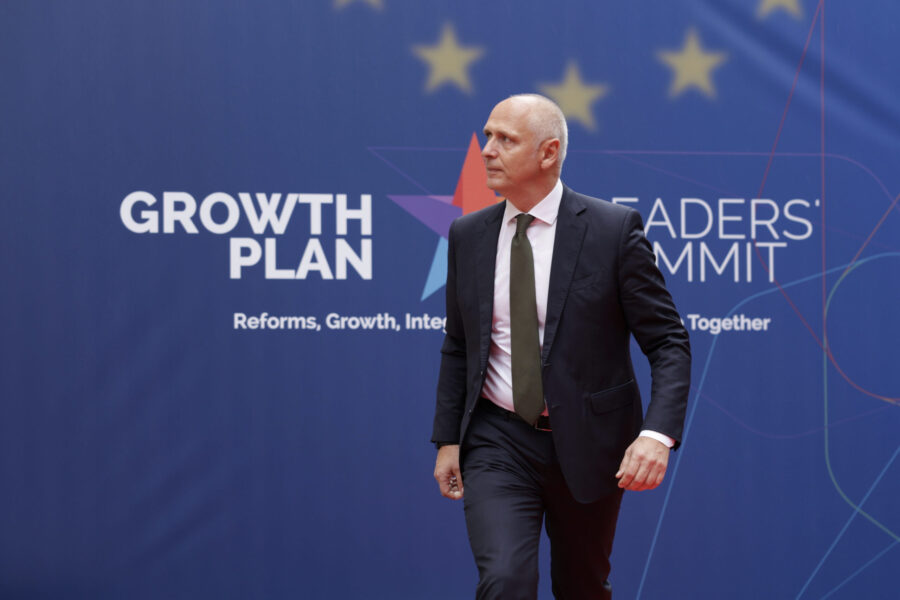
With the EU’s Growth Plan entering its final year, RCC Secretary General Amer Kapetanović has urged Western Balkan leaders to accelerate regional market integration, remove trade barriers and prevent political disagreements from undermining economic cooperation.
TIRANA, Nov. 27, 2026 (BalkanView) — Western Balkan economies must accelerate the implementation of their Common Regional Market and overcome political differences that continue to obstruct economic integration, Regional Cooperation Council (RCC) Secretary General Amer Kapetanović said on Friday.
Speaking at the Growth Plan Leaders’ Summit in Tirana, Kapetanović urged regional governments to strengthen cooperation, establish concrete deadlines and deliver measurable benefits for citizens and businesses.
The summit brought together Western Balkan leaders and European Commissioner for Enlargement Marta Kos to review progress under the European Union’s Growth Plan and identify priorities for reforms and gradual integration into the EU Single Market.
“In a world that has become harder for small economies, the six of us can still choose not to stay small. That is what this market is for, and RCC will see it through with you,” Kapetanović said.
Small economies need a larger market
Kapetanović stressed that the Common Regional Market, coordinated by the RCC, was a central pillar of the EU Growth Plan, alongside domestic reforms and gradual integration into the European single market.
While domestic reforms prepare Western Balkan economies for participation in the EU market, regional integration provides businesses with the scale and competitiveness needed to operate within it, he said.
The initiative seeks to reduce barriers to economic activity across Albania, Bosnia and Herzegovina, Kosovo, Montenegro, North Macedonia and Serbia.
Kapetanović highlighted several achievements demonstrating the practical benefits of regional cooperation, including the introduction of roaming at domestic prices across the six economies in 2021 and the accession of four Western Balkan economies to the Single Euro Payments Area (SEPA).
Participation in SEPA has significantly reduced international payment costs, facilitating cross-border transactions for citizens and businesses, according to the RCC.
However, administrative barriers, restrictions on services and regulatory differences continue to limit the potential of the regional market.
When politics slows economic progress
Kapetanović warned that regional initiatives had advanced more rapidly when cooperation remained focused on technical issues and clearly defined economic benefits.
“We moved fastest where the benefit was visible, the work stayed technical, and the reward was clear. We stalled where technical files were caught in wider disputes,” he said.
The RCC chief called for outstanding disagreements to be resolved, implementation accelerated and concrete deadlines established for remaining commitments.
Referring to findings from the RCC’s Balkan Barometer, Kapetanović said citizens increasingly recognised the importance of regional cooperation but expected more tangible results, particularly amid concerns over rising living costs and economic uncertainty.
Western Balkan leaders welcomed progress under the Common Regional Market and acknowledged the RCC’s coordinating role in advancing regional economic integration.
Discussions focused on removing remaining obstacles and ensuring that political commitments translate into practical economic benefits.
Time running short for Growth Plan delivery
With the EU Reform and Growth Facility entering its final year and the Common Regional Market Action Plan 2025–2028 approaching its midpoint, Kapetanović said the pace of implementation needed to increase considerably.
Delivering the remaining commitments would require stronger coordination, sustained political support and a willingness to compromise in the common regional interest, he said.
The RCC will continue working with Western Balkan governments, the European Commission and regional partners to coordinate implementation and monitor progress.
The challenge facing regional governments is to ensure that commitments made at successive summits result in fewer barriers, lower business costs and greater economic opportunities.
Tourism and 32 investment opportunities
The leaders’ summit concluded a series of high-level meetings in Tirana focused on economic integration, investment and European accession reforms.
At the Tourism Ministerial Meeting, regional representatives launched the RCC-developed Western Balkans Six Regional Tourism Facility, designed to support joint promotion, connected tourism routes and sustainable destination management.
Kapetanović also presented a regional portfolio of 32 investment opportunities at the EU–Western Balkans New Frontier Investment Conference.
The European Integration Ministerial Meeting formed another part of the programme, focusing on advancing reforms and closer integration with the European Union.
Together, the meetings highlighted the economic dimension of the enlargement process, with regional cooperation intended to help Western Balkan businesses and citizens benefit from closer integration before formal EU membership.