



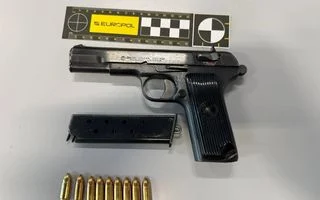
A cross-border police operation in Greece, Spain and Bulgaria has dismantled a Turkish-led criminal network that allegedly trafficked firearms from the Western Balkans and Turkey into the European Union in exchange for cannabis from Spain, much of which was destined for Greece, officials said on Monday.
The EU law enforcement agency Europol said the low-cost but fully functional hybrid weapons – combining original and handmade parts – were difficult to trace and were used as currency in drug deals across the bloc.
“This steady flow of weapons significantly increased the firepower of organised crime groups and contributed to violence across Europe,” Europol said in a statement.
Greek police said officers temporarily detained six people in Thessaloniki – five Turkish nationals and one Greek woman – and searched four locations as part of the coordinated operation.
Europol said the main suspect, arrested in Sofia, is a Turkish national holding a Greek residence permit. He is believed to have coordinated the sourcing and transport of firearms into Spain while overseeing the purchase and distribution of drugs to countries including Greece and Bulgaria.
A total of 21 people were arrested on March 23 – 18 in Spain and three in Bulgaria. Authorities seized 587 kilograms of marijuana and 76 kilograms of hashish with an estimated illicit market value of 4.4 million euros. Police also confiscated seven semi-automatic pistols, one military-grade weapon, silencers and sound suppressors.
Europol said the investigation began in March 2025 after Spanish authorities detected an influx of weapons from Turkey to criminal groups in Catalonia amid rising armed violence.
Investigators found that firearms were smuggled into the European Union using vehicles and trucks with hidden compartments and delivered to Spain. In return, the network is believed to have had the capacity to transport up to 1.5 tonnes of marijuana per month from Catalonia to Greece and Turkey, where its value increased significantly.
Turkish organised crime groups have become increasingly active in Greece in recent years, officials said.