
• Home  
  • Name Dispute Rhetoric Returns to Test Greece–North Macedonia Ties
- Headline - News - Week

Name Dispute Rhetoric Returns to Test Greece–North Macedonia Ties

Relations between Greece and North Macedonia are again under strain after Prime Minister Hristijan Mickoski said his government had “in practice restored the name Macedonia”, prompting a formal response from Athens and reviving concerns over the long-term durability of the Prespa Agreement. Greece’s foreign ministry said the constitutional and internationally recognised name of its northern […]

Relations between Greece and North Macedonia are again under strain after Prime Minister Hristijan Mickoski said his government had “in practice restored the name Macedonia”, prompting a formal response from Athens and reviving concerns over the long-term durability of the Prespa Agreement.

Greece’s foreign ministry said the constitutional and internationally recognised name of its northern neighbour remains “the Republic of North Macedonia”, as explicitly defined in Article 1 of the 2018 Prespa Agreement, which is incorporated into North Macedonia’s constitution and is legally binding on both sides.

“There are no ‘facts on the ground’ in international treaties, nor any room for unilateral reinterpretation or distortion of their content,” the ministry said, adding it would not accept any attempt to falsify or amend the agreement.

The Greek statement followed a televised interview in which Mickoski, responding to criticism from the opposition Social Democratic Union (SDSM), argued that his government had effectively reversed the name change. As evidence, he pointed to public remarks by SDSM leader Venko Filipche, who has used the term “Macedonia” rather than the country’s full constitutional name.

The comments reflect a broader rhetorical strategy by the nationalist VMRO-DPMNE party, which has sought to signal to domestic voters that the Prespa Agreement is politically hollow, while stopping short of any formal institutional steps to revoke it – a move that would carry significant diplomatic and European consequences.

Since taking office, senior government officials, including President Gordana Siljanovska-Davkova, have repeatedly avoided using the constitutional name in public appearances, a practice that has drawn scrutiny in Athens but until now prompted only limited diplomatic responses.

Greek interventions have largely been confined to cases involving statements by top state officials, raising questions over whether Athens is deliberately pursuing a low-profile strategy to avoid escalation, or struggling to enforce clear red lines on the agreement’s implementation.

Greece has repeatedly stressed that progress in bilateral relations and North Macedonia’s European integration depend on full compliance with Prespa and respect for the principle of good neighbourly relations.

Analysts say the agreement is currently being tested not through formal breaches, but through sustained rhetorical erosion that risks creating grey areas in its application if left unchallenged. That dynamic, they add, has implications not only for North Macedonia’s EU path, but also for Greece’s credibility as a guarantor of an international accord it helped broker and signed.
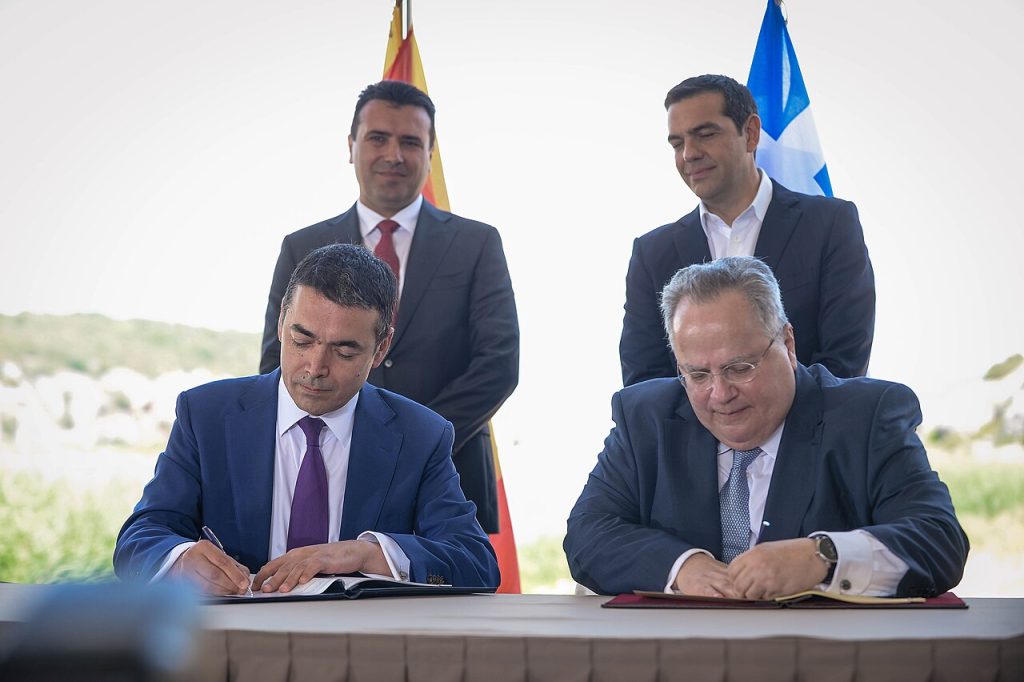
FACTBOX – Prespa Agreement: Key Provisions with Delayed or Disputed Implementation

The Prespa Agreement, signed in 2018 by Greece and North Macedonia and in force since February 2019, resolved a decades-long dispute over the country’s name. While the deal enabled North Macedonia’s NATO accession and opened the path toward EU integration, several provisions tied to specific timelines remain delayed, incomplete or politically contested.

Use of the constitutional name – Article 1

  • Deadline: Immediate and erga omnes (for all domestic and international use)

  • Status: Partially implemented

  • The name Republic of North Macedonia is used in international organisations and official documents.

  • Public and political usage has been inconsistent, particularly after the 2024 change of government.

  • Greece argues systematic avoidance undermines both the letter and spirit of the agreement.

Commercial names, trademarks and brand names – Article 1(3)(h)

  • Deadline: Resolution within three years of entry into force (by 2022), extendable by mutual consent

  • Status: Unresolved

  • An international expert group was established, but no final, binding settlement has been reached.

  • Greek businesses cite continued legal uncertainty over the use of the term “Macedonian”.

Textbooks, maps and educational material – Article 8

  • Deadline: Immediate review; ongoing revisions by joint committee

  • Status: Incomplete

  • Some textbooks were revised after 2019.

  • New editions and reprints have periodically reintroduced contested references, prompting Greek complaints.

Public symbols and references to ancient Hellenic heritage – Article 8

  • Deadline: Removal or contextualisation within 6–12 months (2019–2020)

  • Status: Mostly implemented

  • Major infrastructure and institutions were renamed.

  • Disputes persist over local monuments, plaques and descriptive texts.

Renaming of state institutions and bodies – Article 1

  • Deadline: Gradual alignment by 2020

  • Status: Formally completed, rhetorically disputed

  • Legal and administrative renaming was completed.

  • Political leaders increasingly avoid the constitutional name in public discourse.

Good-faith implementation and non-hostile rhetoric – Article 6

  • Deadline: Continuous obligation

  • Status: Increasingly strained

  • Statements questioning the agreement’s validity and claims that the name has been “restored in practice” have drawn protests from Athens.


The Prespa Agreement remains legally in force, but several time-bound commitments – most notably trademarks and educational oversight – have missed agreed deadlines, while sustained rhetorical backsliding has emerged as the main source of tension between the two countries.

About Us

Adress:


Bul. Ilirya, Nr.5/2-1, 1200 Tetovo
 
Republic of North Macedonia
 
BalkanView is media outlet of BVS

Contact: +389 70 250 516

Sign Up for Our Newsletter

Subscribe to our newsletter to get our newest articles instantly!

BalkanView  @2025. All Rights Reserved.