


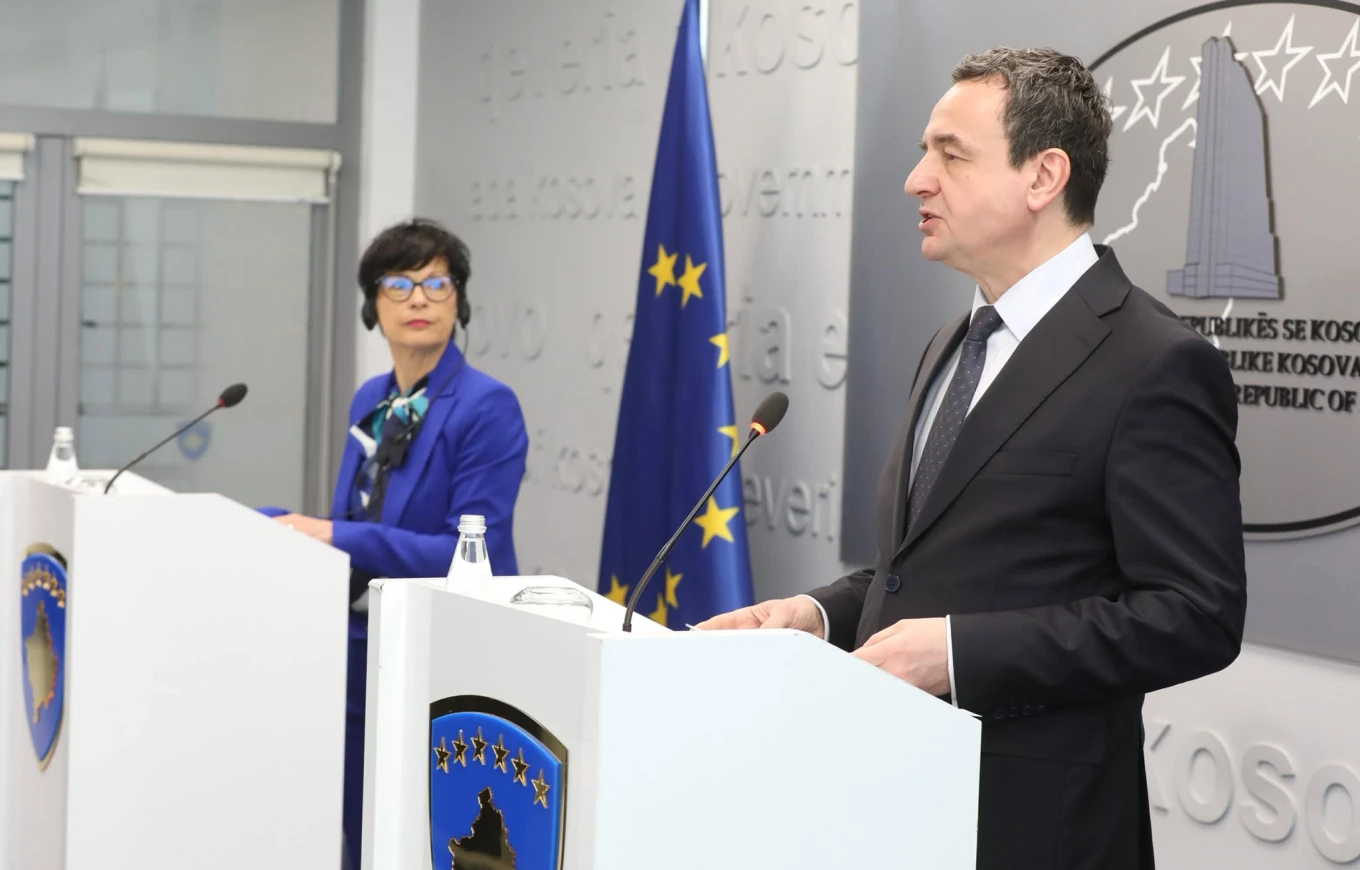
Kosovo Prime Minister Albin Kurti said Kosovo is not seeking shortcuts or special treatment on its path toward European Union membership, but is demanding a fair and merit-based integration process.
Speaking after a meeting with EU Enlargement Commissioner Marta Kos in Pristina, Kurti said Kosovo remains fully aligned with the European Union’s foreign and security policy and shares the bloc’s democratic values.
“We are not asking for shortcuts or a backdoor, only for a merit-based process,” Kurti told reporters.
Kurti said Kosovo applied for EU membership more than 40 months ago and argued that the European Union’s renewed focus on enlargement should now translate into concrete progress for Pristina.
He stressed that public support for EU membership in Kosovo remains around 90 percent, among the highest levels in the region.
“The renewed momentum for enlargement within the European Union should result in deserved progress for Kosovo,” he said.
Kurti acknowledged that political challenges remain both inside Kosovo and within the EU itself, particularly regarding the lack of consensus among EU member states over Kosovo’s status and integration path.
He described building unity inside the European Union on decisions related to Kosovo as a “shared responsibility.”
“We are working with member states, but EU institutions must also push this unity forward,” Kurti said.
The prime minister warned that geopolitical vacuums in the Western Balkans could be exploited by hostile external actors seeking to undermine European values and regional stability.
“Any vacuum left by the European Union is being targeted by malicious actors who undermine EU values and threaten our shared security,” he added.
Kurti also said delays in the functioning of Kosovo’s parliament have slowed parts of the reform agenda and could jeopardize deadlines linked to the EU process.
Regional cooperation was also discussed during the meeting with Commissioner Kos.
Kurti criticized Bosnia and Herzegovina for still not lifting visa requirements for Kosovo citizens and accused Serbia of blocking agreements related to diploma recognition.
He further accused Serbia of supporting destabilizing actions against Kosovo, referencing the armed attack in Banjska in September 2023 and the attack on the Iber-Lepenc canal infrastructure in 2024.
“We have an aggressive neighbor that attacks us instead of cooperating with us,” Kurti said, adding that accountability for such incidents remains essential for regional security.