


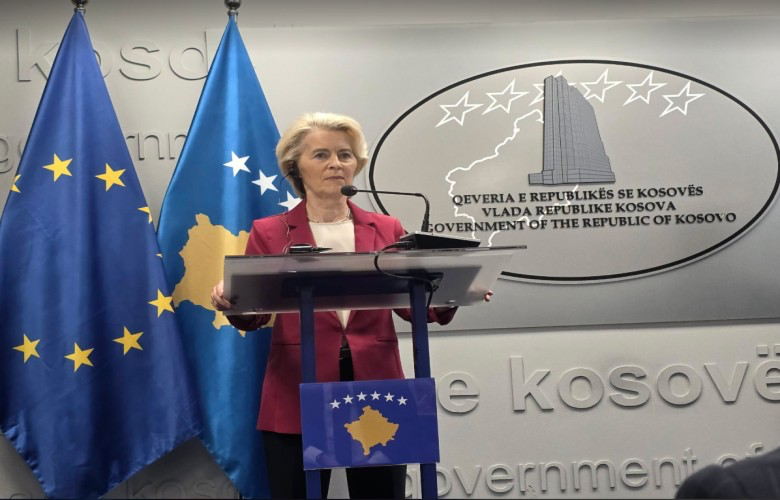
The European Commission president backed the independence of the Kosovo Specialist Chambers but delivered a message likely to resonate strongly in Pristina: the convictions of four former KLA leaders concern individual responsibility and do not put Kosovo’s wartime resistance on trial. She also warned that political stability and the election of a new president are essential for Kosovo’s EU ambitions.
PRISTINA, Oct 1 (BalkanView) — European Commission President Ursula von der Leyen said on Thursday that the war crimes judgment against four former Kosovo Liberation Army leaders must be respected, while stressing that the ruling concerned individual criminal responsibility and did not amount to a judgment on Kosovo’s struggle against Serbian rule.
Speaking alongside Prime Minister Albin Kurti in Pristina, von der Leyen addressed an issue that has dominated Kosovo’s politics since the Kosovo Specialist Chambers delivered its first-instance judgment against former President Hashim Thaçi and three other former senior KLA figures on Sept. 16.
Von der Leyen said the judgment had triggered strong emotions but had been delivered by an independent judicial institution whose mandate should be respected.
The defendants have the right to appeal, she said.
But she drew a clear distinction between the defendants and the wider history of Kosovo’s 1998-99 conflict.
The judgment concerned “the individual responsibility of the defendants,” she said, adding that Kosovo’s resistance had not been on trial.
Von der Leyen also said nothing could rewrite Kosovo’s history, recalling the repression, humanitarian crisis and suffering experienced during the 1998-99 conflict.
She called for the memory of victims from all communities to be respected as part of Kosovo’s path towards reconciliation.
Hague judgment dominates Kosovo politics
The Specialist Chambers convicted Thaçi, former parliamentary speakers Kadri Veseli and Jakup Krasniqi, and former lawmaker Rexhep Selimi of war crimes including unlawful detention, torture, cruel treatment and murder.
Thaçi and Krasniqi were sentenced to 25 years in prison, Veseli to 18 and Selimi to 13.
The four were acquitted of crimes against humanity.
The judgment is not final and can be appealed.
The verdict has prompted widespread opposition in Kosovo, where the KLA is overwhelmingly associated among ethnic Albanians with the struggle that ended Serbian rule.
Thousands have taken part in protests following the judgment, while Kosovo’s parliament on Sept. 28 adopted a declaration condemning the verdict.
Kurti told the joint news conference that the judgment itself established that the KLA as an organisation was not on trial and that allegations concerning organ trafficking were not part of the indictment.
He nevertheless disputed other findings, saying the government believed the judgment contained factual, historical and legal errors that should be addressed during the appeal.
Von der Leyen did not endorse that criticism.
Her position instead sought to preserve two principles simultaneously: respect for the court and its independence, and a distinction between criminal responsibility attributed to particular individuals and the legitimacy of Kosovo’s wartime resistance.
Kosovo can change Specialist Chambers law, but independence is the red line
Von der Leyen was also asked about proposals to amend Kosovo’s legislation governing the Specialist Chambers.
She said decisions concerning Kosovo’s legal framework belonged to Kosovo itself.
But she attached a significant condition: judicial independence must be guaranteed.
The issue has become politically sensitive following the verdict, with proposals emerging in Kosovo to change the law governing the court.
Von der Leyen’s formulation left responsibility for legislation with Kosovo’s institutions while signalling that Brussels would closely watch whether any changes affected the independence of judicial proceedings.
Next political test: electing a president
The Hague dispute was only one part of von der Leyen’s message.
She described Kosovo as being at an important political moment and welcomed the formation of a new parliament and government after a prolonged period of political uncertainty.
The next step, she said, was electing a president.
Von der Leyen urged Kosovo’s political parties to build on recent dialogue, arguing that institutional stability was essential for reforms, economic growth and progress towards the European Union.
“Institutional stability is the foundation for everything else,” she said.
The message puts Kosovo’s internal political negotiations directly alongside its European ambitions.
Without functioning institutions and sufficient political cooperation, Brussels’ message suggests, Kosovo risks losing time not only domestically but also on reforms tied to EU financial assistance and economic integration.
€882 million opportunity
Von der Leyen reiterated her support for Kosovo’s European future but tied progress closely to reforms.
Under the EU Growth Plan for the Western Balkans, Kosovo could receive up to 882 million euros.
Around 62 million euros has already been made available in pre-financing.
The programme is designed to bring Western Balkan economies closer to the EU single market before membership while making access to financing conditional on reforms.
Von der Leyen urged Kosovo to use the opportunity.
She also pointed to two practical areas where closer integration could have a direct impact on citizens and businesses: roaming and membership in the Single Euro Payments Area, or SEPA.
Kosovo has appointed its chief negotiator for roaming talks, and von der Leyen said she hoped negotiations could now begin.
On SEPA, she said adoption of the necessary legislation could open the way towards Kosovo’s participation in the European payments system.
The Commission estimates that SEPA integration could collectively save Western Balkan businesses hundreds of millions of euros annually through cheaper and faster cross-border payments.
The Serbian community and Kosovo’s European future
Von der Leyen also linked Kosovo’s EU ambitions to relations between its communities.
Kosovo, she said, must preserve its multi-ethnic character and build trust with the Kosovo Serb community.
The statement reflected a longstanding EU emphasis on minority rights and interethnic relations as part of Kosovo’s European path.
For Brussels, institutional stability, reform implementation and interethnic trust are therefore not separate issues. They form part of the political criteria surrounding Kosovo’s closer integration with the EU.
Kurti, meanwhile, used the visit to press Kosovo’s case for more concrete European steps, including progress towards EU candidate status.
Kosovo applied for EU membership in December 2022 but has yet to receive candidate status.
A carefully balanced message from Brussels
Von der Leyen’s Pristina remarks came at a particularly sensitive moment.
Kosovo is simultaneously confronting the political fallout from the Hague judgment, negotiations over its next president, demands for deeper European integration and unresolved tensions in relations with its Serb community.
Her message on the Specialist Chambers was therefore carefully calibrated.
Brussels expects the independence and mandate of the court to be respected.
Kosovo retains the authority to determine its own legal framework, provided judicial independence is protected.
The defendants retain their right to appeal.
And, crucially for a society where interpretations of the 1998-99 war remain central to national identity, von der Leyen separated the criminal responsibility determined by the court from Kosovo’s wider wartime resistance.
The Hague judgment, she said, cannot rewrite Kosovo’s history.
But her wider message was equally clear: what Kosovo does next — in parliament, in its institutions and through reforms — will help determine how quickly it moves towards Europe.