


SKOPJE, Aug 13 (Balkan View) – Twenty-five years after the Ohrid Framework Agreement ended North Macedonia’s 2001 armed conflict, disputes over language rights, representation and the meaning of the peace deal persist, while analysts say the country’s challenge has shifted from preventing ethnic conflict to building functional institutions and a shared political community.
The agreement, signed on Aug. 13, 2001 after months of fighting between Macedonian security forces and the National Liberation Army (NLA), preserved the country’s unitary character while expanding political, linguistic and cultural rights for ethnic Albanians and other non-majority communities.
It broadened the official use of Albanian, introduced equitable representation in public institutions, strengthened decentralisation and established the so-called Badinter principle, under which legislation directly affecting ethnic communities requires support from both an overall parliamentary majority and a majority of lawmakers representing non-majority communities.
Journalist and political analyst Xhelal Neziri, in comments to Osservatorio Balcani Caucaso Transeuropa (OBCT), said any assessment of Ohrid should begin with its original purpose.
“The Ohrid Framework Agreement is a peace agreement which stopped the conflict in 2001. Furthermore, it laid the foundation for resolving all outstanding interethnic issues, clearly stating that there are no territorial solutions to ethnic problems and consolidating the unitary character of the state,” Neziri said.
He said the document was deliberately designed as a framework rather than an attempt to anticipate and settle every future dispute.
“That is why it is called a framework agreement.”
Language rights remain contested
The anniversary comes as Albanian students at the Faculty of Law in Tetovo have protested for months over demands to take a state examination in Albanian.
Student representative Zijahudin Elezi told OBCT that the demand was about equality rather than preferential treatment.
“We are not asking for preferential treatment. We are simply asking for equality before the law,” Elezi said.
Students were offered the possibility of taking the theoretical part of the examination in Albanian while completing the practical part in Macedonian, an arrangement they rejected.
“For us, this is not a solution because it does not respect the Law on the Use of Languages and the spirit of the Ohrid Agreement,” Elezi said.
“If we cannot obtain a professional licence in our own language, this also affects the representation of Albanians in public institutions and their job opportunities.”
Researcher and publicist Bekim Adili said disagreements over Ohrid reflected divisions dating back to the circumstances in which the agreement was adopted.
“There was a perception that Albanians had ‘taken the Macedonian state away from Macedonians’. This duality has accompanied the country for the last 25 years,” Adili told OBCT.
He said progress in equitable representation had been uneven.
“There have been years when it produced positive effects, and there have been years of stagnation. Overall, there has been progress, but not to the extent that there should have been.”
Neziri: The wider problem is rule of law
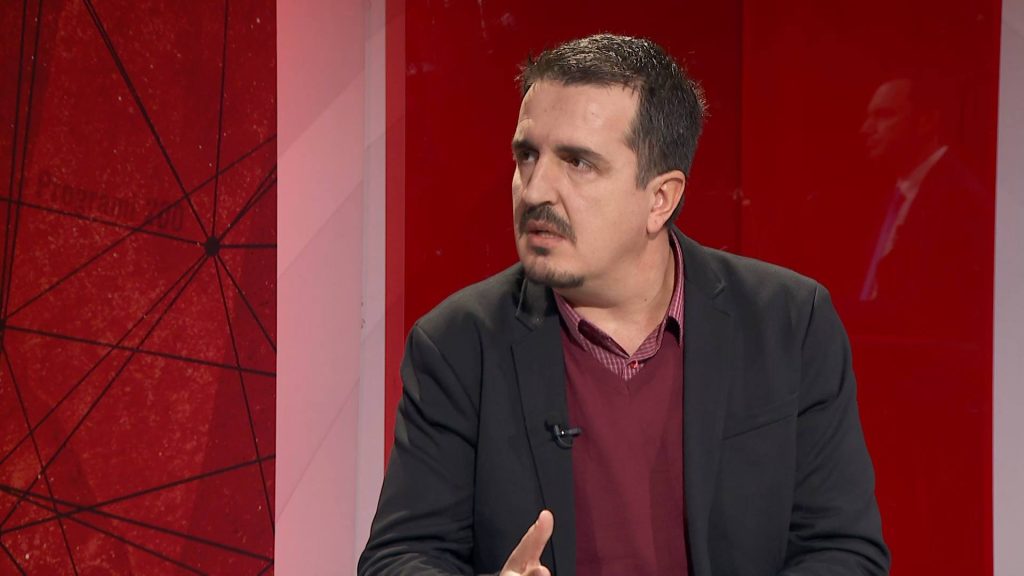
Neziri said shortcomings surrounding Ohrid should also be viewed in the context of North Macedonia’s wider institutional weaknesses.
“We have many laws that have been adopted but are not implemented, and we have laws that are implemented but are not producing the expected results,” he said.
“We generally have a problem with the rule of law, which implies the non-selective and consistent implementation of laws.”
Since 2001, ethnic Albanian representation in the public administration, police, military and other state institutions has increased significantly. Albanian political parties have routinely participated in governing coalitions, while ethnic Albanian politicians have occupied some of the country’s highest state positions.
North Macedonia has also joined NATO and remains a candidate for European Union membership.
Deputy Foreign Minister Zoran Dimitrovski told OBCT that Ohrid was now rarely raised as an unresolved issue in his contacts with foreign officials.
“The implementation of the Ohrid Framework Agreement has hardly ever been discussed in my conversations and contacts with foreigners,” Dimitrovski said.
He said government officials instead stress the established practice of Macedonian and Albanian political representatives governing together.
“We often emphasise that the government has traditionally been composed of political representatives of Macedonians and Albanians, and that it firmly protects the rights of ethnic communities, thus sending a message both to the citizens and to the international community about the stability of interethnic relations in the country.”
A state still searching for a shared political identity
Neziri said the country had missed an opportunity after 2001 to develop “a new political community, or more precisely a civic-territorial nation” that could serve as an inclusive political umbrella without erasing Macedonian, Albanian or other ethnic identities.
Twenty-five years later, Macedonians and Albanians often continue to consume different media, vote predominantly along different political lines and interpret important episodes of the country’s recent history through competing narratives.
“Albanians and Macedonians live divided, although in mutual cohabitation,” Dimitrovski said, while noting that overt ethnic hatred was generally absent and interethnic incidents were rare.
Neziri said the continuing lack of broad support for the Ohrid Agreement among ethnic Macedonians remained one of its political weaknesses.
“The problem is that even today the Ohrid Framework Agreement does not enjoy broad support among ethnic Macedonians,” he said.
“The agreement was not promoted as a compromise between the great expectations of both sides and as an opportunity to build a common, progressive and cohesive state.”
Some of the barriers separating communities could gradually weaken, Neziri said, particularly as technology and real-time translation make information and media content increasingly accessible across linguistic lines.
But the broader challenge remains political: creating institutions and a public sphere in which citizens from different communities regard the state as a shared political good.
From ethnic peace to functional government
Many of North Macedonia’s biggest challenges today cut across ethnic divisions. Young Macedonians and Albanians alike are leaving the country, while corruption, clientelism, political patronage, economic insecurity and weak public institutions affect communities regardless of ethnicity.
The Ohrid Agreement succeeded in creating mechanisms to prevent the political exclusion that contributed to the 2001 crisis. The question after a quarter-century is whether those mechanisms can evolve from instruments of ethnic stability into foundations for effective and inclusive government.
Neziri said political parties still tend to view the agreement through the prism of electoral politics rather than as a shared historical achievement.
“The Ohrid Framework Agreement is not seen by the parties involved as an important historical document, but as significant political capital that can still bring votes,” he said.
“Therefore, I do not expect a joint celebration, nor an in-depth analysis of the agreement’s implementation and results twenty-five years after its signing.”
The divergent memories remain powerful. For many ethnic Albanians, Ohrid represents the constitutional consolidation of demands for linguistic equality, representation and political inclusion. For many ethnic Macedonians, it remains connected to the trauma of the 2001 conflict and constitutional changes adopted under extraordinary circumstances.
A quarter-century after the guns fell silent, the agreement’s most immediate objective has endured: North Macedonia avoided a return to armed ethnic conflict. Its unfinished test is whether coexistence can develop into a genuinely shared, functional and cohesive state.