


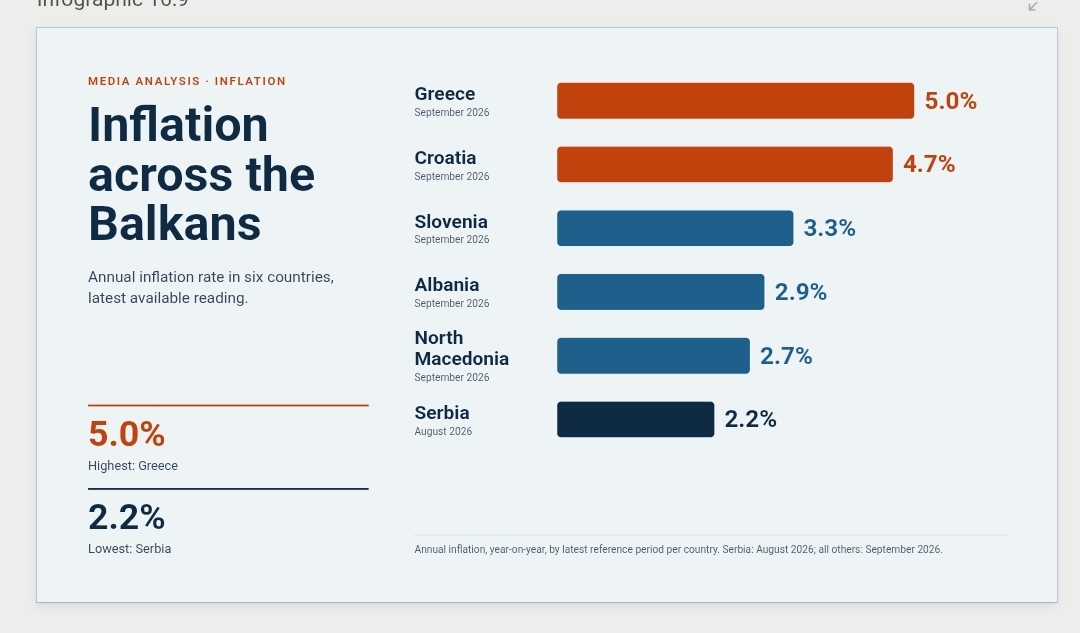
From Greece’s 5% inflation to more moderate price increases in North Macedonia, Albania and Serbia, Balkan economies are entering winter under different levels of pressure. Rising energy costs, expensive services and persistent household expenses are exposing the region’s dependence on imported energy and its uneven economic resilience.
SKOPJE/ATHENS, Oct. 10 (BalkanView) — Inflation is creating an increasingly uneven economic picture across the Balkans, with Greece and Croatia reporting some of the strongest price increases in the region while several Western Balkan economies are experiencing slower inflation.
Greece’s annual inflation accelerated to 5% in September, up from 3.8% in August, according to the country’s statistical authority, ELSTAT. The European Union’s harmonised inflation measure reached 5.1%.
The sharp increase was driven largely by energy costs, with natural gas prices rising 55.2% from a year earlier, heating oil 53.2%, diesel 38.8% and gasoline 22.5%.
The figures highlight a challenge shared by many Balkan economies: their exposure to international energy markets and the impact of rising costs on household purchasing power.
Inflation across the Balkans
The latest available national consumer price inflation figures show substantial differences between neighbouring economies.
Although Greece recorded the highest inflation among the six countries in this comparison, Croatia was not far behind, with annual inflation reaching 4.7%.
Slovenia recorded 3.3%, while Albania and North Macedonia reported more moderate rates of 2.9% and 2.7%, respectively.
Serbia’s latest available annual inflation rate was 2.2% in August.
The figures show that the inflationary pressures affecting Southeast Europe are far from uniform, even though countries share many of the same energy suppliers, transport routes and trading partners.
Greece and Croatia face stronger price pressures
Greece’s inflation has been fuelled by a combination of rising energy costs, tourism-related demand, labour shortages and limited competition in parts of its domestic economy.
According to an analysis by Eurobank, the country’s strong dependence on imported energy makes it particularly vulnerable to international price shocks.
Net energy imports accounted for 78% of Greece’s available energy in 2024, significantly above the European Union average of 57%.
Tourism has added another source of pressure, with hotel prices rising 29.8% annually in September.
Croatia has also experienced substantial price increases, particularly in energy-related categories.
Both countries illustrate how strong demand in services and higher energy costs can reinforce inflationary pressures, even within the eurozone.
Western Balkans: Lower inflation does not mean cheaper living
In the Western Balkans, headline inflation has remained more moderate in several economies.
North Macedonia recorded annual inflation of 2.7% in September, while Albania reported 2.9%.
Serbia’s latest available figure stood at 2.2%.
But lower inflation does not necessarily translate into a significant improvement in living standards.
Households continue to face the cumulative impact of earlier price increases, particularly in food, housing, electricity and heating.
For lower-income families, these expenses account for a larger share of household budgets, making even relatively modest inflation difficult to absorb.
The distinction between inflation and the cost of living is important: a decline in inflation means prices are rising more slowly, not that they have returned to previous levels.
Energy dependence remains a regional weakness
Energy is emerging as one of the central economic challenges for the Balkans ahead of winter.
Greece relies heavily on imported oil and natural gas, while Western Balkan countries face their own vulnerabilities, including ageing electricity infrastructure, dependence on coal-fired generation, limited storage capacity and exposure to fluctuations in regional electricity markets.
These vulnerabilities have encouraged governments to strengthen cross-border cooperation.
At a meeting in Belgrade on Oct. 6, energy ministers from Greece, Bulgaria, Serbia and North Macedonia discussed preparations for winter, electricity exchanges, new gas interconnectors and energy-storage projects.
The countries also reaffirmed their commitment to expanding the Vertical Gas Corridor, which is intended to facilitate gas deliveries from Greek LNG terminals towards Southeast and Central Europe.
For North Macedonia, new gas connections with Greece and Serbia could eventually provide additional supply routes, while closer electricity cooperation with Bulgaria could strengthen regional market integration.
However, the benefits of these projects will depend on their completion, available supply and the development of functioning regional energy markets.
Why the Balkans experience inflation differently
The differences in inflation rates reflect several structural characteristics of Balkan economies.
Countries with high energy-import dependence are more exposed to international oil and gas prices.
Economies with large tourism sectors can experience stronger seasonal demand for accommodation, restaurants and other services.
Domestic market competition also matters. Where consumers have fewer alternatives, businesses may find it easier to pass higher costs on to customers.
Wage developments, government energy policies and the structure of household consumption further influence how international price shocks affect individual countries.
The result is a region facing similar external risks but experiencing different levels of inflation.
Winter will test household budgets
The approaching heating season could place renewed pressure on household spending across Southeast Europe.
Higher costs for electricity, gas, heating oil and transport can also affect food production, distribution and the prices of other goods and services.
Governments face the challenge of protecting vulnerable households without creating additional fiscal pressures or undermining longer-term energy reforms.
For EU members such as Greece, Croatia and Slovenia, inflation is also closely linked to developments in the wider eurozone economy.
For Western Balkan countries seeking EU membership, energy security, market integration and the cost of adapting to European climate policies add another layer of complexity.
The region’s inflation figures therefore tell two stories.
The first is the immediate difference between countries experiencing faster and slower price increases.
The second is a longer-term structural challenge: reducing dependence on imported energy, improving competition and strengthening household purchasing power.
As winter approaches, both will shape the economic outlook across the Balkans.