


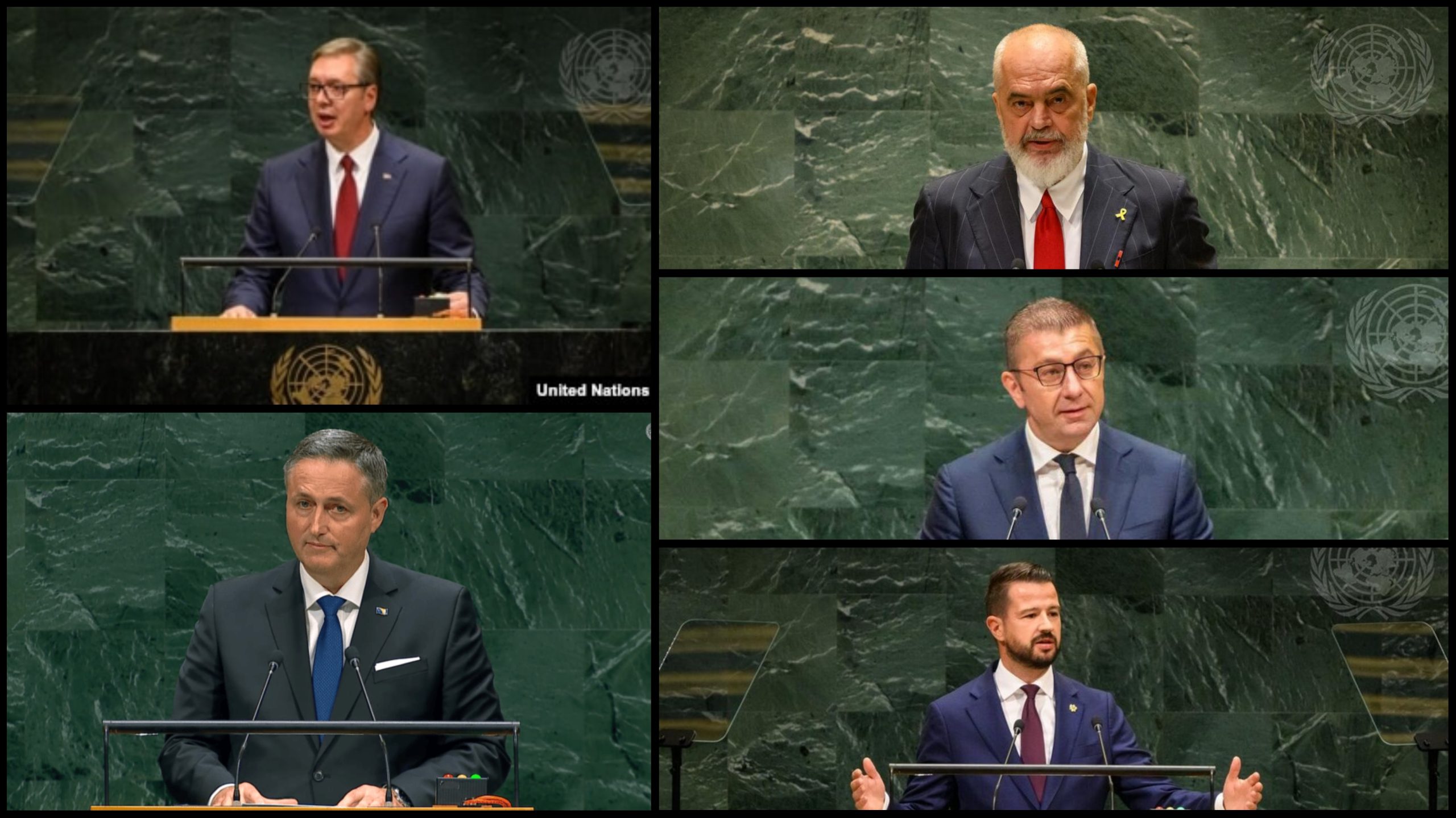
Western Balkan leaders arrived at the United Nations with sharply different diagnoses of what threatens their region — unresolved wars, contested sovereignty, stalled EU enlargement and disruptive technology. But beneath the differences ran a common concern: a growing loss of trust in the rules and institutions meant to manage them.
NEW YORK, Sept 25 (BalkanView) – Five Western Balkan leaders presented markedly different versions of their region at the United Nations this week, divided over war, sovereignty and the legacy of the 1990s but repeatedly returning to the same underlying concern: whether international rules and institutions can still command trust.
Speeches by leaders from Bosnia and Herzegovina, Serbia, Montenegro, North Macedonia and Albania at the 81st U.N. General Assembly ranged from warnings about nationalism and the glorification of convicted war criminals to frustration over European Union enlargement, Serbia’s insistence on sovereignty over Kosovo and Albania’s call for international rules governing artificial intelligence.
Together, they portrayed a region broadly oriented towards European integration but increasingly divided over what most threatens its future.
For Bosnia, the danger remains the unfinished political legacy of the wars of the 1990s. For Serbia, it is what Belgrade regards as the selective application of sovereignty and international law over Kosovo. Montenegro linked reconciliation with EU membership. North Macedonia questioned whether international commitments remain predictable for small states.
Albania largely left traditional Balkan disputes outside the General Assembly hall and instead turned to artificial intelligence, disinformation and democratic governance.
Bosnia: The past is still present
For Bosnia and Herzegovina Presidency Chairman Denis Bećirović, the Balkan past remained inseparable from the international crises of the present.
He described Bosnia as a state that survived aggression, war crimes and genocide but was still confronting attempts to weaken it through political and diplomatic means.
Bosnia, he said, stood at the doorstep of both the European Union and NATO, which he described as the country’s strategic foreign-policy objectives.
But Bećirović devoted a significant part of his address to the legacy of the 1992-95 Bosnian war and the Srebrenica genocide.
He sharply criticised Serbia over what he described as the institutional glorification of Ratko Mladić, the former Bosnian Serb military commander whose convictions for genocide, crimes against humanity and war crimes were upheld by the U.N. tribunal system.
Bećirović also accused the leadership of Bosnia’s Serb-dominated Republika Srpska entity of undermining the Dayton peace settlement and seeking conditions for eventual secession.
Those were Bećirović’s accusations, not uncontested regional facts. Republika Srpska officials rejected his portrayal and said his address did not represent a consensual position of Bosnia’s three-member Presidency.
Bećirović placed the Balkan disputes within a wider argument about the erosion of international law, pointing to conflicts from Ukraine and Gaza to Sudan.
His central message was that international law could not have one meaning for powerful countries and another for smaller states.
That argument would surface repeatedly in the speeches of other Balkan leaders.
The disagreement was over what it meant.
Serbia: Kosovo as evidence of double standards
Serbian President Aleksandar Vučić offered an even more sweeping diagnosis.
The international system as the world had known it had collapsed, he told the General Assembly, arguing that a less predictable order was emerging in which power, economic pressure, technology, cyberattacks and disinformation were increasingly shaping relations between states.
Vučić said Serbia supported the United Nations and reform of its institutions but argued that international rules could command credibility only if they were applied consistently.
For Belgrade, the central example remains Kosovo.
Serbia does not recognise Kosovo’s 2008 declaration of independence and continues to regard the territory as part of the Serbian state, while Kosovo is recognised by the United States and most EU members.
Vučić used the dispute to argue that countries that recognised Kosovo had themselves undermined the principles of sovereignty and territorial integrity they now invoked elsewhere.
He also reiterated Serbia’s ambition to join the European Union, while voicing frustration with the pace of enlargement.
The contrast with Bećirović was stark.
The Bosnian leader invoked international courts and institutions as safeguards against a return to the politics that produced the Balkan wars.
Vučić invoked Serbia’s experience over Kosovo to argue that international principles had been selectively applied.
Both appealed to international law.
They offered almost opposite interpretations of what the Balkan experience says about whether it works.
Montenegro: Reconciliation as part of the European project
Montenegrin President Jakov Milatović offered a third interpretation.
Twenty years after Montenegro joined the United Nations following independence, Milatović presented his country as a NATO member approaching another historic threshold — membership of the European Union.
He said his generation had a responsibility to complete Montenegro’s European path by 2028 and demonstrate that the Balkans could leave old divisions behind.
But some of his most significant regional remarks concerned precisely those divisions.
Lasting reconciliation in the Western Balkans, Milatović said, could not be based on denial, selective justice or the glorification of people convicted of war crimes.
It required respect for international court judgments and equal dignity for every victim regardless of identity or origin.
He did not name Serbia in that passage.
But his formulation placed Montenegro closer to Bećirović’s emphasis on international judicial findings than to Vučić’s focus on Kosovo and what Serbia regards as double standards.
Milatović’s broader argument linked reconciliation, democratic resilience and European integration.
For Montenegro, EU enlargement was presented less as a source of grievance than as an attainable political destination.
That contrasted sharply with the experience described by North Macedonia.
North Macedonia: When compromise stops producing results
North Macedonian Prime Minister Hristijan Mickoski shifted the debate away from war memory and towards the credibility of international commitments.
“Trust cannot indefinitely be a one-sided obligation,” he told the General Assembly.
North Macedonia has been an EU candidate since 2005 but has repeatedly seen its accession process delayed by bilateral disputes and additional conditions.
Mickoski argued that international rules needed to provide predictability for smaller countries as well as powerful ones.
He described European integration as his country’s strategic direction but said North Macedonia’s experience showed the political cost that accumulated when compromises and concessions failed to produce expected progress.
His address also covered artificial intelligence, energy and security, climate change, migration and demographic pressures.
The distinction between Mickoski’s U.N. address and some of his other appearances in New York is important.
In other meetings during the week he spoke more directly about disputes surrounding North Macedonia’s EU accession and the concessions Skopje had made.
At the United Nations, he placed those grievances inside a broader argument about equality between states, institutional credibility and predictable international rules.
The comparison with Montenegro was revealing.
Milatović presented EU enlargement as evidence that reform and persistence could still lead towards membership.
Mickoski presented North Macedonia’s experience as a warning about what happens when citizens cease to see a predictable relationship between concessions, reforms and progress.
They were two Balkan accounts of the same enlargement process — one approaching its intended destination, the other questioning the credibility of the journey.
Albania looks beyond the traditional Balkan agenda
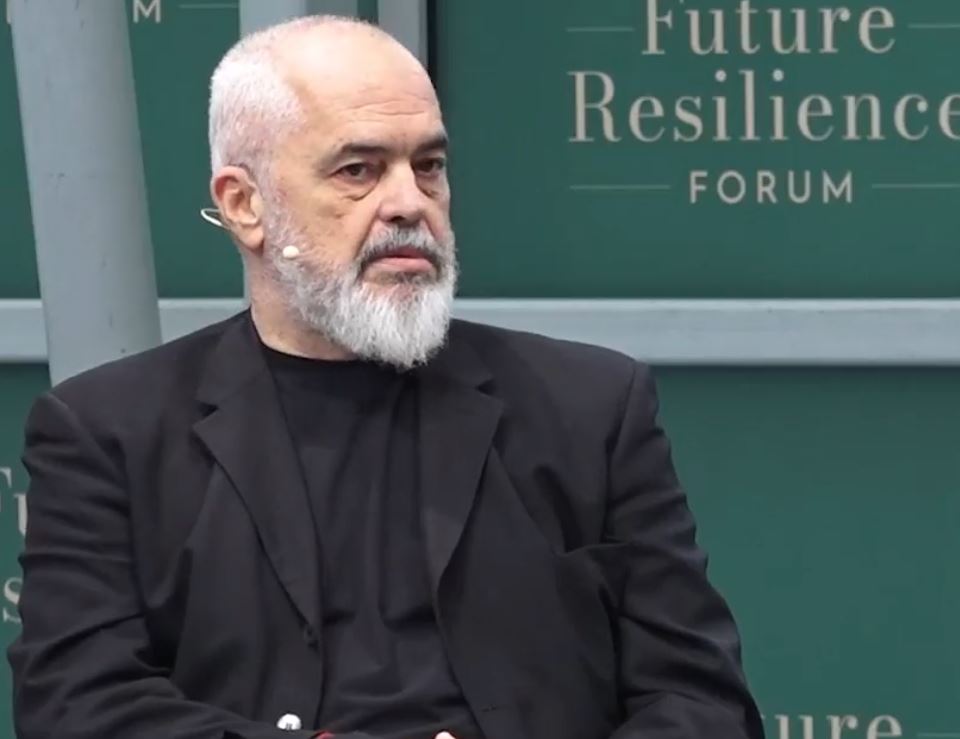
Albanian Prime Minister Edi Rama made the clearest departure from the regional pattern.
Rather than centre his speech on Kosovo, EU enlargement or Balkan history, Rama devoted much of his address to artificial intelligence, algorithms, disinformation and democratic accountability.
Albania, he argued, might not be developing the world’s most sophisticated AI models but was already confronting political and institutional questions created by the technology.
The issue was not simply how much human work machines could perform, but who remained responsible when AI-assisted decisions went wrong and how democratic societies could understand the systems increasingly shaping public information.
Rama called for international rules around what he described as sovereign and democratic artificial intelligence.
Democracies should not halt technological development, he argued, but should demand transparency and accountability over the systems increasingly mediating public life.
He cited Albania’s “Flamingo Revolution” protests as an example of how he said a fabricated narrative could be personalised and amplified through websites, social networks and sources that citizens trusted.
That was Rama’s interpretation of the movement.
The protests that began over controversial development plans around Albania’s protected coastal areas evolved into a broader anti-government movement whose participants have raised environmental, corruption and governance concerns.
Rama’s decision to discuss the protests through the prism of disinformation therefore also brought a contentious domestic political dispute onto the U.N. stage.
One omission was equally significant for a Western Balkan audience.
Rama did not use his General Assembly address to discuss Kosovo, the Kosovo Liberation Army or the recent convictions of former KLA leaders by the Kosovo Specialist Chambers.
He had spoken about former Kosovo President Hashim Thaçi at a separate Albanian-American gathering in New York.
Those comments were not part of his General Assembly address.
The distinction matters.
Rather than use the world’s main diplomatic podium primarily to internationalise a Balkan dispute, Rama tried to place Albania inside an emerging global debate over artificial intelligence, information and democratic governance.
Five definitions of security
The speeches produced no single Western Balkan narrative.
Instead, they offered five definitions of what was at risk.
For Bosnia, security meant protecting the post-war state and defending international judicial findings against denial and revision.
For Serbia, it meant sovereignty and territorial integrity, with Kosovo serving as Belgrade’s central example of what it regards as inconsistent international standards.
For Montenegro, it meant reconciliation based on international judgments and completing integration into European institutions.
For North Macedonia, it meant maintaining confidence that international commitments — particularly those surrounding EU integration — produce predictable consequences even for small states.
For Albania, the definition expanded beyond conventional geopolitics to the information environment itself: who controls algorithms, how narratives spread and who is accountable when governments use artificial intelligence.
One common word: trust
Beneath those differences ran a strikingly consistent theme: trust.
That was also closely aligned with the theme of this year’s General Assembly, centred on restoring trust and managing transformation.
Bećirović warned that violations of international law were eroding confidence in the international system.
Vučić said the international order as previously understood had broken down and called for renewed confidence in the United Nations.
Milatović called for stronger multilateralism and institutions capable of protecting peace and human dignity.
Mickoski said trust could not remain a one-sided obligation and demanded predictability for smaller states.
Rama shifted essentially the same problem into the technological sphere: how can citizens trust democratic institutions when algorithms increasingly determine what information they see and artificial intelligence increasingly participates in public decision-making?
The five leaders approached the problem from different directions.
Bećirović and Milatović asked whether established rules were being respected.
Vučić asked whether those rules were being applied consistently.
Mickoski asked whether complying with them still produced predictable results.
Rama asked what happens when technological change creates an arena in which many of the rules have yet to be written.
Europe remains the reference point
Europe nevertheless remained the central political reference point for most of the region.
Montenegro portrayed EU membership as an achievable next step and attached a 2028 horizon to that ambition.
North Macedonia reaffirmed its European orientation but used its long accession experience to question the predictability of enlargement.
Bosnia identified both EU and NATO membership as strategic objectives.
Serbia continued to describe EU membership as a strategic goal while challenging Western positions on Kosovo and expressing frustration with the enlargement process.
Albania, already advancing through accession negotiations, largely chose to use the U.N. podium for a different conversation.
Nearly three decades after the end of the Bosnian war and more than a quarter-century after the Kosovo conflict, the speeches showed Western Balkan governments operating simultaneously in different political eras.
Bosnia and Serbia remain deeply engaged with competing interpretations of the region’s unresolved past.
Montenegro is trying to make reconciliation and European integration parts of the same political narrative.
North Macedonia increasingly frames its experience around the accumulated cost of waiting, concessions and delayed accession.
Albania sought to move the conversation towards the next global challenge rather than the last Balkan conflict.
Five Western Balkan leaders stood before the same United Nations General Assembly.
They did not offer a common diagnosis of their region.
But in different ways they arrived at the same underlying question: what happens when states and citizens stop trusting the rules and institutions meant to protect them?