



Austrian and European regulatory records reveal sanctions and restrictions involving companies linked to the Serbian banking group before its expansion into North Macedonia. Now, the collapse of Alta Banka in Belgrade has exposed public funds, restricted depositors and triggered a political dispute over who approved the investment.
SKOPJE/BELGRADE, Nov. 4, 2026 (BalkanView) — European regulators had taken action against a company linked to Serbian businessman Davor Macura more than a year before his banking group acquired a bank in North Macedonia, raising questions about whether Macedonian authorities adequately assessed the investor’s regulatory history before approving the takeover.
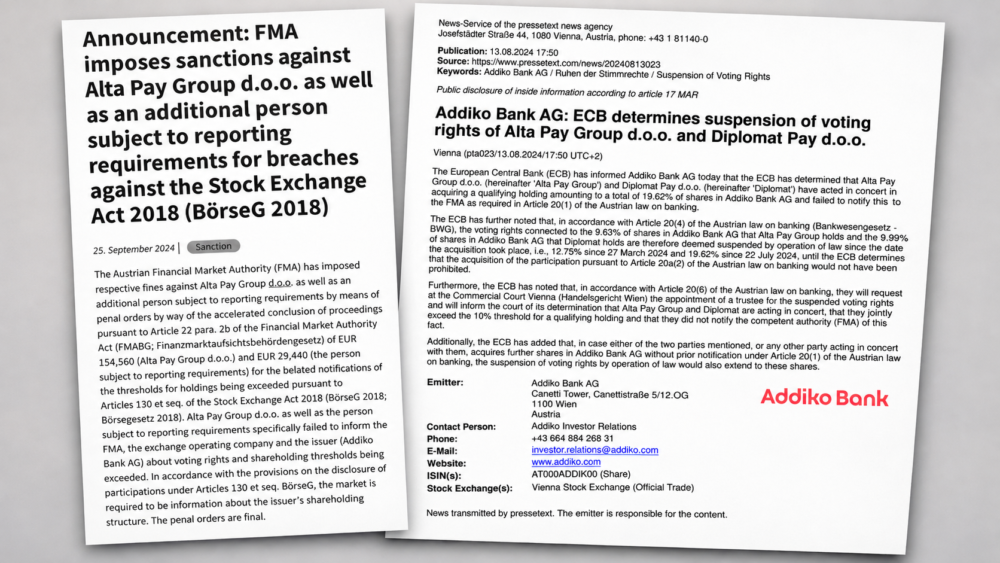
An investigation published by Macedonian news outlet Inbox7, based on Austrian and European regulatory documents, found that Austria’s Financial Market Authority (FMA) imposed a final fine of 154,560 euros on Alta Pay Group in September 2024 for late disclosure of shareholding thresholds in Austria’s Addiko Bank.
A separate fine of 29,440 euros was imposed on another person subject to reporting obligations.
The European Central Bank (ECB) had previously determined that Alta Pay Group and another Serbian company, Diplomat Pay, acted in concert when acquiring a combined 19.62% stake in Addiko Bank without complying with the applicable notification requirement.
Voting rights attached to their shares were consequently suspended.
The measures concerned ownership disclosure and regulatory approval requirements. They did not establish money laundering or wrongdoing by Alta Banka in either Serbia or North Macedonia.
Nevertheless, the publicly available records have become significant following the collapse of Alta Banka in Belgrade, the opening of bankruptcy proceedings and emergency intervention at its North Macedonian subsidiary.
European regulators acted before the Macedonian takeover
On Aug. 13, 2024, Addiko Bank disclosed that the ECB had identified coordinated action between Alta Pay Group and Diplomat Pay in acquiring shares in the Austrian lender.
Alta Pay Group held 9.63% of the shares, while Diplomat Pay held 9.99%.
Their combined stake exceeded the 10% threshold for a qualifying holding, triggering regulatory notification requirements.
The ECB’s assessment resulted in the suspension of the voting rights attached to the holdings.
Austria’s FMA subsequently imposed penalties for delayed notifications of shareholding thresholds. The authority announced on Sept. 25, 2024, that the penalties had become final.
The circumstances later changed.
In February 2025, the ECB determined that the companies had ceased acting in concert on Dec. 10, 2024, after Diplomat Pay sold its shares. The voting-rights suspension was therefore no longer considered applicable from that date.
That development did not automatically invalidate the earlier Austrian penalties.
Alta Pay Group also challenged an ECB decision dated Nov. 26, 2024, before the EU General Court. The action, filed on Feb. 5, 2025, was registered as case T-85/25.
The company contested aspects of the procedure, including access to documents, its opportunity to be heard and the application of rules concerning shareholders acting in concert.
The filing establishes that the decision was legally challenged, not that the court accepted the company’s arguments.
Did North Macedonia examine the regulatory history?
Serbia’s Alta Banka acquired control of Stopanska Banka Bitola in 2025, after which the North Macedonian lender was renamed Alta Banka.
North Macedonia’s central bank approved the acquisition of a qualifying holding by the Serbian investor.
Governor Trajko Slaveski has said the approval followed a review lasting several months and consultations with European regulatory institutions.
However, according to Inbox7’s investigation, his public statements have not clarified whether the specific Austrian penalties, ECB measures and subsequent legal proceedings were considered during that assessment.
The distinction is important.
Alta Pay Group, Alta Banka Belgrade and Alta Banka Bitola are separate legal entities. A regulatory breach by one company does not automatically establish misconduct by another.
Nor do the European documents demonstrate that North Macedonia’s central bank was legally required to reject the takeover.
The unanswered question is whether the investor’s wider business relationships and regulatory history were fully assessed, and what conclusions the Macedonian regulator reached.
More than 40 Serbian public enterprises had bank accounts
The collapse of Alta Banka has also raised questions about the management of public money in Serbia.
An investigation by Radio Free Europe found that more than 40 public enterprises, dozens of state-owned companies and 13 direct budget beneficiaries maintained accounts at the bank.
They included major state-linked businesses such as Elektroprivreda Srbije (EPS), Telekom Srbija, Naftna Industrija Srbije (NIS), Pošta Srbije and Srbijšume, as well as other public institutions.
Several local governments also maintained accounts.
The existence of those accounts does not establish that all the institutions suffered losses.
However, a complete public accounting of the balances held at the bank when its licence was revoked has not yet been provided in the reporting cited by Inbox7.
EPS said its operations were not threatened and that the funds held at Alta Banka represented less than 0.5% of its total monthly electricity-billing inflows.
Telekom Srbija said its deposits at the bank were below 50,000 euros and that its operations were unaffected.
For other public institutions, the amount of money potentially exposed to the bankruptcy proceedings remains unclear.
Bank owner arrested as prosecutors investigate hundreds of millions
Serbia’s central bank revoked Alta Banka Belgrade’s operating licence on Oct. 31.
The Commercial Court in Belgrade opened bankruptcy proceedings on Nov. 3, appointing the Deposit Insurance Agency as bankruptcy administrator.
Macura was arrested on Nov. 2 as Serbian prosecutors investigated allegations involving the unauthorised removal of cash from the bank’s vault.
The investigation concerns assets valued at approximately 45 billion Serbian dinars, equivalent to about 383 million euros, according to the reporting supplied by Inbox7.
Macura and the other suspects are presumed innocent unless proven guilty.
Radio Free Europe also reported that prosecutors requested information from Serbia’s central bank concerning transactions, currency conversions and transfers from Alta Banka accounts abroad.
The investigation has not established that the funds under scrutiny were transferred to any particular foreign country.
According to the financial information cited by Radio Free Europe, Alta Banka’s assets reached approximately 1.82 billion euros by the end of June 2026.
The bank had recorded rapid growth in assets, deposits and lending during the preceding years.
Economists interviewed by the broadcaster questioned whether the expansion and the reported level of cash holdings should have prompted closer regulatory scrutiny.
Their assessments do not establish deliberate wrongdoing by the Serbian central bank.
North Macedonia restricts access to deposits
The Serbian bank’s collapse immediately affected its North Macedonian subsidiary, in which it held a majority stake.
On Nov. 1, North Macedonia’s central bank imposed temporary administration on Alta Banka Bitola.
The regulator said the bank remained liquid and adequately capitalised, emphasising that the intervention was intended to protect customers and financial stability.
Unlike its Serbian parent, Alta Banka Bitola has not lost its banking licence and is not in bankruptcy.
Nevertheless, customers face restrictions.
Individuals using payment cards are generally limited to 10,000 denars, approximately 162 euros, per week, while bank branches have temporarily suspended normal customer services.
The restrictions have caused particular difficulties for pensioners who do not use payment cards.
Slaveski has announced a special arrangement for approximately 3,500 pensioners without cards, potentially allowing a one-time withdrawal of up to 20,000 denars.
He has also said that transfers from Alta Banka Bitola to Serbia after Oct. 26 amounted to approximately 180,000 euros, while incoming transfers from Serbia totalled around 16,000 euros.
The governor characterised those transactions as ordinary payments rather than evidence of multimillion-euro transfers out of the Macedonian bank.
Temporary administration may remain in place for up to three months, although the regulator has indicated that a change in ownership could help resolve the situation sooner.
Political confrontation reaches the prime minister
The banking turmoil has developed into a political dispute in North Macedonia.
The opposition Social Democratic Union (SDSM) accused Prime Minister Hristijan Mickoski of avoiding responsibility while visiting Germany.
“Mickoski is on an excursion in Germany while citizens cannot access their money and pensions because of Alta Banka,” the party said.
SDSM official Andrej Žernovski separately alleged, in comments reported by Serbian news agency Beta, that the bank’s expansion into North Macedonia reflected a business arrangement involving Mickoski and former Serbian President Aleksandar Vučić.
Žernovski said his party had warned about the investor’s capital and the risks associated with the acquisition.
These are political allegations, not established findings.
The Austrian regulatory records cited by Inbox7 do not substantiate claims that the ECB established money laundering by Alta Banka or that the Macedonian takeover was part of an unlawful political arrangement.
Mickoski’s visit to Germany included meetings with Deutsche Telekom executives, business representatives and North Rhine-Westphalia’s state premier, Hendrik Wüst.
The government has described the visit as focused on investment, economic cooperation and technology development.
No response from Mickoski to Žernovski’s specific allegations was included in the supplied reports.
The collapse spreads across the Western Balkans
The consequences of Alta Banka’s failure extend beyond Serbia and North Macedonia.
Montenegro’s regulator revoked the authorisation of a related payment institution on Nov. 1, according to the regional reporting cited by Inbox7.
The case has also intensified scrutiny of cross-border business relationships and the supervision of financial groups operating through separate legal entities.
In North Macedonia, political parties have demanded investigations into potential links between the bank and politically connected businesses.
Those demands do not themselves establish illegal transactions.
The immediate questions concern the Macedonian subsidiary’s financial exposure to its former parent, the information exchanged between regulators and the measures required to restore unrestricted access to customers’ money.
A test of banking supervision
The Austrian penalties were publicly documented before the Serbian group’s acquisition of the Bitola bank.
The ECB’s earlier intervention, its subsequent reassessment and the legal challenge brought by Alta Pay Group were also part of the regulatory history surrounding companies linked to the investor.
None of those developments proves that the Macedonian central bank approved an unsuitable investor or violated its legal obligations.
But the collapse of Alta Banka in Serbia makes the due-diligence process a matter of substantial public interest.