


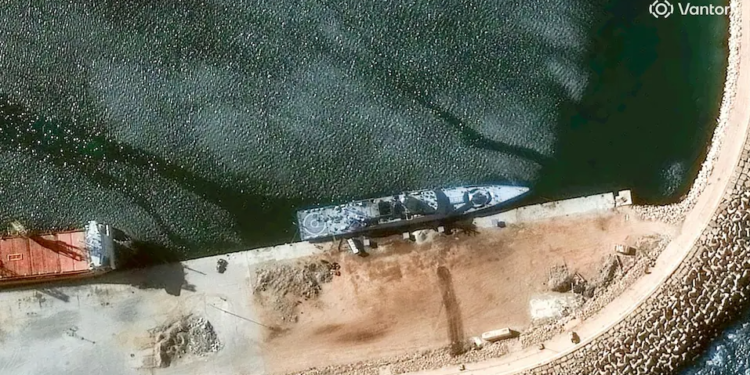
A Ukrainian naval drone strike reportedly sank a Russian corvette in the Libyan port of Benghazi, extending the Russia-Ukraine conflict into the Mediterranean. Albania has rejected allegations that the drones were launched from its territory, while Libyan authorities are demanding an international investigation.
TIRANA/BENGHAZI, Nov. 23 (BalkanView) – Albania on Monday denied allegations that its territory was used to launch Ukrainian naval drones against a Russian warship off Libya, after Ukrainian President Volodymyr Zelensky said his forces had sunk the vessel in an operation involving seven domestically produced unmanned boats.
The attack on the Russian corvette Merkuriy took place on November 22 at the port of Benghazi in eastern Libya, according to reports cited by Macedonian investigative news outlet Inbox7.
Albania’s Ministry for Europe and Foreign Affairs rejected media claims that the drones had departed from the Albanian coast before travelling more than 800 kilometres across the Mediterranean.
“Albania had no involvement in this incident, and its territory was neither used nor made available to launch or facilitate such an attack,” the ministry said.
It described the allegations as unsupported by verifiable evidence and called on those responsible for the reports to correct their information.
Zelensky confirms Ukrainian operation
Zelensky said Ukrainian forces had used seven naval drones to sink the Russian corvette near Libya’s coast, according to Reuters reporting cited by Inbox7.
The Merkuriy, commissioned into the Russian Navy in 2023, was reportedly struck while at Benghazi.
Satellite imagery from geospatial intelligence company Vantor reportedly showed much of the warship overturned and submerged, with only its forward section remaining visible above the water.
Medical sources cited by Reuters said 10 people, including Russian and Libyan nationals, suffered minor injuries.
Authorities in eastern Libya said the vessel had arrived in Benghazi to refuel and replenish supplies while travelling towards Russia.
Zelensky’s acknowledgment establishes Ukraine’s claimed responsibility for the operation but does not independently establish where the drones were launched or the route they followed.
Albania rejects allegations over launch location
The Albanian government said reports suggesting that Ukrainian naval drones departed from its territory were inaccurate.
“We categorically reject these allegations, which have been made without any verifiable evidence,” the foreign ministry said.
The ministry urged greater responsibility when reporting on sensitive international security issues.
The allegations are particularly significant because Albania has been a NATO member since 2009 and has supported Ukraine since Russia launched its full-scale invasion in February 2022.
However, Albania’s political and diplomatic support for Kyiv does not establish participation in the Benghazi operation.
No publicly verified evidence cited in the available reporting identifies the drones’ launch location.
Libya demands international investigation
Osama Hammad, prime minister of the administration governing eastern Libya, called for an international investigation into the attacks near Benghazi.
He said a request had been submitted to the United Nations General Assembly and Security Council.
Eastern Libyan authorities initially suggested that the drones might have been launched from western Libya.
Hammad also called for an examination of reports concerning the possible presence of Ukrainian specialists in Libya.
In a separate incident on November 22, a maritime drone struck a Maltese-flagged merchant vessel, according to two Libyan military sources cited by Reuters.
The same sources said Libyan naval and air forces had intercepted more than 20 unmanned vessels near Benghazi.
Those accounts have not established whether all the reported incidents were part of the same operation.
Ukraine’s naval warfare reaches the Mediterranean
Ukraine has used maritime drones extensively against Russian naval assets since the beginning of the full-scale invasion.
Most previously reported operations have targeted Russian vessels and military infrastructure in the Black Sea.
The reported attack in Benghazi would represent a significant geographical extension of Ukrainian naval operations into the Mediterranean.
It also raises questions about the security of ports hosting Russian military vessels and the ability of relatively small unmanned systems to strike targets far from Ukraine’s coastline.
The location from which the drones were deployed remains a central unanswered question.
A new security concern for the Balkans
The allegations involving Albania bring the Western Balkans into the diplomatic fallout from the attack.
Albania’s NATO membership and support for Ukraine make claims about the possible use of its territory particularly sensitive.
At the same time, the attack highlights the strategic importance of the Mediterranean, where Russian naval activity, regional security arrangements and the interests of NATO member states intersect.
Libya’s continuing political division further complicates efforts to establish the circumstances surrounding the operation.
An international investigation could help clarify the drones’ origins, their route and whether any territory outside Libya was used.
For now, Ukraine has claimed responsibility for sinking the Russian warship, while Albania has categorically denied involvement.