


Security perceptions have improved sharply across the Western Balkans, but rising living costs, emigration, corruption and cybercrime remain widespread concerns. A new regional survey reveals a growing divide between feeling safe today and having confidence in tomorrow.
BELGRADE, Nov. 19, 2026 (BalkanView) – Nearly half of Western Balkan citizens now consider their region a safe place to live, a significant improvement from last year, but economic insecurity and the prospect of losing another generation to emigration continue to undermine confidence in the future, according to a new survey by the Regional Cooperation Council (RCC).
The SecuriMeter 2026 survey, presented on Wednesday at the Belgrade Security Conference, found that 49% of respondents viewed the Western Balkans as a secure place to live, compared with 38% in 2025.
Personal security perceptions were considerably stronger, with 64% reporting relatively high levels of safety in their immediate surroundings.
Yet the findings reveal a striking contradiction: citizens increasingly feel physically secure while remaining deeply concerned about their economic prospects, institutional performance and the future of their communities.
The survey covered Albania, Bosnia and Herzegovina, Kosovo, Montenegro, North Macedonia and Serbia.
Cost of living emerges as the biggest security concern
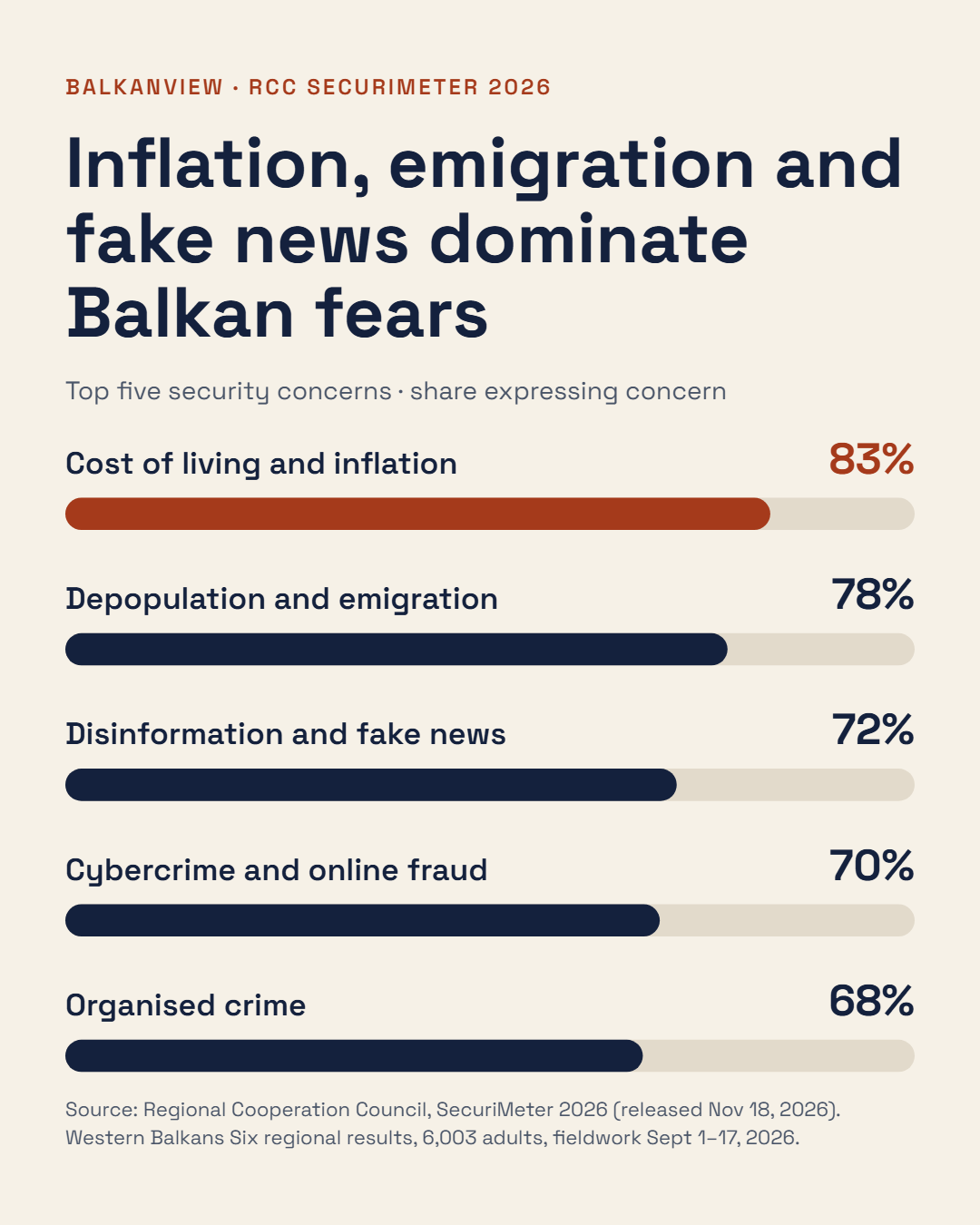
The most widespread concern was the cost of living and inflation, cited by 83% of respondents.
Depopulation and emigration followed at 78%, while 72% expressed concern about disinformation and fake news.
Cybercrime and online fraud worried 70%, and organised crime remained a concern for 68%.
The results suggest that the meaning of security in the Western Balkans is increasingly extending beyond conventional military threats, territorial disputes and political instability.
For many citizens, financial stability, reliable information, employment opportunities and confidence in public institutions are equally important.
“Security is not only about protecting people from traditional threats. It is also about whether they can afford to live with dignity, trust the institutions meant to protect them and see a future for themselves and their families in this region,” said Pavle Janković, head of the RCC Political Department.
Janković said the findings could help policymakers identify shared challenges and develop regional responses based on citizens’ concerns.
The generation that may leave
Perhaps the most consequential finding concerns young people.
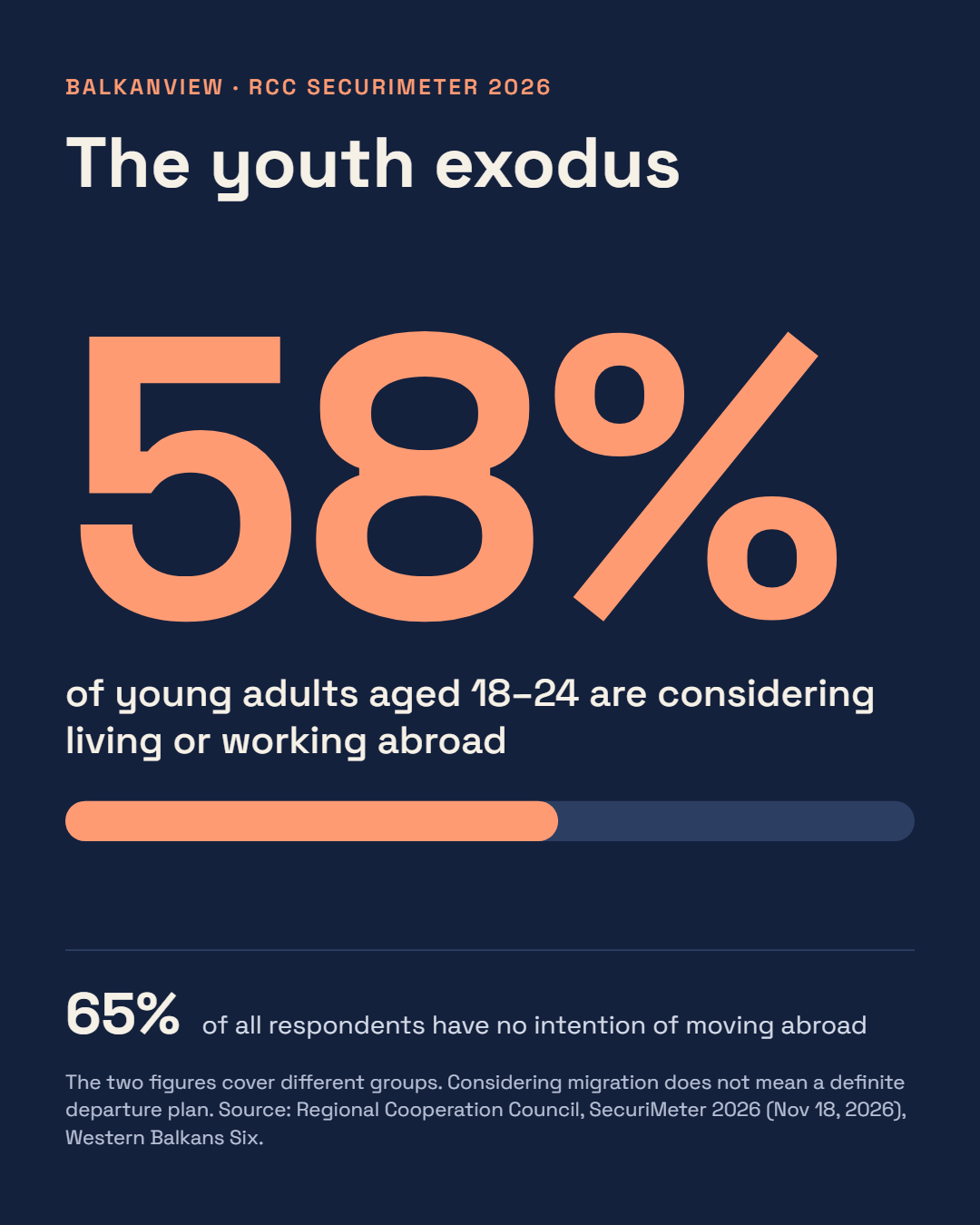
While 65% of respondents overall said they had no intention of moving abroad, 58% of young adults aged 18 to 24 were considering leaving their country to live or work elsewhere.
The contrast highlights the region’s demographic vulnerability.
Western Balkan economies have experienced decades of emigration, particularly among younger and working-age populations, contributing to labour shortages, ageing societies and pressure on public services.
The latest survey suggests that the desire to seek opportunities abroad remains widespread among the youngest adults, even as general security perceptions improve.
The 58% figure measures consideration of migration, not confirmed departure plans or future migration flows.
Nevertheless, it indicates a substantial challenge for governments seeking to retain the workers, professionals and taxpayers needed to sustain economic development.
RCC Senior Security Advisor Aner Zuković said economic opportunity and resilience had become central to understanding security.
“People may feel safer in their immediate surroundings, but that does not necessarily mean they feel secure about their future,” he said.
“When more than eight in ten are concerned about living costs and more than half of young adults are considering moving abroad, we need to recognise that economic security, opportunity and resilience are integral to the broader security picture.”
Only one in three can afford a €1,000 emergency
The survey also revealed significant financial vulnerability.
Only about one-third of respondents said they could cover an unexpected expense of €1,000 without borrowing money or relying on assistance from others.
The finding suggests that many households have limited financial reserves to cope with sudden medical costs, unemployment or other emergencies.
Economic vulnerability is particularly significant in a region where wages and pensions remain below those in wealthier European economies.
Even households with regular employment may struggle to accumulate savings if essential expenses consume much of their disposable income.
The survey also found that 55% of respondents had little or no confidence in their community’s ability to recover from a serious crisis.
Together, these findings point to weaknesses in household financial resilience and public confidence in collective crisis management.
They also help explain why improving perceptions of physical safety have not necessarily translated into greater optimism about the future.
Corruption remains widespread despite improvement
Institutional trust remains another major challenge.
More than three-quarters of respondents, 77%, considered corruption widespread in their economy.
That represented an improvement from 86% in 2023, but the latest figure still indicates deep public concern about the integrity of institutions.
More than half of respondents, 52%, disagreed that public institutions treated people equally.
Confidence in political parties was particularly low, standing at just 16%, the lowest among the institutions surveyed.
The findings suggest that political representation and institutional fairness remain important weaknesses in the region’s governance environment.
Perceptions of corruption are not direct measurements of the frequency of corrupt acts. Nevertheless, widespread public belief that corruption is prevalent can weaken trust in government and discourage confidence in public decision-making.
For countries seeking EU membership, the results underline the importance of reforms that improve accountability, transparency and equal treatment.
Digital threats become mainstream security concerns
The survey shows that digital security has become a major concern across the Western Balkans.
Nearly three-quarters of respondents, 74%, were worried about the theft of their personal information.
Another 72% expressed concern about the misuse of personal data by private companies or online platforms.
Disinformation and fake news were also a concern for 72%, while 70% worried about cybercrime and online fraud.
The findings reflect growing public anxiety about the security of digital communications, financial transactions and personal information.
They also point to the need for stronger cybersecurity protections, data privacy safeguards and public awareness.
Disinformation presents an additional challenge because it can affect trust in institutions, social cohesion and the quality of public debate.
The survey measures citizens’ concerns rather than the actual prevalence of cybercrime or disinformation.
Illegal weapons and organised crime remain concerns
Traditional security threats have not disappeared from the public agenda.
More than half of respondents, 53%, said they felt threatened by the illegal possession and misuse of firearms in their neighbourhood.
At the same time, 84% said they would not consider owning a gun.
The findings suggest that public concern about illegal weapons does not necessarily translate into a desire for personal firearm ownership.
Organised crime also remained a major concern, cited by 68% of respondents.
These issues continue to require cooperation among law enforcement agencies and governments, particularly where criminal networks operate across national borders.
Immigration exposes divided public attitudes
The survey found mixed views about immigration.
Nearly half of respondents, 48%, believed immigration increased crime, while 21% recognised that immigrants could help fill important job vacancies.
The results highlight a tension facing Western Balkan economies.
Many countries are experiencing demographic decline and labour shortages, yet significant sections of the population remain sceptical about immigration.
Such attitudes could complicate efforts to attract foreign workers to sectors struggling with labour shortages.
The RCC stressed that the findings reflect public perceptions rather than verified evidence about immigration’s effects on crime.
The distinction is important because attitudes towards immigration may be influenced by political narratives, personal experiences and the information environment.
From military security to human security
The SecuriMeter findings point towards a broader understanding of security in the Western Balkans.
While regional perceptions of safety have improved, citizens remain concerned about whether they can afford essential goods, protect their personal information, trust public institutions and build a future without leaving their home countries.
These concerns are interconnected.
Economic insecurity can contribute to emigration, demographic decline can weaken labour markets, and institutional distrust can reduce confidence in governments’ ability to respond effectively.
Addressing these problems therefore requires more than traditional security policies.
It also calls for economic development, stronger social protection, institutional reform, digital resilience and regional cooperation.
The findings were discussed in Belgrade by economists, political scientists and civil society representatives, including Adnan Efendić of the University of Sarajevo, Jorida Shytaj of Europe Plus, Filip Ejdus of the University of Belgrade, Daliborka Uljarević of the Centre for Civic Education and Dane Taleski of the Prespa Institute.
The discussion focused on institutional trust, economic resilience and the importance of coordinated responses to shared challenges.
A safer region, but an uncertain future
Improved security perceptions are a positive development for a region still shaped by the legacy of conflict, political disputes, and economic transition.
The proportion of citizens who regard the Western Balkans as safe has risen by 11 percentage points in a year.
But the survey’s broader message is more complex.
A region cannot rely on improvements in physical security alone if its citizens remain worried about living costs, corruption, economic vulnerability and the prospect of losing younger generations.
The biggest long-term challenge may be ensuring that people who feel safe in their communities also see enough opportunity to stay.
For Western Balkan governments, the test is increasingly whether they can transform improved perceptions of safety into lasting confidence in economic security, institutional fairness and the future.