



From Greece and Bulgaria to North Macedonia, Serbia and Albania, economic growth has not necessarily translated into financial security for households. New European data and research into the lasting effects of the Greek debt crisis expose a regional challenge: millions of people remain vulnerable to unexpected expenses despite years of economic development and European integration.
SKOPJE/ATHENS, Nov. 12 (BalkanView) – Economic growth, rising property prices and closer integration with the European Union have transformed much of the Balkans over the past two decades, but millions of households across the region remain financially vulnerable.
Greece, one of the region’s largest economies and an EU member since 1981, offers a particularly striking example.
More than half of its population cannot afford an unexpected financial expense, according to Eurostat figures for 2025, while new research by European Central Bank economists shows that wealth inequality remains elevated more than a decade after the country’s sovereign debt crisis.
The findings raise questions extending far beyond Greece: Why does economic recovery not necessarily produce greater financial security, and how vulnerable are households across the Balkans to another economic shock?
Greece and Bulgaria expose Europe’s financial divide
According to Eurostat, 50.5% of Greece’s population was unable to cover unexpected financial expenses in 2025, the highest proportion in the European Union.
The EU average stood at 29.2%, down from 30% in 2024.
Bulgaria, another Balkan member of the EU, recorded a rate of 42.4%, also significantly above the European average.
By comparison, only 15.3% of people in the Netherlands reported being unable to meet an unexpected expense.
The figures highlight substantial differences in household financial resilience across the European Union, with Greece recording a rate more than three times that of the Netherlands.
For the Balkans, the results also challenge the assumption that EU membership and higher national income automatically provide households with greater protection against financial hardship.
The Balkans: Different economies, shared vulnerabilities
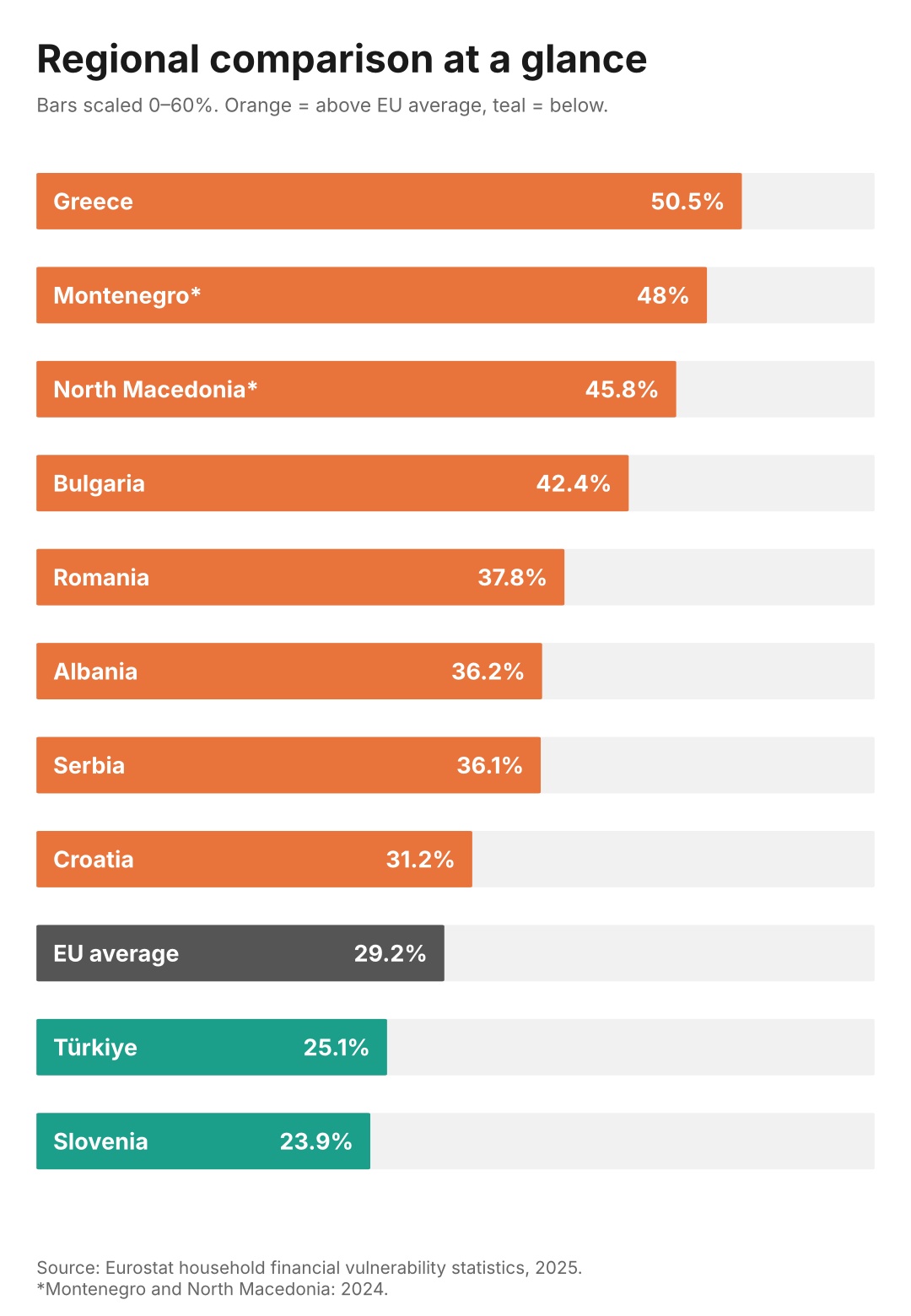
Southeastern Europe includes some of the EU’s most economically developed newer members, such as Slovenia, alongside countries still struggling to close the income gap with Western Europe.
The Western Balkans face additional challenges, including lower average wages, limited employment opportunities, demographic decline and dependence on income earned abroad.
Household financial vulnerability nevertheless varies considerably across the region.
The Western Balkan economies — Albania, Bosnia and Herzegovina, Kosovo, Montenegro, North Macedonia and Serbia — face many of the same structural pressures, although differences in statistical coverage and reference years complicate direct comparisons.
The ability to cover unexpected expenses is particularly important in economies where households may have limited savings and rely heavily on regular employment income, pensions or financial assistance from relatives.
The indicator measures whether households can meet an unexpected expense from their own resources. It does not directly measure absolute poverty, income levels or the distribution of wealth.
The expense threshold is also determined at national level, meaning that comparisons reflect households’ capacity to absorb financial shocks relative to their country’s living standards.
Greece: The economic crisis that never fully ended
Greece’s experience illustrates how the consequences of a financial crisis can persist long after national economic indicators begin to recover.
In an analysis published by the European Central Bank, researchers Danilo Bianco, Jiri Slacalek and Oreste Tristani examined how successive economic shocks affected household wealth across the eurozone.
Their findings show that countries severely affected by the sovereign debt crisis — Greece, Spain, Italy, Portugal, Cyprus and Ireland — experienced a different trajectory from much of the rest of the eurozone.
While wealth inequality across the eurozone increased between 2010 and 2014 before subsequently declining, inequality in the crisis-hit economies continued rising until 2021.
By 2023, it remained significantly above its 2010 and 2014 levels.
In Greece, the recession triggered by concerns over public debt sustainability in 2010 led to a collapse in property values and household incomes.
Families that had borrowed to purchase homes saw the value of their assets decline while their mortgage obligations remained.
Lower-income households were also forced to spend savings to cover everyday expenses.
Financial assets, which tend to be concentrated among wealthier households, recovered more quickly.
The result was a widening gap between households that retained assets and those that lost much of their financial security during the crisis.
The housing paradox: Rising prices can deepen inequality
The Greek experience is particularly relevant to the Balkans because residential property represents an important component of household wealth throughout the region.
The ECB researchers identified two factors that contributed to persistent inequality in the countries hit hardest by the debt crisis.
Financially vulnerable households struggled to rebuild their savings after years of economic hardship, while homeownership declined, particularly among younger people.
When property prices began recovering, fewer households were able to benefit.
Existing homeowners could accumulate wealth through rising property values, while those without property faced higher barriers to entering the housing market.
Similar concerns are emerging across the Balkans as housing affordability becomes a growing challenge in cities such as Athens, Belgrade, Skopje, Tirana, Pristina and Podgorica.
For existing property owners, rising real estate prices can represent an increase in wealth.
For young people attempting to purchase their first home, the same price increases can mean years of additional saving, larger mortgages or prolonged dependence on family support.
The Greek findings do not establish that every Balkan housing market follows the same pattern. They nevertheless illustrate how a property market recovery can benefit existing asset owners while widening the gap with households that own little or no property.
The Western Balkans: Lower incomes, limited financial buffers
For the six Western Balkan economies, financial insecurity is closely connected to the region’s long-standing development challenges.
Albania, Bosnia and Herzegovina, Kosovo, Montenegro, North Macedonia and Serbia have pursued economic reforms and closer integration with the European Union, but their average living standards remain below those of the bloc.
Many households depend on income from employment, pensions and financial support from family members abroad.
Remittances can provide an important source of financial stability, particularly in countries with large emigrant populations.
However, they can also expose households to economic developments in the countries where their relatives work.
A recession in Germany, Switzerland, Italy or other major destinations for Balkan workers could affect not only employment abroad but also household income in their countries of origin.
The region’s financial resilience therefore depends partly on economic conditions outside its borders.
Greece’s debt crisis offers a warning about the consequences when declining incomes, unemployment and falling asset values occur simultaneously.
Inflation: A common shock across the region
The COVID-19 pandemic and the inflation surge that followed exposed households throughout southeastern Europe to further economic pressure.
Rising food, energy and housing costs reduced purchasing power, particularly among lower-income families that spend a larger proportion of their earnings on essential goods and services.
The ECB researchers found that pandemic-era government support and the erosion of the real value of debt during the subsequent inflation surge helped reduce wealth inequality across much of the eurozone.
However, inequality remained elevated in the countries most severely affected by the earlier debt crisis.
The findings suggest that temporary government assistance may protect household incomes during a crisis without necessarily reversing deeper structural inequalities.
For Western Balkan governments, which generally have more limited fiscal resources than wealthier EU member states, the challenge is particularly acute.
Measures to cushion energy and food price increases can provide immediate relief, but their longer-term impact depends on employment, productivity, social protection and households’ ability to accumulate savings.
EU membership is not an automatic guarantee of prosperity
The Balkan region offers a useful comparison between countries at different stages of European integration.
Greece has been an EU member since 1981, Slovenia since 2004, Bulgaria and Romania since 2007, and Croatia since 2013.
The six Western Balkan economies remain outside the bloc, despite years of accession-related reforms and economic integration.
EU membership provides access to the single market, investment opportunities, development funding and institutional frameworks that can support economic convergence.
But Greece’s experience demonstrates that membership alone cannot prevent financial crises or ensure that the benefits of growth are distributed evenly.
Bulgaria’s high level of household financial vulnerability further illustrates that economic convergence with the EU does not automatically eliminate financial insecurity.
For countries such as North Macedonia, Albania, Serbia and Montenegro, the implications are significant.
European integration can help create conditions for economic development, but national policies remain essential in determining whether that development improves the financial position of ordinary households.
What should Balkan governments measure?
Governments across southeastern Europe frequently cite GDP growth, foreign investment, wage increases and infrastructure development as evidence of economic progress.
Such indicators provide important information about the performance of national economies.
However, they do not necessarily show whether households can withstand an unexpected expense, whether younger people can afford housing or whether families are accumulating savings.
A more comprehensive assessment of economic progress would also examine household disposable income, poverty rates, savings, debt, housing affordability and the distribution of wealth.
For the Balkans, these indicators could provide a clearer picture of whether economic development is improving people’s everyday lives.
They could also help policymakers identify which households are most vulnerable to future crises.
The Greek case shows why this matters: a country can recover from recession, experience rising property prices and improve its economic performance while a substantial proportion of its population remains financially insecure.
The Balkan question: Growth for whom?
The economies of southeastern Europe have changed considerably since the political and economic upheavals of the 1990s.
EU enlargement, foreign investment, labour mobility and expanding trade have created new opportunities across the region.
Yet the ability of households to withstand economic shocks remains uneven.
Greece’s persistent wealth divide demonstrates that the effects of a crisis can survive for more than a decade, even when national economic indicators recover.
For the Western Balkans, where incomes remain lower and economic convergence is still incomplete, the experience offers an important lesson.
Economic growth is necessary, but it is not sufficient.
The region’s long-term prosperity will also depend on whether households can build savings, access affordable housing and withstand periods of unemployment, inflation or other financial shocks.