


The European Commission’s latest reports reveal a widening gap between countries advancing towards EU membership and those held back by political deadlock, corruption and weak institutions. Montenegro has provisionally closed 21 negotiating chapters, Albania is accelerating reforms, while North Macedonia, Serbia, Kosovo and Bosnia and Herzegovina face different obstacles.
By BV Team
BRUSSELS, Nov. 5, 2026 (BalkanView) — The European Union’s six Western Balkan membership hopefuls are moving at increasingly different speeds, with Montenegro approaching the final stage of accession and Albania making substantial progress, while political disputes and institutional weaknesses continue to delay their neighbours, according to European Commission reports published on Wednesday.
The Commission’s assessments of Albania, Bosnia and Herzegovina, Kosovo, Montenegro, North Macedonia and Serbia show that the region’s integration is no longer advancing as a single process.
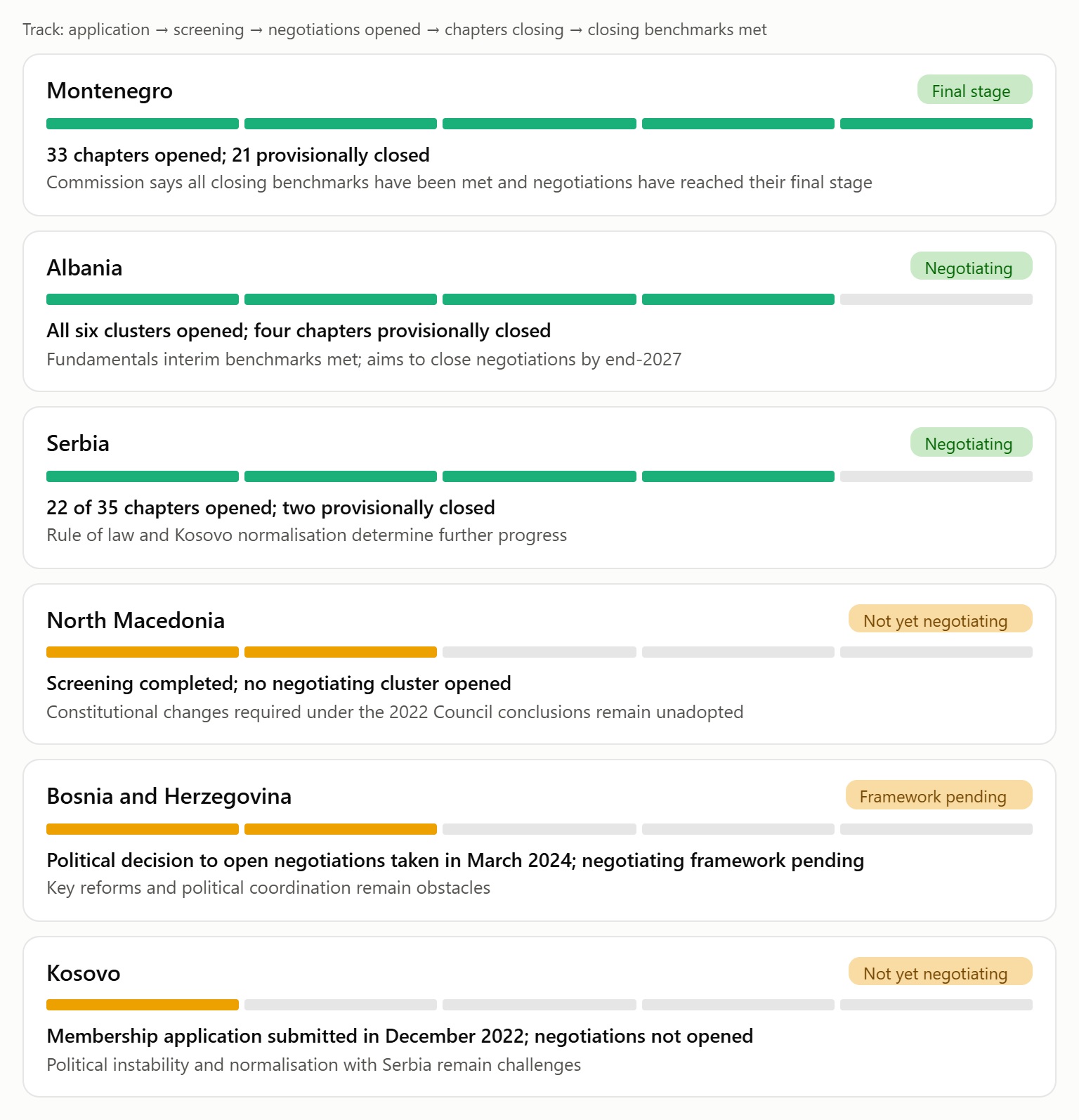
Montenegro has provisionally closed 21 of its 33 negotiating chapters, including 14 during the latest reporting period. Albania has opened all negotiating clusters and provisionally closed four chapters, while maintaining its ambition to complete negotiations by the end of 2027.
Serbia, despite having negotiated since 2014, has provisionally closed only two chapters. North Macedonia has yet to open its first negotiating cluster, with constitutional amendments remaining a central obstacle.
Bosnia and Herzegovina has still not completed the steps needed to move into substantive accession negotiations, while Kosovo remains at an earlier stage of integration, complicated by domestic political instability and unresolved relations with Serbia.
The contrast underscores an increasingly important reality for the Western Balkans: EU accession is becoming a test of institutional performance and political commitment, rather than simply a measure of how long a country has been waiting.
The Six Countries’ Position on the Road to EU Membership
Source: European Commission 2026 country reports.
Montenegro: The Frontrunner Is Approaching the Finish Line
Montenegro emerges as the clearest success story in the 2026 enlargement package.
The country has opened all 33 negotiating chapters and provisionally closed 21, including 14 during the reporting period. The EU Council established a working party to draft Montenegro’s accession treaty in April 2026, and the Commission presented a draft financial package in June.
The Commission says Montenegro has reached the final stage of accession negotiations, reflecting sustained political commitment and the implementation of reforms.
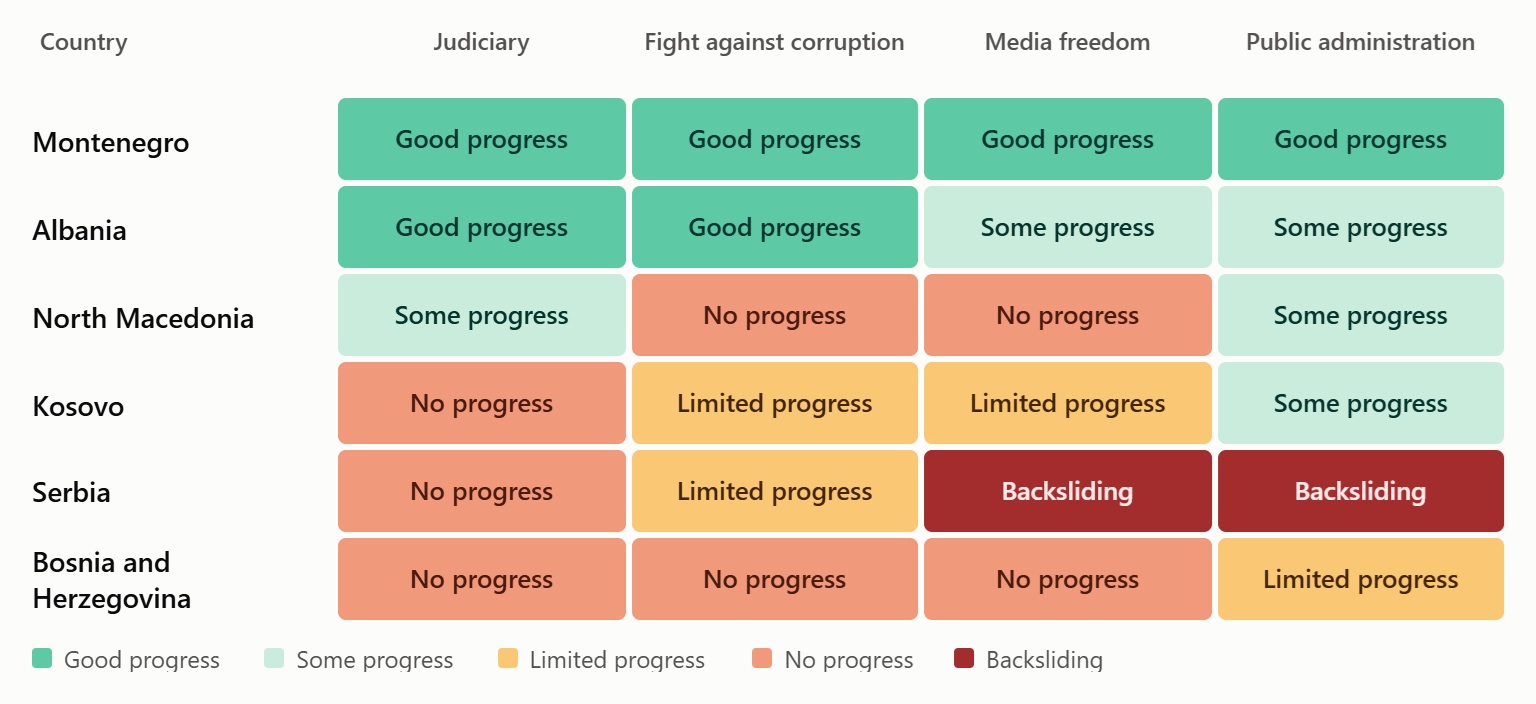
The improvement is particularly evident in the judiciary, corruption prevention, public administration and media freedom, where the Commission records good progress.
Montenegro adopted constitutional amendments strengthening the independence of judicial and prosecutorial councils, while parliamentary cooperation helped advance EU-related legislation.
The Commission nevertheless identifies continuing risks, including reliance on urgent legislative procedures and political disagreements that could disrupt reform momentum.
The country’s progress demonstrates that accession can advance rapidly when political institutions maintain a common objective despite internal disagreements.
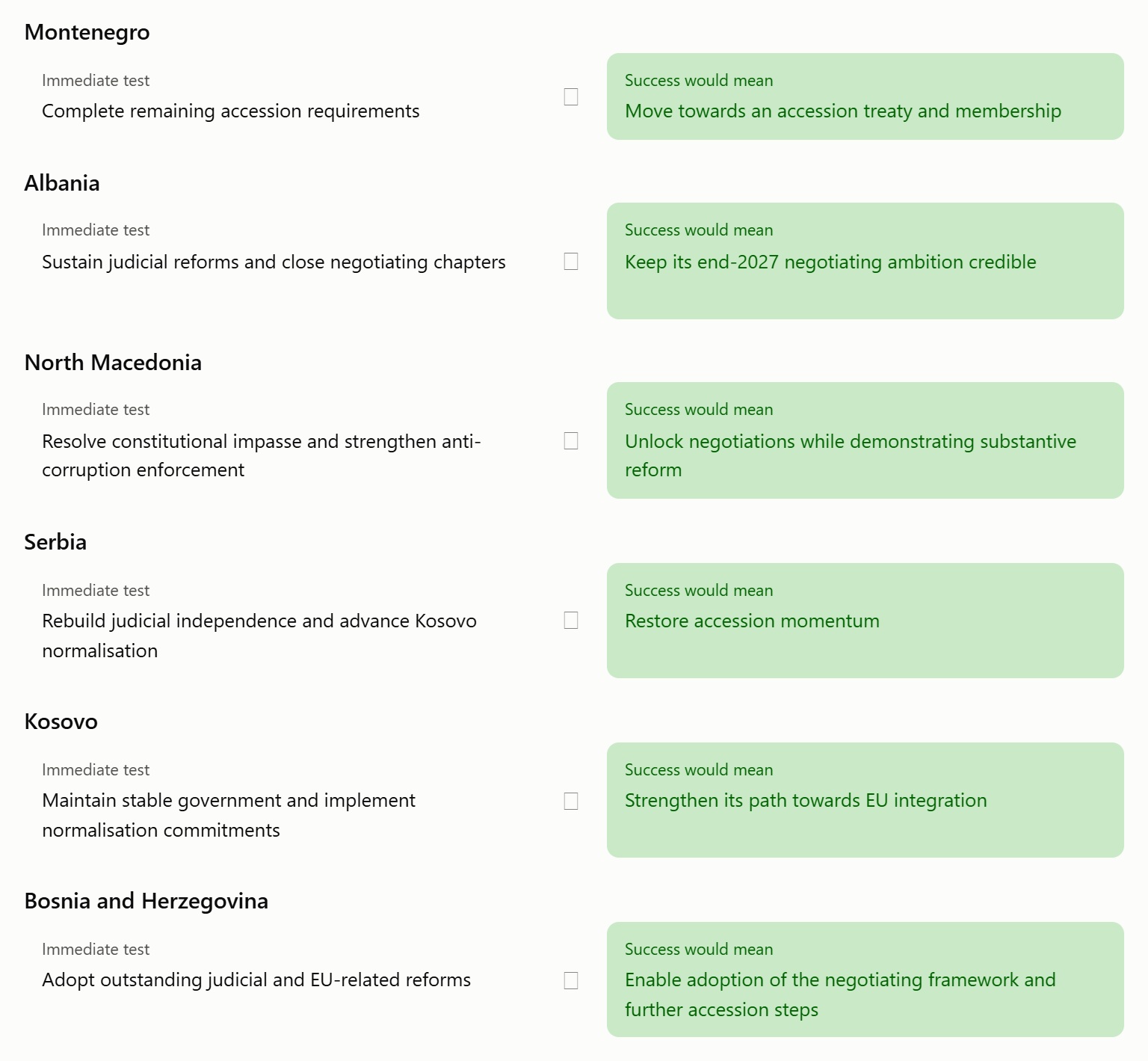
Its challenge is now to translate negotiating achievements into lasting institutional performance and complete the remaining accession requirements.
Albania: Rapid Progress, but Growing Pressure at Home
Albania is emerging as the second major frontrunner.
The Commission confirms that Tirana opened its final negotiating cluster, met the interim benchmarks under the fundamentals cluster and provisionally closed four chapters.
The government aims to close all negotiating chapters by the end of 2027, an ambitious timetable that will require sustained reform implementation.
Albania received particularly positive assessments for judicial reform and the fight against corruption.
The Commission says the vetting process for judges and prosecutors has been completed, while the Specialised Structure Against Organised Crime and Corruption, known as SPAK, has continued to demonstrate independence.
These developments distinguish Albania from several regional neighbours where judicial reform remains stalled or vulnerable to political interference.
But Albania’s progress comes amid mounting domestic dissatisfaction.
The Commission describes the country’s largest civic mobilisation since its democratic transition, with protests beginning in May 2026 over plans for a tourism development in the protected Pishë Poro–Narta area.
The demonstrations broadened into demands for transparency, accountability and action against corruption.
The Commission also identifies shortcomings in electoral reform and media freedom, despite some progress in the latter area.
Albania’s experience therefore illustrates a distinction between technical accession progress and public confidence in domestic governance.
Its government has advanced negotiations, but the sustainability of those gains will depend on whether reforms are felt beyond institutions and legislation.
North Macedonia: A Political Blockade Meets Unfinished Reforms
North Macedonia presents one of the clearest examples of a country whose accession process is constrained by both bilateral political disagreements and domestic reform weaknesses.
The Commission confirms that all screening reports have been presented to the Council, but the country has made no progress on the constitutional amendments required under the 2022 Council conclusions.
Those amendments remain a prerequisite for advancing to the next stage of negotiations.
The issue has become central to the dispute involving Bulgaria and the recognition of Bulgarians in North Macedonia’s constitution.
The Commission also calls for the implementation in good faith of existing bilateral agreements, including the Prespa Agreement with Greece and the friendship treaty with Bulgaria.
However, the constitutional dispute is not the country’s only challenge.
The Commission reports some progress in judicial reform, including adoption of a new Law on the Judicial Council, but finds no progress in fighting corruption.
It describes corruption as prevalent and a matter of serious concern.
Media freedom also received a no-progress assessment, despite steps towards aligning legislation with the European Media Freedom Act.
Public administration reform advanced somewhat through the expansion of electronic services and improvements in digital document management.
North Macedonia’s strongest area remains foreign policy alignment.
The country maintains full alignment with the EU’s common foreign and security policy, including measures related to Russia’s war against Ukraine.
This creates a striking contrast: Skopje is closely aligned with Brussels geopolitically but remains unable to advance its accession negotiations.
For North Macedonia, resolving the constitutional dispute would remove a major political obstacle. It would not, by itself, resolve the Commission’s concerns about corruption, judicial independence and media freedom.
Serbia: A Political Transition Inherits a Troubled EU Record
Serbia’s 2026 report provides an institutional assessment of a country undergoing a major political transition.
The Commission notes that the Student List won an absolute majority of parliamentary mandates in the October 25 election, according to preliminary results.
But the report’s substantive findings largely concern the period before that vote, making it primarily an assessment of the system inherited by the incoming leadership rather than its performance in office.
The findings are severe.
The Commission records no progress in judicial reform, limited progress against corruption, backsliding in public administration and further deterioration in media freedom.
It identifies increasing political pressure on judges and prosecutors, persistent concerns about prosecutorial autonomy and weaknesses in the handling of high-level corruption cases.
The Council of Europe’s anti-corruption body GRECO found that Serbia had satisfactorily addressed only three of 24 recommendations in its fifth evaluation round, according to the Commission.
The report also describes growing pressure on civil society, including smear campaigns, attacks and reports of spyware targeting activists and political opponents.
In the media sector, the Commission finds further backsliding, citing the deterioration of journalists’ working conditions, growing market concentration and concerns about political and economic influence over editorial decisions.
Serbia has opened 22 of its 35 negotiating chapters, but provisionally closed only two.
The Commission reiterates that the overall pace of negotiations depends on progress in the rule of law and normalisation of relations with Kosovo.
The incoming government therefore faces a dual challenge: restoring confidence in democratic institutions and demonstrating that Serbia can fulfil the commitments required for EU membership.
The electoral transition offers an opportunity for reform, but the Commission’s assessment shows how extensive the inherited institutional problems are.
Kosovo: Political Instability Slows a Strongly Pro-European Society
Kosovo’s European integration remains constrained by repeated political crises and unresolved relations with Serbia.
The Commission notes that Kosovo submitted its EU membership application in December 2022 and that EU integration continues to enjoy broad political and public support.
Yet repeated elections and prolonged periods of caretaker government disrupted the functioning of institutions during the reporting period.
The Commission describes early parliamentary elections in December 2025 and June 2026, with turnout falling from 45% to 37%.
The eight-percentage-point decline suggests growing voter fatigue, according to the Commission.
The report records no progress in the functioning of the judiciary and limited progress against corruption and in media freedom.
It also identifies political and economic influence over the judiciary as a significant obstacle to institutional independence.
Nevertheless, Kosovo registered some progress in public administration reform, including centralised recruitment and expanded digital services.
A notable development was the Commission’s decision to lift measures imposed on Kosovo in 2023, following the peaceful transfer of local governance in northern municipalities and subsequent de-escalation.
Financial assistance and meetings under the Stabilisation and Association Agreement resumed.
But the EU-facilitated dialogue with Serbia remains an important condition for further integration.
Kosovo’s experience demonstrates that strong public support for EU membership cannot substitute for stable institutions, effective governance and progress in regional normalisation.
Bosnia and Herzegovina: Institutional Paralysis Remains the Biggest Obstacle
Bosnia and Herzegovina continues to face some of the most serious structural obstacles to EU accession.
Although the European Council decided in March 2024 to open accession negotiations, the negotiating framework remains conditional on further reforms.
The Commission’s 2026 report describes increasing disengagement from the EU path, political fragmentation and the failure to adopt important legislation.
The country’s complex institutional structure continues to complicate decision-making and coordination between different levels of government.
The Commission reports no progress in judicial reform, no progress against corruption and no progress in media freedom.
It finds limited progress in public administration reform.
The report identifies serious shortcomings in judicial independence, institutional accountability and the effectiveness of anti-corruption measures.
It also notes that key legislation, including laws governing the High Judicial and Prosecutorial Council and the country’s courts, remains outstanding.
Political tensions, divisive rhetoric and historical revisionism further complicate the reform environment.
The Commission raises particular concerns about genocide denial and the glorification of convicted war criminals.
Bosnia and Herzegovina’s main problem is therefore not simply the pace of technical alignment with EU rules.
It is the difficulty of building the political consensus and institutional capacity needed to implement reforms consistently across the country.
Comparative Reform Progress Across the Western Balkans
Source: European Commission 2026 country reports. These are qualitative assessments of progress during the reporting period, not numerical scores.
The Widening Gap: What the Six Reports Reveal
Three conclusions emerge from the Commission’s assessments.
First, the enlargement process is becoming increasingly differentiated. Montenegro and Albania are advancing through negotiating milestones while the other four countries remain constrained by different combinations of political disputes, institutional weaknesses and unfinished reforms.
Second, judicial independence and corruption are central dividing lines.
Montenegro and Albania received good-progress assessments in both areas. North Macedonia made no progress against corruption, Serbia made no progress in judicial reform, Kosovo made no progress in the judiciary, and Bosnia and Herzegovina made no progress in either area.
Third, democratic change does not automatically produce European integration.
Serbia’s student-led election victory could create conditions for reform, but the incoming authorities will inherit a system the Commission describes as weakened by political interference and institutional deterioration.
North Macedonia’s full alignment with EU foreign policy demonstrates strategic commitment but has not overcome the constitutional dispute or domestic reform shortcomings.
Kosovo’s pro-European orientation has similarly been insufficient to compensate for political instability and stalled normalisation with Serbia.
For Bosnia and Herzegovina, the fundamental challenge remains achieving the political cooperation necessary to make institutions function effectively.
The Next Decisive Test for Each Country
Source: BalkanView editorial synthesis based on European Commission recommendations.
A Region Moving Towards Europe — But Not Together
The Commission’s 2026 enlargement package points to a Western Balkans increasingly divided between countries demonstrating measurable negotiating and institutional progress and those struggling to meet the political and governance conditions for advancement.
Montenegro’s achievements show that sustained political commitment can translate into rapid progress. Albania’s experience suggests that major judicial and anti-corruption reforms can help accelerate negotiations, even amid domestic unrest.
For the others, the obstacles are more complex.
North Macedonia faces a constitutional dispute alongside persistent corruption concerns. Serbia must translate political transition into institutional reform. Kosovo needs stable governance and progress in normalisation. Bosnia and Herzegovina must overcome the political fragmentation that continues to obstruct essential reforms.
The Commission’s reports do not establish a single accession timetable for the six countries, nor do they guarantee that those currently leading will complete the process without further obstacles.
But they reveal a clear shift in the region’s European trajectory.
The Western Balkans still share the ambition of EU membership. What it no longer shares is the same pace of progress — or the same prospect of reaching the finish line.
Methodology: This feature compares the six European Commission country reports published on Nov. 4, 2026. Tables use the Commission’s reported accession milestones and qualitative assessments. The reports principally assess developments from Sept. 1, 2025, to Sept. 1, 2026, while also mentioning selected subsequent events. The tables are editorial comparisons, not official composite EU rankings.