


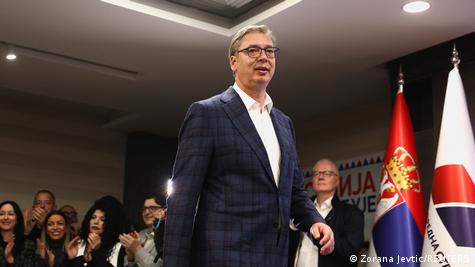
What began with the deaths of 16 people at a railway station has ended in Serbia’s biggest political upheaval in more than a decade. A student-led movement has won more than half the vote, according to preliminary results, forcing Aleksandar Vučić to concede defeat and opening a new chapter for the Western Balkans.
BELGRADE, Oct. 26 (BalkanView) – Serbia’s student-backed political movement has secured a decisive victory in snap parliamentary elections, according to preliminary results, ending 14 years of electoral dominance by Aleksandar Vučić’s Serbian Progressive Party (SNS) and triggering celebrations across the country.
Hundreds of thousands of people took to the streets of Belgrade, Novi Sad, Niš and other cities overnight, according to Serbian media reports, after Vučić acknowledged that his electoral alliance had lost Sunday’s vote.
With results from 7,998 polling stations processed, Serbia’s Republic Electoral Commission reported 52.33% of the vote for the Student List and 39.44% for Vučić’s United Serbia alliance, according to the Tanjug news agency.
Separately, polling agency Ipsos and election-monitoring organisation CeSID projected 52.9% for the students and 38.8% for Vučić’s alliance, based on 96% of their sample.
The Student List is projected to secure approximately 140 seats in Serbia’s 250-member parliament, giving it a majority sufficient to form a government without the support of other major parties.
The final allocation of parliamentary seats remains subject to official confirmation.
A political earthquake after 14 years
Vučić acknowledged defeat on Sunday evening, saying the results clearly showed that his political alliance had lost.
He estimated that the Student List would secure between 135 and 140 parliamentary seats, while his alliance would win approximately 105.
“We have learned how to be in opposition,” Vučić said, according to Serbian media.
He said he remained proud of the SNS’s record in government and insisted that the party’s organisational structure remained strong.
Vučić also said he would remain in Serbia and continue his political activities.
His concession represents a major political setback for a party that has dominated Serbia’s institutions since 2012.
Although Vučić acknowledged the election result, he continued to accuse the student movement of benefiting from foreign political support, without presenting evidence.
Latest election figures
The turnout estimate of 69.7% is substantially higher than the approximately 58% recorded in Serbia’s 2023 parliamentary election.
The high level of participation suggests that the student movement succeeded in mobilising citizens who had previously abstained or supported other political options.
Celebrations sweep across Serbia
Crowds gathered in central Belgrade throughout Sunday night, waving flags, chanting and celebrating the election result.
Thousands converged on Slavija Square, the area around parliament and the park opposite the Serbian Presidency building.
Cars sounded their horns, fireworks were set off and people danced in the streets.
Similar celebrations were reported in Novi Sad, Niš, Zemun and Gornji Milanovac.
Serbian media reported that police officers withdrew from some locations and removed riot-control equipment as crowds continued celebrating.
In Novi Sad, protesters removed a large banner depicting nationalist politician Vojislav Šešelj from a building associated with the Serbian Radical Party.
The banner had reportedly been displayed for more than two decades and included a message denying the Srebrenica genocide.
The removal became one of the most widely discussed images of election night.
In Belgrade, crowds also dismantled barriers around the tent encampment established by Vučić supporters near parliament, known as Ćacilend.
The events underscored the intensity of public reaction to the electoral result.
How students transformed tragedy into political change
The movement began after a concrete canopy collapsed at Novi Sad railway station on November 1, 2024, killing 16 people.
The disaster triggered protests demanding accountability over alleged corruption, negligence and failures in public infrastructure management.
Students initially organised university blockades and street demonstrations.
The movement gradually expanded, attracting professors, farmers, artists, professionals and other citizens dissatisfied with the government.
Its organisers relied on university assemblies, decentralised decision-making and local networks rather than a conventional party structure.
The movement later organised nationwide marches and mass demonstrations, including one of the largest anti-government gatherings in Belgrade’s recent history in March 2025.
Political analysts say the movement’s ability to turn public anger into a sustained organisation was central to its electoral success.
Helena Ivanov of the Henry Jackson Society told the BBC that the Novi Sad tragedy had been the emotional turning point that triggered a broader movement.
She said the students subsequently developed the organisational capacity needed to contest elections and monitor voting procedures.
A student movement without student candidates
One of the movement’s most unusual features is that its parliamentary list does not include students.
Instead, organisers selected academics, professionals, public figures and individuals with experience in public institutions.
The decision reflected an effort to reassure voters that the movement could govern while allowing students to retain their role as organisers and advocates for reform.
Among the prominent candidates are cardiologist Ilija Srdanović, former central bank governor Dejan Šoškić, former basketball star Dejan Bodiroga and actor Tihomir Stanić.
The movement’s electoral list also includes university professors and other professionals.
Srdanović, a professor at the University of Novi Sad, headed the electoral list.
However, the movement has not formally identified a future prime minister.
Šoškić has been mentioned in media speculation as a possible candidate for the post, although no appointment has been announced.
What the new majority promises
The Student List campaigned on a programme centred on fighting corruption, strengthening institutions and restoring public accountability.
Its political platform includes proposals to investigate abuses of public office, reform the police and reduce political influence over public institutions.
The movement has also promised changes to the media environment, including stronger independence for public broadcaster RTS.
Another priority is reforming the management of state-owned enterprises to reduce political appointments.
Its proposals include investigating allegations of excessive police force during protests and possible connections between public officials and organised crime.
The SNS has consistently rejected accusations that its administration systematically tolerated corruption or politically controlled public institutions.
Radomir Saičić, a candidate on the Student List, said the election demonstrated that political change was possible.
He also called on supporters to avoid confrontation and celebrate peacefully.
Former central bank governor Dejan Šoškić similarly urged citizens to preserve public order.
Vučić remains politically relevant
Despite the scale of the defeat, analysts warn that Vučić and the SNS remain important political actors.
The SNS-led alliance is projected to retain more than 100 parliamentary seats, giving it a substantial opposition presence.
Vučić said the party would continue fighting politically and predicted that some business figures might distance themselves from it following the loss of power.
He nevertheless insisted that the party’s organisational foundations remained intact.
Nikola Xaviereff-Weckwerth, a Balkans specialist at the German Council on Foreign Relations, described the students’ electoral achievement as a generational success while cautioning that Vučić remained part of Serbia’s political landscape.
The incoming majority will therefore face a substantial parliamentary opposition and the challenge of transforming a protest movement into an effective governing structure.
Political tensions persist after the vote
The celebrations were accompanied by isolated confrontations and disputes.
Ana Brnabić, Serbia’s acting president following Vučić’s resignation, became involved in a heated verbal exchange with Student List supporters on a street in Belgrade.
Videos circulated by Serbian media showed her confronting members of the crowd after reportedly being subjected to insults.
Media outlets sympathetic to the government portrayed the incident as harassment of a public official, while other outlets highlighted Brnabić’s reaction.
The confrontation illustrated the deep political divisions that remain despite the election result.
Regional leaders congratulate the students
The Student List’s victory prompted reactions across the Western Balkans.
Montenegrin President Jakov Milatović congratulated the movement and said its victory could open a new chapter in relations between Montenegro and Serbia.
Montenegrin Prime Minister Milojko Spajić expressed a similar view, calling for relations based on mutual respect and open dialogue.
In Bosnia and Herzegovina, Bosnian Serb leader Milorad Dodik congratulated the Student List despite his longstanding political relationship with Vučić.
Željka Cvijanović, a member of Bosnia’s tripartite presidency, also congratulated the movement and expressed hope that Serbia would continue its development.
The reactions suggest that regional leaders are preparing for a political transition in Belgrade.
However, the future direction of Serbia’s relations with its neighbours remains uncertain.
What could change in the Western Balkans?
A new government in Serbia could influence several major regional issues.
These include Belgrade’s relations with Kosovo, its political ties with Republika Srpska, its approach to Montenegro and its relations with the European Union.
Serbia’s position towards Russia could also come under scrutiny.
Vučić has suggested that a student-backed government might introduce sanctions against Moscow, but the movement has not announced such a decision.
Bosnia and Herzegovina’s Defence Minister Zukan Helez called on the incoming political leadership to confront the legacy of the Srebrenica genocide and the siege of Sarajevo.
The Student List’s future regional policy will depend on its leadership, governing programme and the political compromises required after taking office.
From victory to responsibility
The movement now faces a challenge fundamentally different from organising demonstrations.
Its parliamentary representatives will need to form a government, select ministers, negotiate institutional reforms and address economic and foreign policy issues.
The student organisers have said their objective is to transfer the struggle for accountability from the streets into state institutions.
That transition will test whether a decentralised civic movement can maintain its unity once confronted with the demands of government.
The victory also raises expectations among citizens who have spent nearly two years protesting against corruption and demanding institutional change.
The Student List’s candidates will face pressure to deliver tangible reforms while preserving the broad coalition that brought them to power.
For Serbia, the election marks the beginning of a political transition rather than the completion of one.
The SNS’s electoral dominance has been broken, but the durability of the new political order will depend on what follows.