


Bulgaria’s presidential election is heading for a second round after incumbent Iliana Iotova failed to secure an outright victory. Opposition challenger Andrey Gyurov is closing the gap, while low voter turnout, the war in Ukraine and concerns about the concentration of political power are shaping the final battle for the presidency.
SOFIA, Oct. 25 (BalkanView) – Bulgaria is heading for a presidential runoff between incumbent Iliana Iotova and opposition-backed candidate Andrey Gyurov on November 1, according to preliminary election results and parallel vote counts released on Sunday evening.
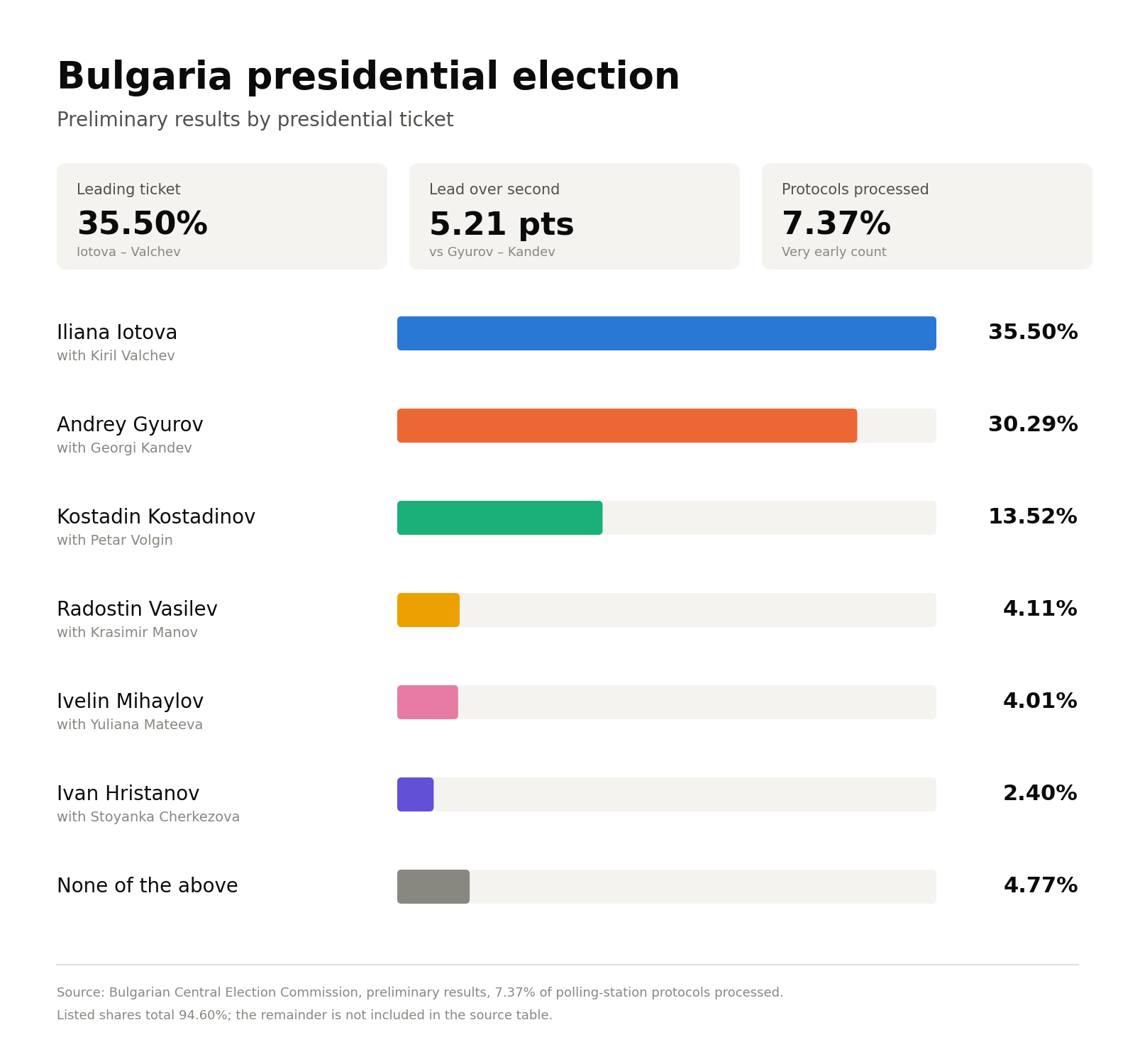
Iotova led with 35.5% of the vote, compared with 30.29% for Gyurov, according to the Central Election Commission’s initial figures based on 7.37% of polling-station protocols.
Parallel vote counts by polling agencies Myara and Alpha Research, based on their complete samples, also indicated that neither candidate had secured a first-round victory.
The result sets up a closely watched contest that will test the political influence of Prime Minister Rumen Radev and his ruling Progressive Bulgaria party, which won a commanding parliamentary majority in April.
Gyurov, a former caretaker prime minister backed by opposition parties, has called for a televised debate with Iotova ahead of the runoff.
Early results show a five-point gap
The first official figures published by Bulgaria’s Central Election Commission showed Iotova ahead by approximately five percentage points.
The early count places nationalist politician Kostadin Kostadinov in third place, with 13.52% of the vote.
His supporters could become an important factor in the runoff, particularly because of the differences between the leading candidates over Bulgaria’s foreign policy and the war in Ukraine.
However, the final distribution of votes and the behaviour of supporters of eliminated candidates remain uncertain.
Iotova warns low turnout threatens political change
Speaking after polls closed, Iotova thanked voters but expressed concern about low participation.
She said Bulgarians should not expect political change if they stayed away from the ballot box.
Iotova urged citizens to participate more actively in the runoff, arguing that the country faced important decisions about its future.
She said Bulgaria needed stability and warned against returning to periods of political confrontation and ineffective governance.
The incumbent also reiterated her ambition to position Bulgaria as a guarantor of security in South East Europe.
Referring to the war in Ukraine, she said she wanted to be a president committed to peace.
“Without peace, there is no security and no prosperity,” she said, according to Bulgarian National Television.
Iotova also emphasised national sovereignty and said she wanted Bulgarian flags, rather than foreign flags, to dominate public gatherings.
She argued that the country needed stable government rather than fragile political arrangements.
Gyurov challenges Iotova to public debate
Gyurov welcomed his first-round performance and said the result demonstrated growing support for political change.
He described the vote as a mandate to continue campaigning for a different direction for Bulgaria.
The opposition candidate said the country needed an active president capable of explaining decisions and uniting citizens.
He invited Iotova to an open debate before the November 1 runoff.
“I invite Mrs Iotova to an open, honest and civilised debate about how we will use our powers and how we will act when Bulgaria faces a difficult choice,” Gyurov said.
He also said the outcome should be determined by voters rather than negotiations between party leaderships.
Gyurov pledged to seek support from citizens across the political spectrum, regardless of party affiliation.
His campaign will now focus on mobilising voters who supported other candidates or abstained in the first round.
Low turnout raises questions about voter mobilisation
Participation has emerged as one of the central issues in the election.
According to the Central Election Commission, turnout stood at 15.95% at 4 p.m., with 1,058,669 people having voted out of an electorate reported at 6,637,238.
That figure represents an afternoon snapshot rather than the final turnout.
Iotova suggested that the absence of one of Bulgaria’s major political forces from the presidential contest had contributed to lower participation.
Neither GERB nor the Movement for Rights and Freedoms fielded its own presidential candidate.
The two parties collectively attracted more than 660,000 votes in April’s parliamentary election, making their supporters potentially influential in the second round.
Political analysts have suggested that the mobilisation of these voters could significantly affect the outcome.
Ukraine war remains a dividing line
The presidential race has been increasingly shaped by Bulgaria’s response to Russia’s war against Ukraine and recent drone attacks on vessels in the Black Sea.
Iotova has campaigned on a platform emphasising diplomacy, peace and avoiding direct military involvement in Ukraine.
Gyurov has criticised the concentration of political power and called for a more active presidency capable of challenging government decisions.
The campaign has also exposed differences over Bulgaria’s security priorities and its approach to international alliances.
Although the Bulgarian president has limited executive authority, the office plays an important role in national security, international representation and institutional oversight.
The next president will therefore influence the country’s political debate at a time of heightened regional uncertainty.
A test for Radev’s political dominance
The runoff will be closely watched as a measure of support for Prime Minister Radev’s governing party.
Radev’s Progressive Bulgaria secured an unusually strong parliamentary majority earlier this year, changing the balance of power after years of fragmented governments.
Iotova, who previously served as Radev’s vice-president, has his political backing.
A victory for her would reinforce the ruling party’s position across Bulgaria’s main institutions.
A Gyurov victory, by contrast, could create a more assertive institutional counterweight to the government.
The opposition has warned that the concentration of political power risks weakening democratic accountability.
The governing camp has emphasised stability and the ability to pursue long-term national priorities.
November 1 becomes decisive
The two leading candidates now have one week to mobilise additional support.
Iotova enters the runoff with a lead in the initial count, but Gyurov’s performance suggests a more competitive race than earlier polling had indicated.
The votes of nationalist candidates’ supporters, GERB sympathisers and citizens who stayed home in the first round could determine the result.
The final official first-round figures are still pending.
For Bulgaria, the November 1 vote will decide not only who occupies the presidency but also whether the country’s current political balance is reinforced or challenged.