


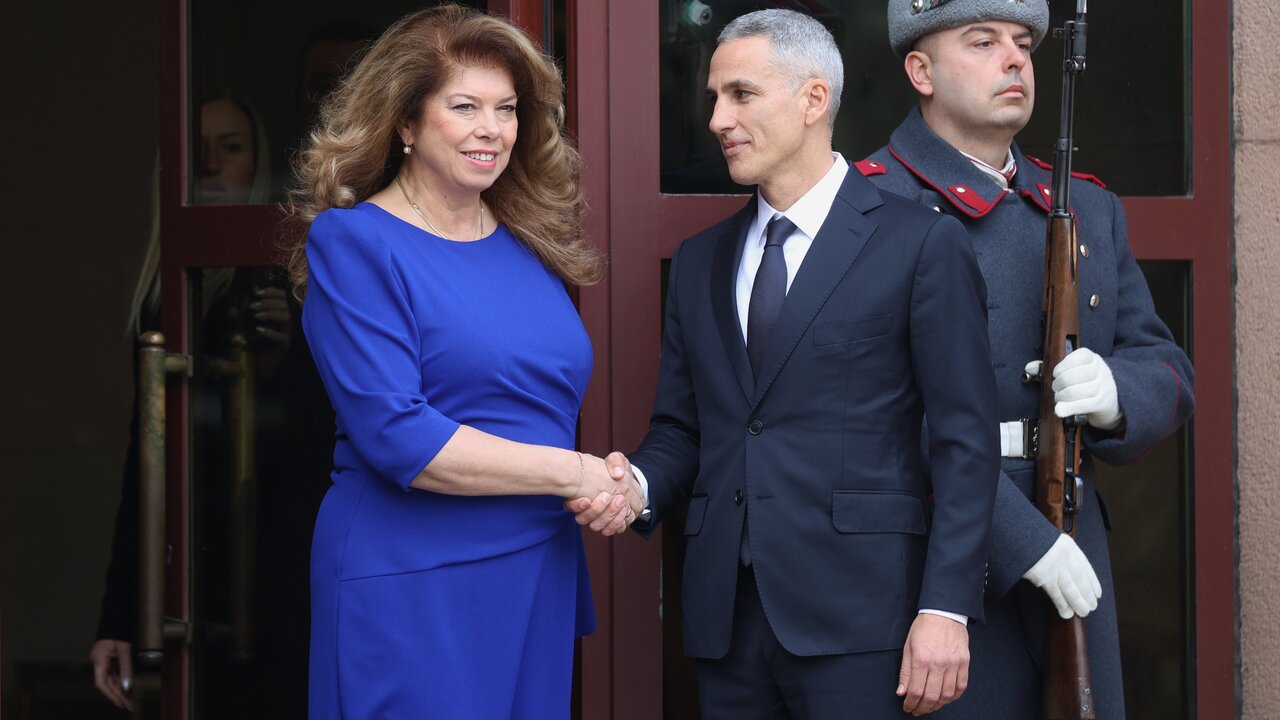
Nearly 6.6 million Bulgarians are eligible to vote in a presidential election that has become a test of Prime Minister Rumen Radev’s political dominance. A series of drone attacks in the Black Sea has pushed Russia’s war in Ukraine to the centre of the campaign, narrowing the gap between the two leading candidates.
SOFIA, Oct. 25 (BalkanView) – Bulgarians began voting on Sunday in a presidential election overshadowed by Russia’s war in Ukraine and growing concerns about security in the Black Sea, with incumbent President Iliana Iotova facing a challenge from opposition-backed candidate Andrey Gyurov.
The election is widely regarded as the first major political test for Prime Minister Rumen Radev’s Progressive Bulgaria party, which secured an unprecedented parliamentary majority in April.
Although 27 presidential tickets are competing, opinion polls indicate that the contest is largely between Iotova, who is backed by Radev, and Gyurov, a former caretaker prime minister supported by opposition parties.
According to Bulgarian National Television (BNT), approximately 6.59 million citizens are eligible to vote, including around 46,000 young people who have reached voting age this year.
Polling stations opened on Sunday morning and are scheduled to close at 8 p.m., with voting potentially extended by an hour where voters are still waiting.
A candidate can win in the first round by securing more than half of valid votes, provided turnout exceeds 50%. Otherwise, a runoff will take place on November 1.
Ukraine war dominates final stage of campaign
The presidential campaign initially attracted limited public attention, with relatively small rallies and few direct confrontations between the leading candidates.
That changed following drone attacks targeting vessels in the Black Sea.
The incidents brought regional security and Bulgaria’s position on Russia’s war against Ukraine to the forefront of political debate.
Several European leaders, including Ukrainian President Volodymyr Zelenskyy, have blamed Russia for the attacks.
Bulgarian authorities initially avoided directly identifying those responsible, prompting criticism from opposition politicians and some members of the public.
Radev subsequently said there was insufficient conclusive evidence to attribute the attacks to a particular party, although he acknowledged that Russia appeared to benefit from their consequences.
The Bulgarian government later summoned Russian Ambassador Eleonora Mitrofanova for consultations.
The incidents have also prompted a change in Sofia’s security posture.
After initially declining to participate in the so-called Coalition of the Willing and a NATO counter-drone initiative, the government reconsidered its position following the attacks.
Iotova promises no Bulgarian troops in Ukraine
Iotova has sought to present herself as a candidate committed to diplomacy and avoiding direct military involvement in Ukraine.
She has advocated what she calls a “Coalition for Peace”, arguing that Bulgaria should play a stronger diplomatic role in efforts to end the war.
During a campaign rally this month, she criticised politicians whom she described as advocates of military escalation.
She also pledged that no Bulgarian soldiers would be sent to Ukraine during her presidency.
The issue has featured prominently in her campaign despite a 2025 parliamentary declaration ruling out the participation of Bulgarian armed forces in combat operations on Ukrainian territory.
Critics argue that her position has failed to address broader security concerns arising from the conflict.
Boriana Dimitrova, director of the polling agency Alpha Research, told Deutsche Welle that the drone attacks had brought geopolitical tensions directly into the everyday concerns of Bulgarian voters.
She said uncertainty surrounding the government’s response had contributed to a decline in Iotova’s support.
Opposition warns of concentration of power
Gyurov has framed the presidential election as an opportunity to establish an institutional counterweight to Radev’s parliamentary majority.
Although Bulgaria’s presidency is largely ceremonial, the head of state has important constitutional powers.
These include representing the country internationally, serving as commander-in-chief of the armed forces, appointing officials to certain institutions and exercising a suspensive veto over legislation.
Political scientist Hristo Panchugov of New Bulgarian University said the election was particularly significant because a single party now held a clear parliamentary majority.
He argued that the president’s capacity to challenge government decisions had become more important under these circumstances.
Gyurov has similarly warned that the concentration of political authority could weaken democratic checks and balances.
In an interview with Deutsche Welle, he said the president must be capable of saying “no” when necessary.
Iotova declined Deutsche Welle’s request for an interview.
Polls show Iotova ahead, but lead narrows
Despite growing criticism of the government’s foreign policy, Iotova remains the frontrunner.
Preliminary findings from Alpha Research indicate that she leads Gyurov by approximately 12 percentage points in the first round.
However, the gap has narrowed in recent weeks.
Dimitrova said the decline in Iotova’s support reflected uncertainty surrounding some of her political positions, particularly on security and foreign policy.
The narrowing margin has increased the importance of voters whose preferred parties are not fielding presidential candidates.
Supporters of the nationalist Revival party, which has adopted positions sympathetic to Russia, could play a significant role in a second round.
Analysts expect many of those voters to favour Iotova.
GERB and DPS voters could decide the result
Another important factor is the absence of presidential candidates from two established political parties, GERB and the Movement for Rights and Freedoms (DPS).
Together, the parties received more than 660,000 votes in April’s parliamentary election.
According to Alpha Research, approximately half of GERB supporters do not intend to vote in the first round.
Many of those who do participate are expected to support Gyurov, reflecting GERB’s longstanding rivalry with the political forces associated with Iotova.
The mobilisation of these voters could become decisive if the election proceeds to a runoff.
Gyurov’s campaign has intensified its efforts to attract undecided voters, while nationalist parties have also sought to capitalise on public dissatisfaction with the government’s response to the Black Sea incidents.
Voting begins across Bulgaria and abroad
BNT reported that voting was proceeding across the country on Sunday morning, with polling stations generally opening on schedule.
There are 9,373 polling stations equipped for machine voting in Bulgaria, while 613 polling stations have been organised abroad.
Authorities have also introduced accessibility measures, including tactile voting templates for visually impaired citizens in some districts.
In the Shumen region, election officials reported that voting began without major disruptions.
A technical malfunction at one polling station in the Montana region required a switch from machine voting to paper ballots.
A test for Bulgaria’s political direction
The election comes six months after Radev’s party won a parliamentary majority that transformed Bulgaria’s political landscape.
It also follows years of political instability and repeated elections.
For the governing party, an Iotova victory would strengthen its political position and consolidate its influence over national institutions.
For the opposition, a Gyurov victory would provide an institutional counterweight to the government.
The result will also offer an indication of public attitudes towards Bulgaria’s foreign policy, relations with Russia and support for Ukraine.
While the president does not independently determine the country’s foreign policy, the office can influence public debate and the direction of national security discussions.
With the Black Sea increasingly affected by the war in Ukraine, Sunday’s vote has become a test not only of domestic political loyalties but also of Bulgaria’s response to a changing European security environment.