


After 14 years of political dominance, Aleksandar Vučić has acknowledged defeat in Serbia’s parliamentary election. A student-led movement born from protests over a deadly railway station collapse is projected to win an outright majority, opening the door to a historic transfer of power in Belgrade.
BELGRADE, Oct. 25 (BalkanView) – Serbia’s Aleksandar Vučić conceded defeat in Sunday’s snap parliamentary election after preliminary projections showed a student-led opposition movement winning an outright majority, potentially ending 14 years of dominance by his Serbian Progressive Party (SNS).
Speaking at SNS headquarters in Belgrade after polls closed, Vučić acknowledged that his electoral alliance, Aleksandar Vučić – United Serbia, had lost to the Student List, which emerged from nearly two years of anti-government demonstrations.
“We still do not have final results … it is clear that we have lost these elections,” Vučić said, according to the BBC.
His concession followed projections indicating that the student-backed movement had secured enough votes to govern without relying on other major parties.
The result, if confirmed by Serbia’s electoral authorities, would represent one of the most significant political changes in the country since the SNS came to power in 2012.
Students projected to win 139 parliamentary seats
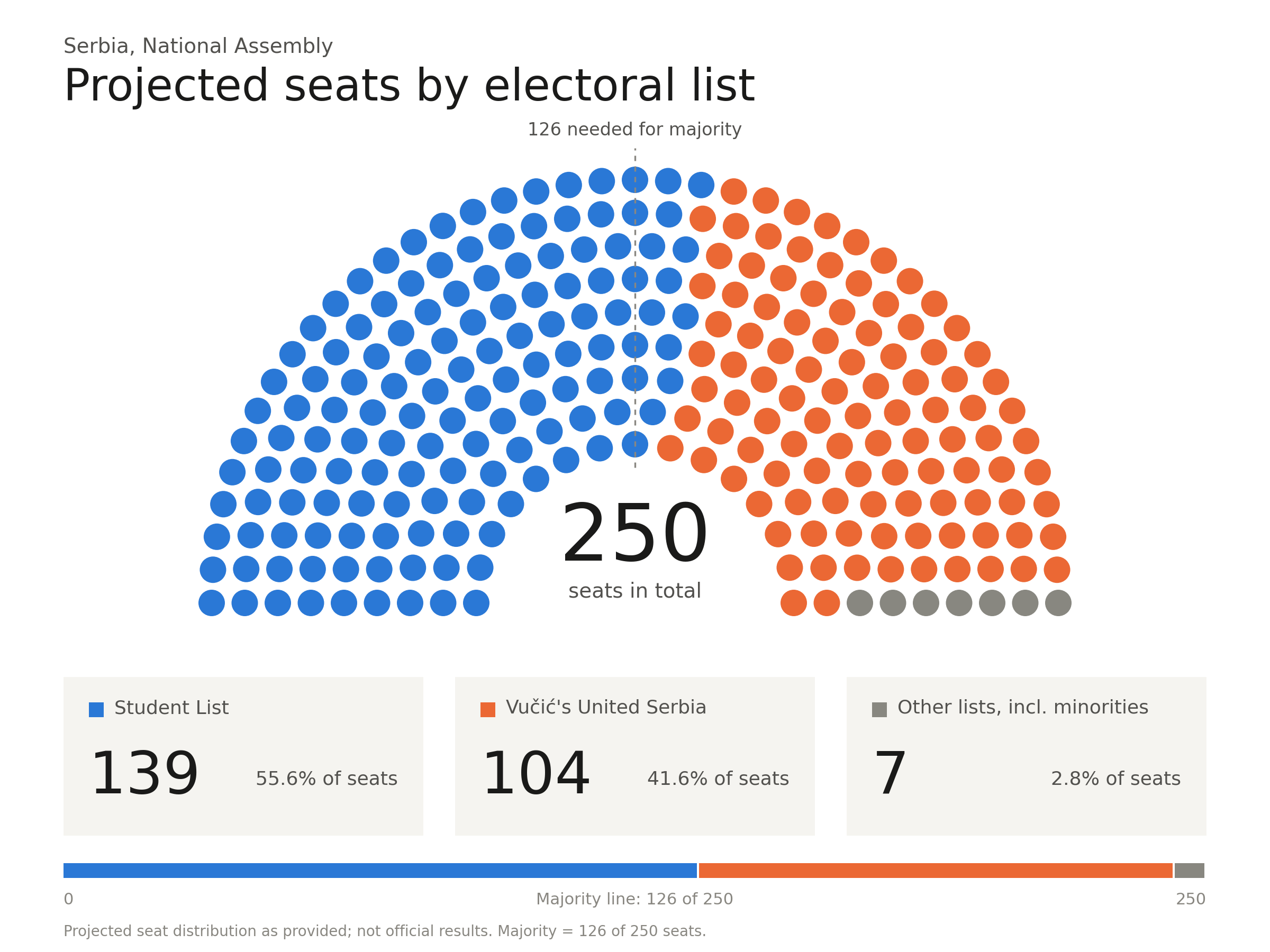
According to projections by polling agency Ipsos and election-monitoring organisation CeSID, the Student List is expected to win 139 seats in Serbia’s 250-member parliament.
Vučić’s United Serbia alliance is projected to secure 104 seats.
The projections would give the Student List a comfortable majority above the 126 seats required to control parliament.
The election-monitoring organisation CRTA separately estimated that the Student List had won 51.47% of the vote, compared with 40.42% for Vučić’s alliance.
Vučić offered a similar assessment, saying the student-backed list could secure between 135 and 140 seats, while his alliance would win approximately 105.
He estimated that the Student List had received around 2.2 million votes, compared with 1.72 million for his coalition.
These figures remain projections rather than final certified results.
Vučić accepts defeat and promises peaceful transition
Vučić said his political alliance would accept the election outcome and would not attempt to overturn it through legal challenges.
He indicated that his statement should be understood as an acknowledgement of the results.
The former president, who resigned in September to seek the premiership, said he would remain in Serbia and continue his political activities.
He also pledged that his party would not organise unrest following the election.
Vučić said the Student List should be able to form a new government relatively quickly if the projections were confirmed.
His remarks marked a significant change in Serbia’s political landscape, where the SNS has maintained a dominant position through successive parliamentary and presidential elections.
From a railway tragedy to political victory
The student movement emerged following the collapse of a concrete canopy at Novi Sad railway station in November 2024, which killed 16 people.
The disaster triggered widespread public anger over alleged corruption, negligence and a lack of institutional accountability.
Students organised university blockades, demonstrations and marches, gradually building a nationwide protest movement.
What began as demands for accountability over the railway station disaster developed into a broader campaign challenging the government’s political legitimacy.
The movement attracted support from university professors, civil society organisations and citizens dissatisfied with Serbia’s political institutions.
Its decision to contest parliamentary elections transformed the protest campaign into an electoral challenge to the SNS.
Sunday’s projected victory suggests that the movement succeeded in mobilising voters beyond its original student base.
Celebrations erupt across Serbia
News of Vučić’s concession triggered celebrations among Student List supporters in several Serbian cities.
In Belgrade, crowds gathered at Slavija Square and other central locations, chanting, dancing and waving flags.
Car horns sounded across parts of the capital, while fireworks illuminated the night sky.
Celebrations were also reported in Novi Sad and Niš.
Supporters gathered at the Student List’s headquarters as early projections indicated that the movement had secured a parliamentary majority.
The scenes contrasted sharply with the atmosphere at SNS headquarters, where Vučić addressed supporters and acknowledged the result.
Early official results differed from projections
Initial figures released by Serbia’s Republic Electoral Commission showed Vučić’s alliance ahead, but they were based on a limited number of polling stations.
With only 203 polling stations processed, the commission reported 54.21% for United Serbia and 36.85% for the Student List.
Those early figures differed substantially from the broader projections produced by Ipsos, CeSID and CRTA.
The discrepancy reflects the limited coverage of the initial official count and does not by itself establish which estimate will ultimately prove accurate.
Final parliamentary seat allocations will depend on the certified vote totals and the applicable electoral rules.
Vučić alleges foreign involvement
Despite accepting defeat, Vučić accused foreign political interests of supporting the student movement.
He claimed that certain European governments and political groups in the United States opposed to President Donald Trump had helped the movement.
He did not present evidence supporting those allegations.
Vučić also criticised non-governmental organisations and independent Serbian media outlets, including N1 and Nova S.
He singled out human rights activist Nataša Kandić, claiming that her political views had prevailed in the election.
He further suggested that a future government might introduce sanctions against Russia in 2027, although he provided no evidence of such plans.
The Student List’s actual foreign policy priorities will depend on its leadership, programme and decisions if it forms a government.
What happens next?
The Republic Electoral Commission must complete the vote-counting and certification process under Serbia’s electoral laws.
Once the results are confirmed, the newly elected parliament will convene and begin the process of forming a government.
If the Student List secures the projected 139 seats, it would have sufficient parliamentary support to elect a government without entering a coalition with another major party.
However, the movement would still need to agree on a prime minister, cabinet members and a governing programme.
The transition could also test the cohesion of a movement that brought together different political and social groups around demands for institutional reform.
Regional implications of Serbia’s political shift
A change of government in Belgrade could have significant consequences for the Western Balkans.
Serbia’s relations with Kosovo, Bosnia and Herzegovina, Montenegro and North Macedonia have been shaped in part by Vučić’s political leadership.
A new government would also face decisions concerning EU integration, relations with Russia and China, and Serbia’s position on sanctions against Moscow.
Vučić called on Bosnian Serb leader Milorad Dodik to cooperate with Serbia’s future leadership, while suggesting that policy towards Republika Srpska and Sarajevo could change.
He also claimed that his alliance had performed strongly among Serbian voters in neighbouring countries and Kosovo, although detailed official results were not available to substantiate that assertion.
For the European Union, a change in Belgrade could open a new phase in relations with Serbia, but any shift would depend on the priorities of the incoming government.
The Student List’s projected victory does not automatically establish how it will approach Kosovo, Russia or regional disputes.
The end of an era?
The election marks a potentially decisive turning point for Serbia.
For more than a decade, Vučić and the SNS dominated the country’s political institutions, while critics accused the authorities of undermining media independence, weakening democratic checks and using state resources for political advantage.
The government has repeatedly rejected accusations of systemic electoral manipulation and authoritarian practices.
The student movement challenged that dominance through sustained protests and ultimately through the ballot box.
Its projected parliamentary majority would give it the opportunity to translate demands for accountability and institutional reform into government policy.
But electoral victory would also bring responsibility for managing Serbia’s economy, foreign relations and deeply polarised political environment.
With Vučić acknowledging defeat and supporters celebrating across the country, Serbia appears poised for its first major transfer of power in 14 years.
The final confirmation now rests with the electoral authorities.