


More than 6.45 million Serbians are eligible to vote in a parliamentary election that could reshape the country’s political future. After nearly two years of student-led protests, the ruling party faces its most significant challenge in years, with concerns over electoral fairness and unusually high international scrutiny.
BELGRADE, Oct. 25 (BalkanView) – Serbians began voting on Sunday in a snap parliamentary election widely seen as a test of Aleksandar Vučić’s political dominance, as a student-led opposition movement seeks to turn nearly two years of anti-government protests into electoral victory.
Polling stations opened at 7 a.m. local time and are scheduled to close at 8 p.m., with approximately 6.45 million registered voters eligible to elect 250 members of parliament.
Eighteen electoral lists, fielding a combined 2,418 candidates, are competing in the election, the third parliamentary vote in Serbia in five years.
The contest takes place against a backdrop of deep political polarisation, allegations of institutional pressure and growing public dissatisfaction with corruption and government accountability.
Vučić, who resigned as president in September to run for prime minister, is seeking to extend his political influence through the ruling Serbian Progressive Party (SNS) and its coalition, “Aleksandar Vučić – United Serbia.”
His principal challenger is the student-backed electoral list, which emerged from the mass protests that followed the collapse of a railway station canopy in Novi Sad in November 2024, killing 16 people.
A referendum on Vučić’s rule
Although 18 lists are competing, the election has increasingly taken on the character of a referendum on Vučić’s political leadership.
The SNS has dominated Serbian politics for more than a decade, while the student movement has developed into a major political force by mobilising public anger over corruption, institutional accountability and democratic standards.
The protests began after the Novi Sad railway station disaster and expanded into a nationwide movement demanding political responsibility and institutional reform.
Students organised demonstrations, university blockades and marches across Serbia, drawing support from different sections of society.
Their decision to participate in parliamentary elections has transformed the movement from a protest campaign into a direct electoral challenge.
The outcome could determine whether the governing coalition retains control of parliament or faces a new political balance.
The numbers behind Serbia’s election
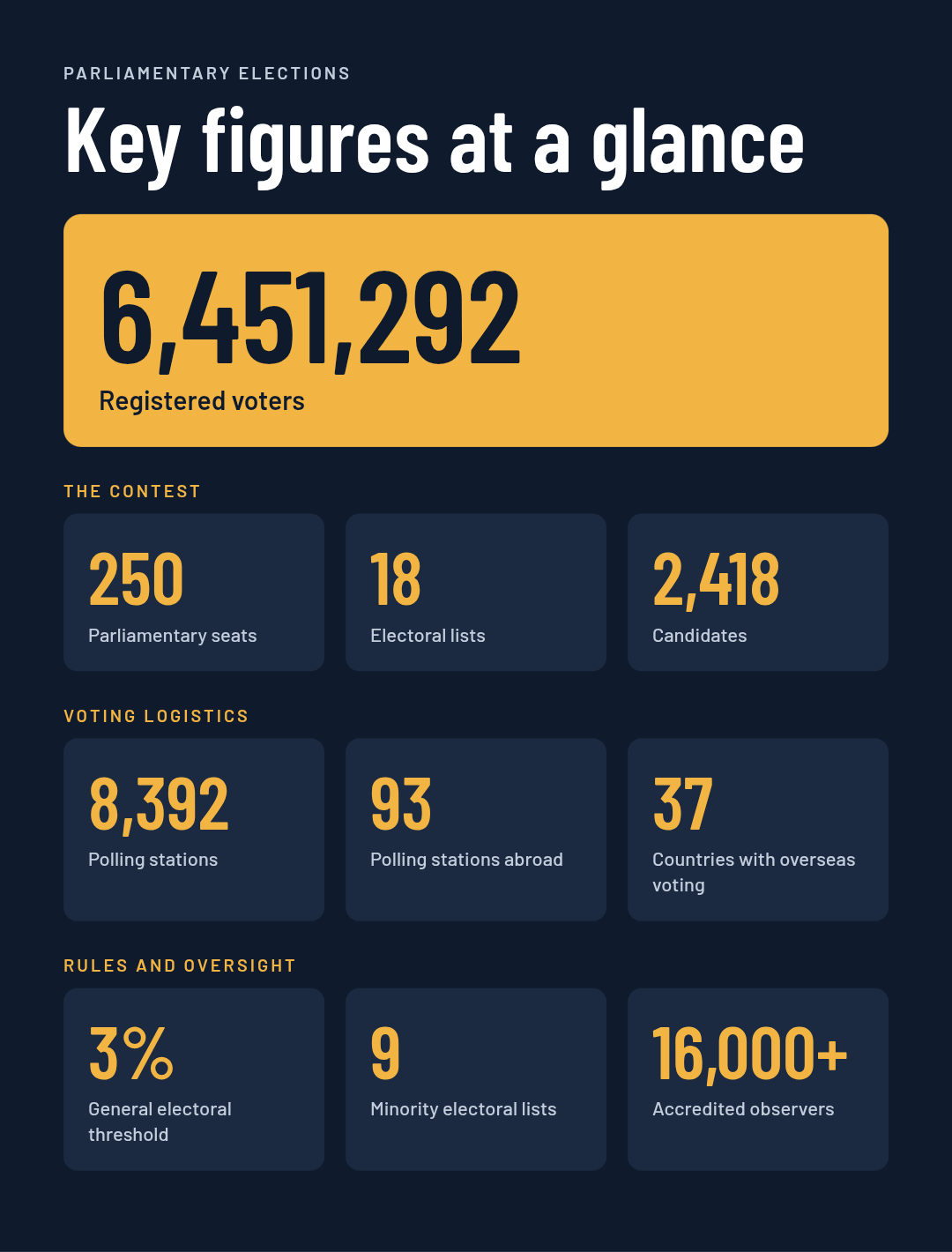
The general threshold for entering parliament is 3% of votes, while electoral lists representing national minorities benefit from special provisions.
| The election is being held at 8,392 polling stations, including 93 abroad and 29 in correctional institutions. |
|---|
Voting is scheduled to continue until 8 p.m., when the electoral silence period also ends.
Kosovo Serbs travel to central Serbia to vote
Voting arrangements for Serbian citizens living in Kosovo have again become a politically sensitive issue.
Serbian media reported that groups of Kosovo Serbs travelled by bus and private vehicles to central Serbia early on Sunday to cast their ballots.
Voters from northern Kosovo municipalities, including Leposavić, were among those reported to have made the journey.
Polling stations were not organised in their communities in Kosovo.
According to Radio Free Europe/Radio Liberty, more than 115,000 people on Serbia’s electoral register have addresses in Kosovo.
The voting arrangements reflect the unresolved political dispute between Belgrade and Pristina, with Serbia continuing to claim sovereignty over Kosovo despite its 2008 declaration of independence.
Electoral irregularities under scrutiny
Domestic and international election observers have raised concerns about the conditions surrounding the vote.
The Organisation for Security and Co-operation in Europe’s Office for Democratic Institutions and Human Rights (ODIHR) said in its preliminary assessment that the election was taking place amid prolonged political crisis and polarisation.
It also noted that some important recommendations from previous elections had not been implemented.
Serbian election-monitoring organisation CRTA said the campaign had been marked by restrictions on freedoms and widening inequalities between political competitors.
Media reported irregularities in the electoral register, including more than 500,000 voters whose addresses were not precisely recorded.
The Serbian authorities have defended the accuracy of the electoral register and rejected allegations of systemic electoral misconduct.
Previous parliamentary elections in December 2023 were also accompanied by allegations of voter pressure and irregularities, which the government disputed.
Observers are expected to pay particular attention to potential pressure on voters, the use of public resources and the administration of polling stations.
More than 16,000 observers monitor the vote
The election has attracted an unusually large monitoring presence.
According to Serbia’s Republic Electoral Commission, more than 16,000 domestic and international observers have been accredited.
Twenty-six domestic organisations are deploying more than 15,000 observers, while 57 foreign organisations and associations are sending more than 600.
ODIHR’s mission includes 14 experts based in Belgrade, 30 long-term observers deployed across Serbia and approximately 300 short-term observers monitoring election-day procedures.
Other international monitoring missions include representatives of the European Parliament, the Parliamentary Assembly of the Council of Europe and the OSCE Parliamentary Assembly.
Russia is also sending observers, including representatives of its parliament and Central Election Commission.
The extensive monitoring reflects concerns over the credibility of the electoral process and the importance of the result for Serbia’s democratic institutions.
Turnout could prove decisive
Voter participation is expected to be a crucial factor in the contest.
Turnout in Serbia’s December 2023 and April 2022 parliamentary elections was approximately 58%.
In 2020, when part of the opposition boycotted the vote, participation fell to around 49%.
The student-backed movement has sought to mobilise voters who are dissatisfied with the government, including younger citizens and people who previously abstained.
The ruling coalition, meanwhile, retains a substantial organisational network and has mobilised supporters through large campaign gatherings.
Both sides have presented the election as a defining moment for Serbia’s future.
However, the impact of turnout on the final result will depend on which groups participate and how their votes are distributed among competing lists.
When will the results be announced?
The first projections from election-monitoring organisations CRTA and CeSID are expected after 9 p.m. on Sunday.
The Republic Electoral Commission is required to establish preliminary results for processed polling stations within 24 hours of voting ending.
A consolidated report on the results is generally due within 96 hours of receiving all polling-station summary reports, although legal challenges could affect the timetable.
The final outcome will determine the distribution of 250 parliamentary seats and which political forces can form a government.
Why the election matters beyond Serbia
The result will have implications across the Western Balkans.
Serbia remains a central actor in regional politics, particularly regarding relations with Kosovo, Bosnia and Herzegovina and the European Union.
The next government will also face questions over Serbia’s foreign policy alignment, its relations with Russia and China, and the country’s EU accession process.
For Vučić’s coalition, victory would reinforce its claim to political legitimacy after nearly two years of protests.
For the student-backed movement, a strong result would demonstrate that sustained civic mobilisation can translate into electoral influence.
The election could also lead to a period of political uncertainty if the results are closely contested or their credibility is challenged.
As millions of voters head to polling stations, Serbia faces a choice between continuity under its long-dominant political leadership and a student-backed movement promising political change.