


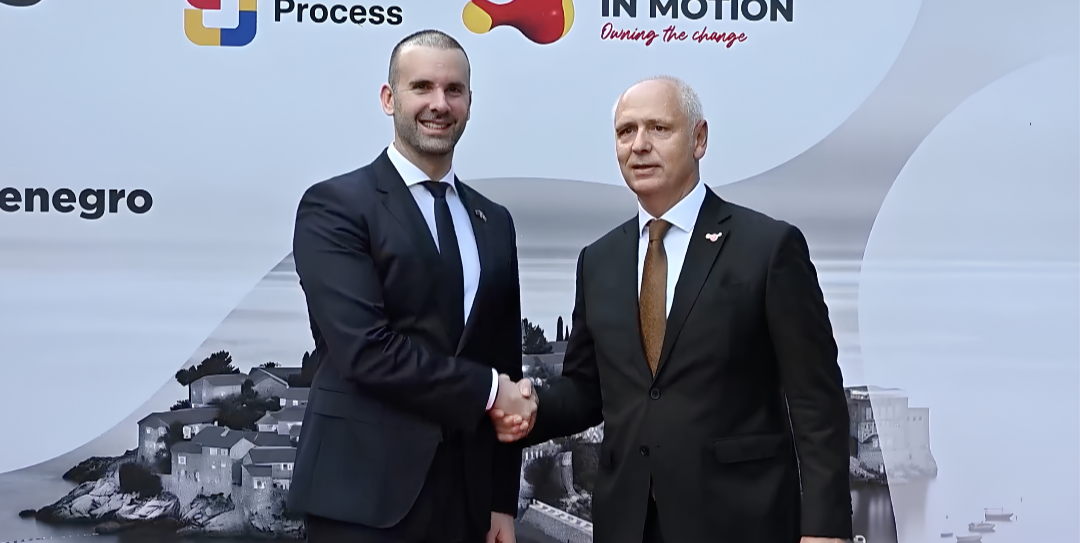
The Western Balkans are running out of excuses for delayed regional integration, the head of the Regional Cooperation Council warned at the Berlin Process Summit in Montenegro. Despite years of agreements, political obstacles continue to slow progress on trade, mobility and economic cooperation.
SVETI STEFAN, Montenegro, Oct. 22 — Western Balkan governments must accelerate regional integration and implement long-standing commitments if they want to take advantage of renewed momentum towards European Union membership, Regional Cooperation Council (RCC) Secretary General Amer Kapetanoviq said on Thursday.
Addressing regional and European leaders at the Berlin Process Summit in Sveti Stefan, Kapetanoviq warned that political hesitation and slow implementation were undermining progress towards a more integrated Western Balkans.
“The momentum of regional cooperation is not where it needs to be. Technical progress too often moves faster than political decisions, and decisions faster than implementation,” he said.
The summit, which concludes Montenegro’s 2026 chairmanship of the Berlin Process, brought together leaders from the six Western Balkan economies and European partners to assess progress on regional cooperation and set priorities for closer integration with the EU.
Kapetanoviq said the region needed renewed political determination to overcome barriers to cooperation, accelerate economic integration and promote reconciliation.
Too many promises, too little implementation
The RCC chief acknowledged progress under the Berlin Process, particularly the abolition of roaming charges within the Western Balkans and agreements facilitating regional mobility.
However, he said these achievements demonstrated what could be accomplished when political leaders maintained their commitments rather than allowing agreements to stall.
“Our credibility is being tested: we still promise more than we deliver,” Kapetanoviq said.
“We must finish what we promised on the free movement of people, goods and services across the region.”
His remarks highlighted a persistent challenge for the Western Balkans: translating political agreements into practical changes that citizens and businesses can experience.
Despite efforts to establish a Common Regional Market, barriers to trade, movement and economic cooperation continue to limit the region’s integration.
Three priorities for the next phase
Kapetanoviq outlined three priorities for regional governments and European partners ahead of the next Berlin Process Summit.
The first is to strengthen the Berlin Process as an instrument for accelerating EU enlargement, including through gradual integration into the European Single Market.
The second is to advance the Common Regional Market to attract investment, support businesses and generate employment.
The third is to accelerate implementation of existing commitments on the free movement of people, goods and services, while using practical cooperation to support reconciliation.
Kapetanoviq argued that these priorities should reinforce one another, with regional integration helping prepare the six economies for eventual EU membership.
He also linked the Western Balkans’ stability to Europe’s wider security interests.
A stable and interconnected region operating under European standards, he said, was an essential part of a secure and resilient Europe.
Regional AI roadmap endorsed
The summit also endorsed a regional Artificial Intelligence Roadmap developed by the RCC, marking a step towards closer cooperation on emerging technologies.
The roadmap had been welcomed at the eighth Western Balkans Digital Summit in Herceg Novi on Oct. 13-14.
That gathering identified digital identity, cybersecurity, stronger connectivity and more affordable roaming with the EU as priorities for regional cooperation.
The endorsement reflects efforts to align the Western Balkans’ digital transformation with European standards and reduce fragmentation between national systems.
For the six economies, closer cooperation on artificial intelligence and digital infrastructure could support public administration, businesses and cross-border services.
Industrial cooperation and green transition
The RCC also highlighted initiatives launched during Montenegro’s Berlin Process chairmanship.
On Sept. 30, the council facilitated the launch of the WB6–EU Industrial Parks Partnership in Budva.
The initiative connects seven industrial parks and business zones from the Western Balkans with six counterparts in the European Union.
It aims to strengthen industrial cooperation, encourage investment and integrate regional businesses more closely into European supply chains.
Earlier in September, the RCC organised the Third Ministerial Meeting on the Green Agenda for the Western Balkans in Žabljak.
Participants endorsed a 2026 ministerial declaration and regional initiatives covering climate adaptation, biodiversity protection, forest restoration and the reduction of plastic pollution.
These initiatives form part of broader efforts to implement the Common Regional Market Action Plan and the Green Agenda for the Western Balkans, building on commitments made at the 2025 Berlin Process Summit in London.
A test of political commitment
The Berlin Process was launched in 2014 to strengthen cooperation between the Western Balkans and European partners, with a particular focus on connectivity, economic development and regional integration.
More than a decade later, its achievements include regional mobility arrangements, roaming agreements and initiatives aimed at reducing economic barriers.
Yet implementation remains uneven, with political disagreements and administrative obstacles continuing to affect cooperation.
Kapetanoviq’s message in Sveti Stefan was that the next stage of regional integration would depend less on announcing new initiatives and more on completing those already agreed.
As Montenegro’s chairmanship concludes, the Western Balkans face growing pressure to demonstrate that regional cooperation can deliver tangible economic and social benefits.
For the RCC chief, the credibility of the process will increasingly be measured by results rather than declarations.