



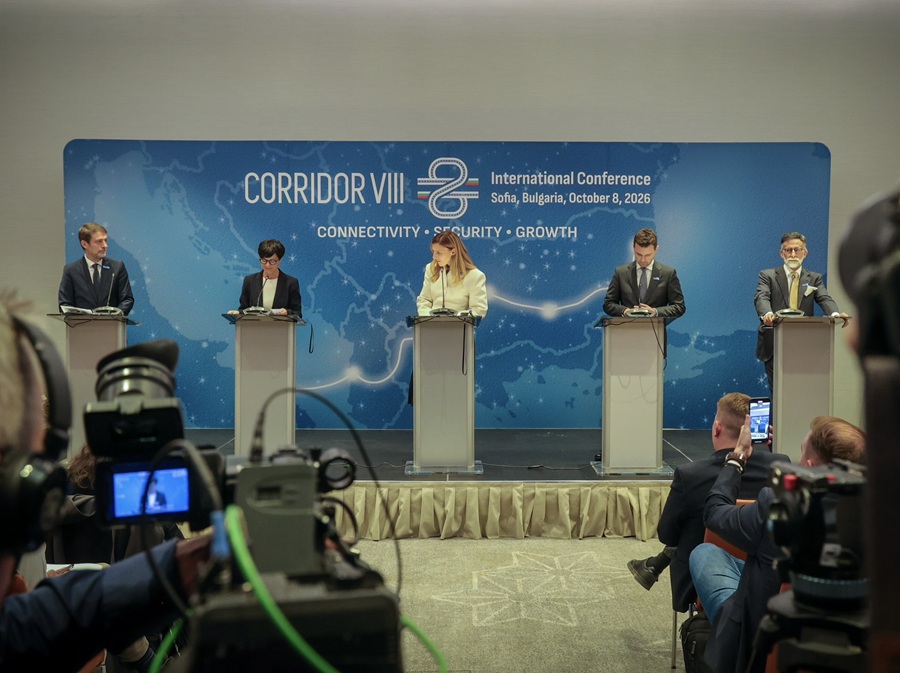
SOFIA, Oct 8 (BalkanView) — The European Union is backing transport infrastructure projects in North Macedonia and Albania with 319 million euros ($370 million) as European and Balkan officials seek to accelerate completion of Corridor VIII, a strategic transport route linking the Adriatic and Black seas.
Speaking at an international ministerial conference in Sofia on Thursday, EU Enlargement Commissioner Marta Kos said the corridor would improve regional connectivity, strengthen European security and help prepare the Western Balkans for future EU membership.
The meeting brought together senior officials from Bulgaria, North Macedonia, Albania, Italy and the European Commission, alongside diplomatic representatives from the United States, Britain, Ukraine, Romania and other European countries.
Once completed, Corridor VIII will connect Albania’s Adriatic ports with North Macedonia and Bulgaria’s Black Sea infrastructure through a network of roads and railways.
The project, discussed for decades but repeatedly delayed by infrastructure gaps and political disagreements, has gained new strategic significance since Russia’s full-scale invasion of Ukraine in 2022.
European governments increasingly view transport infrastructure as essential not only for economic development but also for military mobility, supply-chain resilience and collective defence.
Brussels puts €319 million behind connectivity
Kos said the European Union was supporting transport projects in North Macedonia and Albania with 319 million euros, linking the investment to the bloc’s broader enlargement strategy.
“That is exactly what we want Corridor VIII to do — connect the Adriatic and Black seas and bring benefits to people in Bulgaria, North Macedonia, Albania and beyond,” Kos said.
She described the project as part of the infrastructure needed for an enlarged European Union.
“We are already building the connections of tomorrow’s European Union. One day, these roads and railways will run through a united Europe without internal borders,” she said.
Kos said better transport connections would reduce travel times, lower business costs and strengthen economic links between EU members and candidate countries.
The commissioner also highlighted the corridor’s potential to become part of a broader transport network connecting Europe with Asia at a time when international trade routes face disruption.
The announced 319 million euros covers EU-supported projects in North Macedonia and Albania, rather than the entire cost of completing Corridor VIII.
NATO’s eastern and southern flanks
Security featured prominently in the Sofia discussions.
Bulgarian Foreign Minister Velislava Petrova said the war in Ukraine had fundamentally changed how governments assessed the strategic importance of infrastructure.
“Corridor VIII is primarily about connectivity, but today connectivity is much more than infrastructure,” Petrova said.
“It is not only about railways and roads, but about geopolitics, economic opportunities and security.”
She said secure transport routes, diversified supply chains, energy connections and resilient critical infrastructure had become elements of national and collective security.
The corridor provides an east-west connection across three NATO member states — Albania, North Macedonia and Bulgaria — and could facilitate the movement of military personnel, equipment and supplies between the Adriatic and Black Sea regions.
Bulgarian Transport Minister Georgi Peev said the European Commission, European Parliament and NATO were working to support the timely completion of the route.
“Our strategic geographical position makes Corridor VIII a key project not only for the transport network but also for security and military mobility in the region,” Peev said.
The security discussions came against the backdrop of reported drone attacks on commercial vessels in the Black Sea, which European officials condemned as a threat to maritime security and international trade.
The missing railway between Bulgaria and North Macedonia
One of the most important unfinished sections is the railway connection between Bulgaria and North Macedonia.
The two countries signed an agreement in November 2025 to construct a cross-border railway tunnel, with the agreement entering into force in March 2026.
North Macedonian Foreign Minister Timcho Mucunski said the project was now entering a stage in which political commitments needed to produce tangible construction results.
“Corridor VIII is not simply about roads and railways. It is about resilience, security and Europe’s strategic connectivity,” Mucunski said.
“Now is the opportunity to turn this political commitment into concrete results on the ground.”
He stressed that every participating country needed to complete its section of the route.
“Every part of the corridor matters, and every partner must deliver its part,” he said.
Bulgaria is implementing railway upgrades along the Sofia-Pernik-Radomir-Gyueshevo route as part of the EU’s Trans-European Transport Network, known as TEN-T.
Peev said financing had already been secured and a contract signed for the section from Gyueshevo to the entrance of the planned cross-border tunnel.
Approximately 2.4 kilometres of railway remain to be constructed on Bulgarian territory between Gyueshevo and the border.
The Bulgarian government is also exploring public-private partnership options for the proposed Rila motorway, which would improve road access to the Gyueshevo border crossing.
Officials said project timelines were being aligned with the EU’s next long-term budget for 2028-2034.
Albania seeks faster progress
Albanian Foreign Minister Ferit Hoxha said Corridor VIII had three central dimensions: economic development, European integration and security.
He pointed to the construction of the Tirana-Durrës-Mother Teresa Airport railway as an example of Albania’s efforts to modernise transport infrastructure.
“Delays cost us competitiveness, investment and trust,” Hoxha said.
“A secure European corridor connecting countries in the region and NATO allies strengthens Europe’s security.”
He described the corridor’s evolution from a longstanding infrastructure ambition into a concrete political commitment.
“Corridor VIII was once a dream drawn on paper. Today it is a commitment,” he said.
For Albania, the project could strengthen the role of Adriatic ports as gateways for trade moving between Italy, the Western Balkans and southeastern Europe.
Italy backs the route across the Adriatic
Italy reaffirmed its support for the project, citing its economic and strategic interests in stronger connections across the Adriatic.
Nicola Verola, director-general for European affairs at the Italian Foreign Ministry, said Rome viewed Corridor VIII as important for investment, regional integration and security.
“Italy is part of this corridor and stands firmly behind the project,” Verola said.
He argued that improved transport links could strengthen the Adriatic region’s position in international trade while encouraging closer cooperation among neighbouring countries.
“Connectivity is, I would say, an engine of integration,” he said.
Italy’s participation gives the corridor a broader European dimension, connecting the Western Balkans with transport and commercial networks across the Adriatic.
Bulgaria proposes wider Europe-Asia links
Bulgarian Foreign Minister Petrova also announced plans for a regional connectivity summit in spring 2027, to be jointly hosted by Bulgaria and the European Commission.
The summit will examine links between Corridor VIII and the Middle Corridor, a trade route connecting Europe with Central Asia through the Caucasus and the Caspian Sea.
The initiative aims to explore opportunities to triple trade flows by 2030.
Officials said stronger connections between the two routes could offer businesses additional transport options amid disruption to established international supply chains.
The proposal reflects a wider European effort to develop alternative commercial routes and reduce dependence on vulnerable transport corridors.
From political disputes to infrastructure delivery
Corridor VIII has long faced delays caused by financing gaps, difficult terrain and disagreements between participating countries.
The missing Bulgaria-North Macedonia railway connection remains a particularly important obstacle to establishing a continuous rail route.
The Sofia conference signalled renewed political determination to overcome those barriers.
For North Macedonia, the project is especially significant because its territory forms the central section of the route, connecting Albania’s Adriatic infrastructure with Bulgaria’s Black Sea network.
Completion could strengthen the country’s position as a regional transport and logistics hub while improving access to European markets.
But the political commitments announced in Sofia will still depend on construction progress, financing, cross-border coordination and the completion of unfinished infrastructure.
Mucunski announced that Skopje would host the next ministerial meeting on Corridor VIII.
For European officials, the message from Sofia was that the corridor has moved beyond a conventional infrastructure project.
It is now being promoted as a strategic investment in the Western Balkans’ economic integration, NATO mobility and the security architecture of an enlarged Europe.