


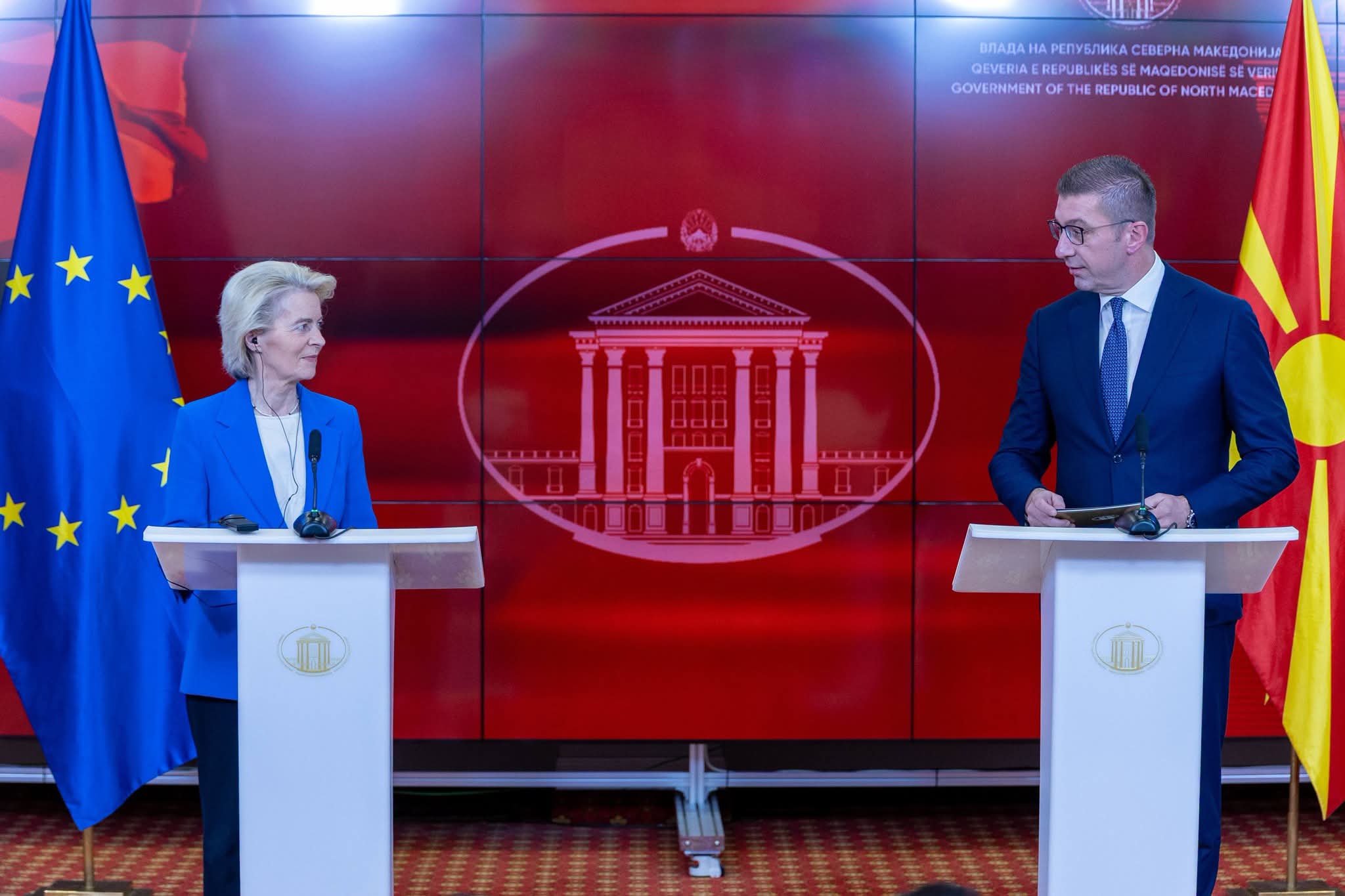
Ursula von der Leyen’s declaration in Skopje that North Macedonia would join the EU with its identity and language has triggered a new political confrontation in Athens, with former Greek prime minister Antonis Samaras accusing Kyriakos Mitsotakis’ government of remaining silent as the consequences of the Prespa Agreement unfold.
ATHENS, Oct 3 (BalkanView) — Former Greek Prime Minister Antonis Samaras attacked the government of Kyriakos Mitsotakis on Saturday over its handling of North Macedonia, after European Commission President Ursula von der Leyen publicly backed the country’s identity, language and culture during a visit to Skopje.
Samaras, a longstanding critic of the 2018 Prespa Agreement, said von der Leyen’s remarks showed that the situation had gone beyond what he described as the original failures of the deal that ended the decades-long dispute between Athens and Skopje.
“The situation has become much worse than the fiasco of the Prespa accord, and we are watching silently,” Samaras said in a video statement.
His intervention prompted a swift response from the Greek government, which said North Macedonia’s path towards the European Union depended on respecting agreements already reached with Greece.
The clash brings North Macedonia back into Greece’s domestic political debate at a particularly sensitive moment for Skopje, which is trying to unblock its EU accession process following von der Leyen’s visit on Friday.
Von der Leyen’s words trigger debate in Athens
Speaking alongside North Macedonian Prime Minister Hristijan Mickoski in Skopje, von der Leyen said the country belonged at the European table and explicitly addressed concerns over identity and language.
She said the EU would welcome North Macedonia with its identity and language, adding that Macedonian culture and language could enrich the Union.
Those remarks became the focus of Samaras’ criticism.
The former prime minister has consistently opposed the Prespa Agreement, signed in 2018 by the government of then-Prime Minister Alexis Tsipras and subsequently ratified by the Greek parliament.
Under the agreement, the neighbouring country changed its constitutional name to North Macedonia, allowing Greece to lift its objections to its NATO membership and clearing one of the main obstacles on its Euro-Atlantic path.
Samaras has argued that the agreement made unacceptable concessions on questions connected to language and identity.
His latest intervention therefore turns von der Leyen’s remarks in Skopje into another front in a much broader political dispute over how Greece should manage relations with its northern neighbour.
Mitsotakis government responds: EU path passes through Greece
The Greek government rejected Samaras’ criticism.
Government spokesman Pavlos Marinakis said Athens would continue defending what it regards as Greece’s national interests and insisted that North Macedonia must strictly respect agreements already reached.
“North Macedonia’s path to Europe passes through Greece and requires strict respect for what has been agreed,” Marinakis said.
Marinakis also shifted responsibility for the Prespa Agreement towards Tsipras and the lawmakers who supported it.
Mitsotakis opposed the agreement while he was opposition leader but also warned at the time that once ratified it could not simply be cancelled unilaterally.
The exchange illustrates a continuing fault line in Greek politics: disagreement over the Prespa deal persists even though the agreement itself remains the framework governing relations between Athens and Skopje.
Bulgaria adds another layer
Samaras’ criticism was not limited to North Macedonia.
He also attacked an agreement between Greece and Bulgaria under which Athens returned remains identified as those of medieval ruler Czar Samuel, while Bulgaria returned 48 religious artefacts removed from Greek monasteries during World War One.
Samaras argued that Greece had received too little in return and said that, when he was prime minister, he had sought the return of all religious objects removed from northern Greece.
The Greek government pushed back on that criticism as well. Greek government-linked reporting pointed to the position of the Holy Synod, which welcomed the return of the 48 religious relics and expressed hope that the agreement could lead to the return of more church treasures.
The coincidence is politically significant because North Macedonia’s EU dispute is currently centred on Bulgaria.
Von der Leyen travelled to Skopje on Friday seeking to help restart dialogue between North Macedonia and Bulgaria, with a possible bilateral meeting expected in Sofia next week.
Athens re-enters the North Macedonia debate
For Skopje, the Greek reaction introduces another dimension into an already complicated accession process.
North Macedonia currently faces an immediate EU requirement to amend its constitution to include Bulgarians and several other communities before it can move forward with opening the Fundamentals cluster.
Von der Leyen reiterated that requirement in Skopje, describing it as the key step North Macedonia still needed to take.
At the same time, however, her explicit references to Macedonian identity, language and culture were intended to address some of the most politically sensitive concerns surrounding the accession process.
The result was a striking contrast.
In Skopje, von der Leyen’s message sought to combine reassurance over identity with pressure to fulfil the constitutional requirement.
In Athens, the identity component of that message immediately revived a dispute that Greece formally settled with North Macedonia eight years ago.
And the Mitsotakis government’s response made clear that Athens still considers itself an important actor in its neighbour’s European trajectory.
For North Macedonia, therefore, the latest controversy is a reminder that even as the immediate accession dispute has shifted from Athens to Sofia, the legacy of the Prespa Agreement remains politically alive in Greece.