


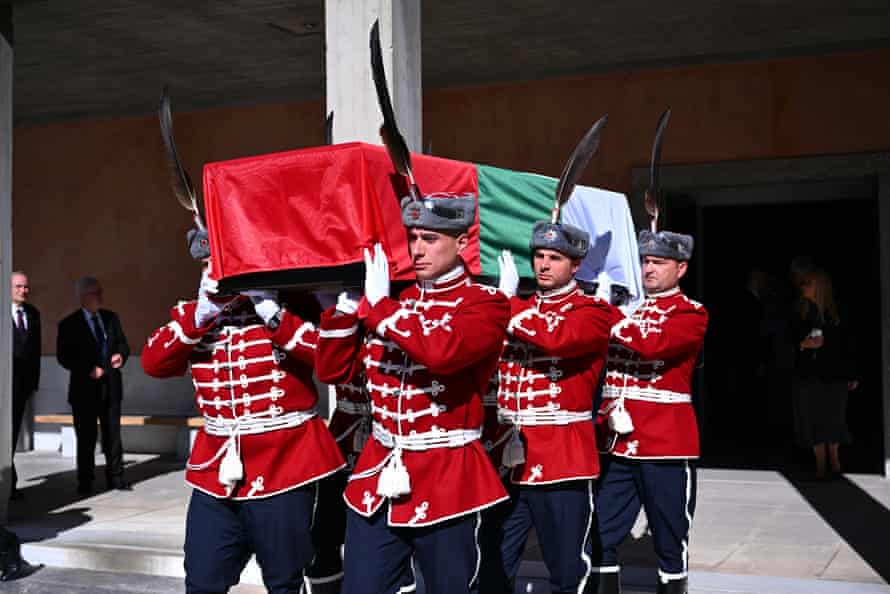
Greece has returned to Bulgaria remains identified as those of Tsar Samuel, while Sofia has sent back 48 religious treasures removed from northern Greece during World War One. The exchange closes a negotiation stretching back roughly half a century — and turns one of the Balkans’ most contested medieval figures into an unlikely symbol of reconciliation.
THESSALONIKI/SOFIA, Oct 3 (BalkanView) — Greece and Bulgaria exchanged medieval remains and religious treasures on Saturday in a landmark cultural agreement that their leaders portrayed as evidence that even some of the Balkans’ most sensitive historical disputes can be resolved through diplomacy.
At a ceremony at Thessaloniki’s Museum of Byzantine Culture, Greece handed Bulgaria remains identified as those of Tsar Samuel, the medieval ruler whose empire fought a prolonged struggle against Byzantium more than 1,000 years ago.
Bulgaria, in return, handed Greece 48 religious and historical objects removed from churches and monasteries in northern Greece during World War One.
The exchange followed negotiations dating back about half a century and was attended by Greek Prime Minister Kyriakos Mitsotakis and Bulgarian Prime Minister Rumen Radev.
The symbolism was unmistakable.
Samuel has long occupied an important place in competing interpretations of Balkan medieval history. Bulgaria regards him as one of its great medieval rulers, and Sofia organised an elaborate state ceremony for the return of the remains.
But on Saturday, the emphasis from both governments was not on reopening historical disputes.
It was on reconciliation.
“If in the past Tsar Samuel divided us, I can say that today he unites us,” Radev said.
A journey from Prespa to Sofia
The remains associated with Samuel were discovered in 1964 by Greek archaeologist Nikolaos Moutsopoulos at the Basilica of St Achillios on an island in Lake Prespa in northern Greece.
Greece preserved the remains for decades.
Under the agreement, Athens transferred to Bulgaria not only the remains identified as Samuel’s but also anthropological material discovered in four sarcophagi at the basilica. Bulgarian authorities have said some of the other remains are believed to belong to Samuel’s son and successor Gavril Radomir and other members of the royal family.
After the Thessaloniki ceremony, Bulgaria gave the remains a state homecoming.
A Bulgarian military transport aircraft carried them to Sofia and was escorted after entering Bulgarian airspace by MiG-29 and F-16 fighter jets.
The ceremony in the capital included military honours and a 21-gun salute, followed by a procession to the Church of St Sophia, where members of the public were given an opportunity to pay their respects.
The scale of the ceremony illustrated Samuel’s significance in Bulgaria’s national historical narrative.
Greece gets back treasures taken in 1917
For Greece, the agreement brought home 48 objects of religious, cultural and emotional importance.
They include icons, crosses, vestments, reliquaries and an episcopal throne removed in 1917 from the Metropolis of Serres and Nigrita and the monasteries of Timios Prodromos and Panagia Eikosifoinissa during World War One.
The objects had subsequently been preserved in Bulgaria.
They will initially be displayed at the Museum of Byzantine Culture in Thessaloniki until Nov. 5 before being returned to the monasteries and religious institutions from which they originated.
Mitsotakis said the agreement demonstrated what neighbouring countries could accomplish when they moved beyond what he described as the maximalist approaches of the past.
The negotiations themselves illustrate the difficulty.
According to the Greek government, discussions over the issue began as far back as the 1970s between Greek Prime Minister Konstantinos Karamanlis and Bulgarian communist leader Todor Zhivkov.
It took around half a century for an agreement to emerge.
From contested history to cultural diplomacy
That long history gives Saturday’s exchange significance beyond the objects themselves.
Historical identity, medieval rulers, language, religion and competing interpretations of the past have repeatedly shaped political disputes across the Balkans.
Greece and Bulgaria are now both members of the European Union and NATO, but their histories include periods of war, territorial competition and competing national narratives.
Radev said their shared EU membership had helped each country better understand the historical sensitivities of the other.
Mitsotakis similarly presented the exchange as evidence that difficult episodes from the past could be transformed into “bridges” towards a common future.
The two governments also indicated that Saturday’s agreement may not be the end of the process.
Mitsotakis said the bilateral channel was now opening further and expressed hope that additional objects of importance to both countries could eventually be returned.
Mitsotakis turns to the Parthenon
The Greek prime minister also used the ceremony to connect the agreement with Athens’ much larger international campaign: the return of the Parthenon sculptures from Britain.
Mitsotakis argued that changing international attitudes towards cultural heritage strengthened Greece’s case for reunifying the sculptures currently divided between Athens and the British Museum.
He said cultural objects should not be treated as spoils of war and argued that the integrity of monuments should guide decisions over their location.
For Mitsotakis, the Greek-Bulgarian agreement demonstrated what could be achieved through political will after decades of disagreement.
But he also reiterated a longstanding Greek red line: Athens would not accept an arrangement that required Greece to recognise foreign ownership of the Parthenon sculptures or formally “borrow” what it considers its own cultural heritage.
Samuel becomes a symbol of reconciliation
The most striking symbolism, however, may lie with Samuel himself.
The ruler died in 1014 after decades of warfare between his state and the Byzantine Empire.
More than a millennium later, remains attributed to him have travelled from the Prespa region through Thessaloniki to Sofia — not as the result of another Balkan confrontation, but through an agreement between two neighbouring governments.
Bulgaria welcomed him with fighter jets, military honours and artillery salutes.
Greece welcomed home religious treasures absent for more than a century.
And after approximately 50 years of negotiations, both governments chose to present the exchange not as a victory by one side over another, but as an example of what can happen when historical disputes move from nationalist competition to diplomacy.
As Radev put it, Samuel, a ruler whose legacy once divided the neighbours, was now being used to bring them closer.