


North Macedonia and Bulgaria are heading for a new round of direct talks after Ursula von der Leyen intervened to restart dialogue over Skopje’s stalled EU bid. But behind the diplomatic opening lies an unchanged reality: Brussels still expects North Macedonia to amend its constitution before accession negotiations can move forward.
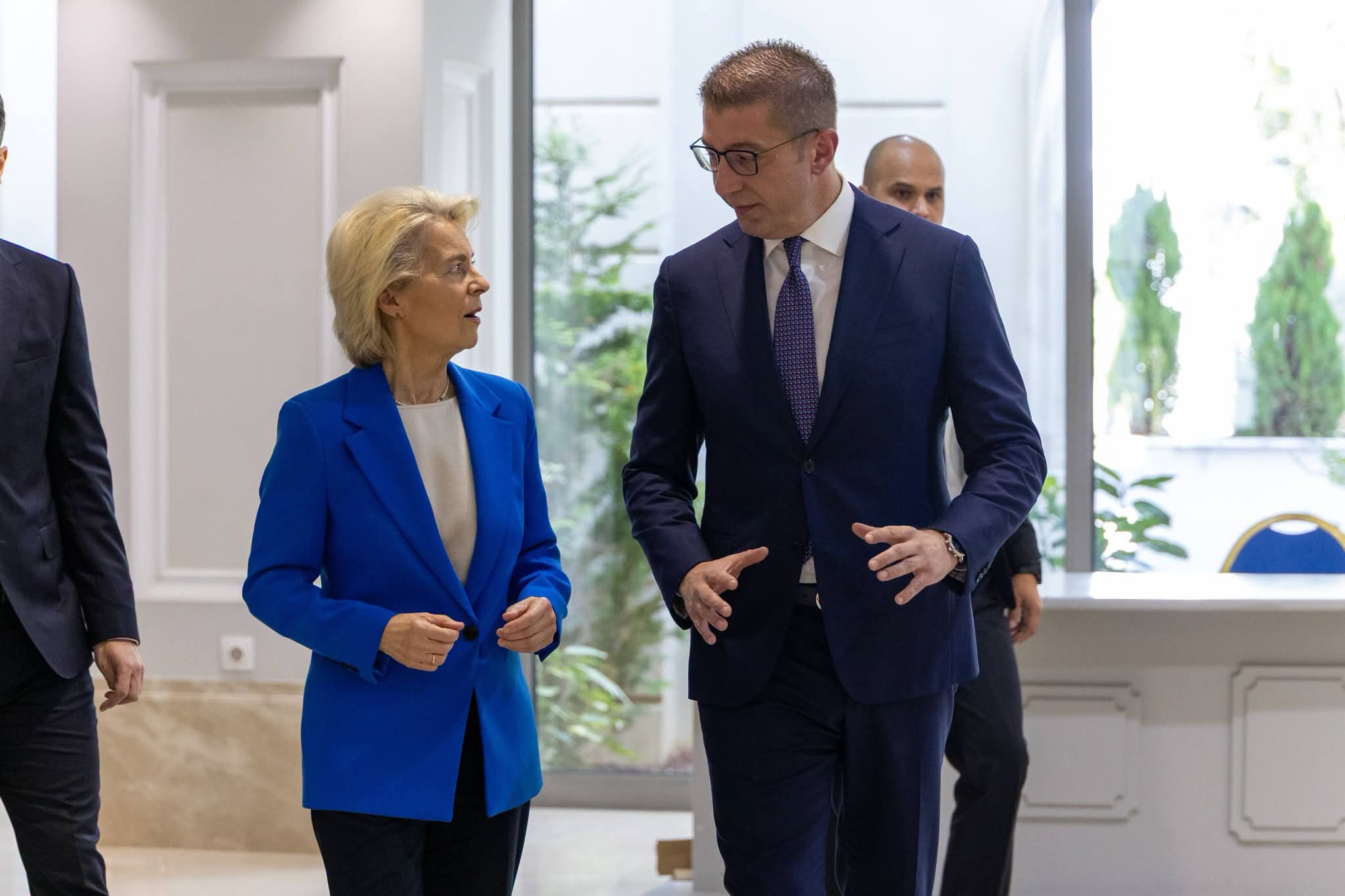
SKOPJE/SOFIA, Oct 2 (BalkanView) — North Macedonia will seek direct talks with Bulgaria next week in the first concrete attempt to break a prolonged deadlock over its European Union accession, following discussions in Skopje between Prime Minister Hristijan Mickoski and European Commission President Ursula von der Leyen.
Foreign Minister Timcho Mucunski is expected to request a meeting with his Bulgarian counterpart during a visit to Sofia connected to Corridor VIII, after von der Leyen suggested that the two sides resume direct dialogue.
Mickoski said he immediately instructed Mucunski to send a diplomatic note requesting the meeting.
Von der Leyen described the planned contact as a “first new step” towards turning the current stalemate back into an active political process.
“We agreed to have the first new step next week and to try to unblock the process, actually turn it into a process,” she said.
The move introduces a new diplomatic dynamic into a dispute that has effectively separated North Macedonia from Albania on their EU paths.
But it does not change the formal EU conditions facing Skopje.
Brussels offers dialogue — not a new negotiating framework
Von der Leyen made clear in Skopje that constitutional amendments remain the immediate requirement for North Macedonia to advance.
The changes would add Bulgarians and several other communities to the country’s constitution, in accordance with commitments linked to the EU negotiating framework agreed in 2022.
“There is only one key step that you need to take now to be able to move forward and open the first cluster, Fundamentals,” von der Leyen said.
That position is consistent with European Commission documents. The Commission has repeatedly said North Macedonia needs to adopt the constitutional changes envisaged in the 2022 EU Council conclusions before the accession process can advance.
The significance of von der Leyen’s intervention therefore lies less in changing the conditions than in attempting to create a political process capable of getting Skopje and Sofia talking again.
Mickoski wants stronger EU involvement
Mickoski has argued that North Macedonia needs greater political certainty before making decisions with long-term consequences.
He said Skopje was not asking Brussels to take its side against Bulgaria, but wanted the EU to help create conditions for a sustainable solution in which obligations are clear and the accession process cannot repeatedly be reopened through new bilateral demands.
“If decisions with long-term consequences are expected from us, then it is justified for us to expect a clear European perspective for what follows,” Mickoski said.
His government has increasingly sought stronger EU involvement in the dispute. Macedonian officials have previously floated the possibility of European representatives being present in talks with Bulgaria, while Mickoski has also mentioned NATO involvement.
Sofia has resisted suggestions that another mediator is necessary, arguing that the issue has already been incorporated into the EU accession framework.
Bulgaria: The obligations are already clear
The diplomatic opening comes as Bulgarian politicians continue to signal little appetite for renegotiating the existing framework.
Bulgarian MEP Kristian Vigenin said Sofia should make no further concessions and argued that North Macedonia’s commitments were not bilateral obligations to Bulgaria but obligations undertaken within the EU accession process.
“I expect American pressure on North Macedonia to fulfil its commitments, because that is the only way to accelerate its accession to the EU,” Vigenin told Bulgarian television.
He said he did not expect external pressure to fundamentally alter Bulgaria’s position.
That exposes the central difference between the narratives in Skopje and Sofia.
The Macedonian government increasingly presents the dispute as a problem requiring additional European political engagement and guarantees against future bilateral conditions.
Bulgaria argues that the political compromise has already been reached and incorporated into the EU framework, meaning the next move belongs to North Macedonia.
Nikoloski: Bulgaria is the only obstacle
That divide was illustrated again on Thursday when North Macedonia’s Deputy Prime Minister and Transport Minister Aleksandar Nikoloski told a discussion in Brussels that Bulgaria was the sole reason the country was not progressing towards EU membership.
“Unfortunately, the only reason we are not moving forward is the veto by Bulgaria,” Nikoloski said.
He argued that North Macedonia had maintained political, economic and inter-ethnic stability, aligned itself with the EU’s Common Foreign and Security Policy and delivered economic and reform results.
Sofia rejects the characterization that the current impasse is simply a Bulgarian veto, pointing instead to the commitments incorporated into the EU negotiating framework.
The European Commission’s position sits differently from both political narratives: it continues to support North Macedonia’s membership perspective while explicitly calling for the constitutional amendments agreed under the existing process.
Identity enters the debate again
Von der Leyen also addressed one of the most politically sensitive elements of the dispute: Macedonian identity and language.
She said North Macedonia would enter the European Union with its identity and language intact and argued that Macedonian culture and language would enrich the bloc.
Her remarks appear designed to address fears in North Macedonia that concessions made during the accession process could affect questions of national identity.
At the same time, she praised North Macedonia’s previous strategic decisions, including the Prespa Agreement, its contribution to European security and its support for Ukraine.
The prize: a roadmap towards membership
Perhaps the most consequential part of von der Leyen’s message concerned what could happen after the stalemate is overcome.
North Macedonia has watched other candidates move towards increasingly defined accession timelines while its own process remains blocked.
Von der Leyen indicated that Brussels could move quickly to provide North Macedonia with a clearer roadmap once the political blockage is removed.
“The moment we unblock the situation here, my personal view is that we can be very fast with North Macedonia,” she said.
Her visit was part of a Western Balkans tour focused on accession and gradual integration, backed by the EU’s 6-billion-euro Growth Plan for the region.
That gradual integration is intended to allow Western Balkan countries to gain some benefits of membership before formally joining, including closer participation in the Single Market, infrastructure connections and access to European programmes.
Sofia becomes the next test
The immediate focus now shifts from Skopje to Sofia.
Mucunski’s expected visit next week will provide the first indication of whether von der Leyen’s intervention can produce substantive dialogue rather than another exchange of established positions.
A meeting would not by itself resolve the dispute.
Nor does von der Leyen’s intervention remove the constitutional amendments from the accession process.
Instead, it creates two parallel tracks: Brussels is encouraging renewed political dialogue with Bulgaria while continuing to tell Skopje that the formal requirement for opening the Fundamentals cluster remains unchanged.
That leaves the central question unresolved: can renewed diplomacy produce enough political certainty for North Macedonia to make the constitutional changes — without reopening the broader deal that Bulgaria says is already settled?