


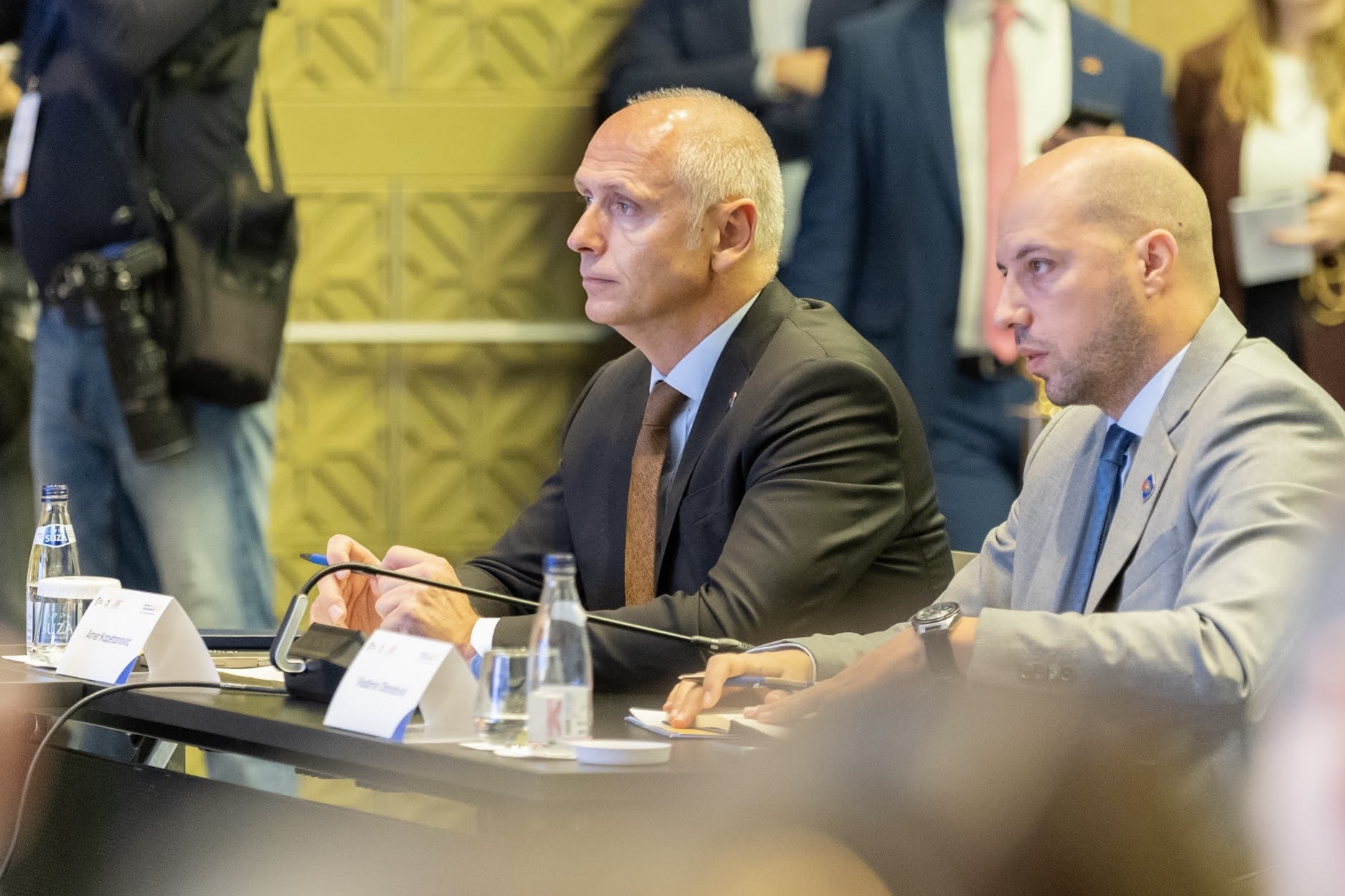
Europe can no longer treat the Western Balkans as a security periphery, RCC chief Amer Kapetanović said at a Berlin Process meeting in Montenegro, warning that cyberattacks, hybrid threats and disinformation increasingly cross borders while the region’s economic gap with the EU remains a vulnerability.
PRŽNO, Montenegro, Oct 1 (BalkanView) — A more resilient Western Balkans would directly strengthen European security, the head of the Regional Cooperation Council said on Thursday, urging deeper regional cooperation as European governments seek to accelerate the region’s integration with the European Union.
RCC Secretary General Amer Kapetanović told foreign ministers gathered in Montenegro under the Berlin Process that security, economic convergence and opportunities for young people should be treated as interconnected challenges rather than separate policy areas.
“Regional cooperation is not a waiting room for European integration, and it is not a substitute for it either,” Kapetanović said. “It is the practical means of making this region, and by extension Europe, more resilient, more connected and more secure.”
The meeting brought together foreign ministers from the six Western Balkan economies with EU Enlargement Commissioner Marta Kos and ministers from several EU member states, including Germany, Croatia, Slovenia and Austria.
Their discussions focused on EU integration, regional relations, security and resilience and implementation of the EU Growth Plan for the Western Balkans.
The talks come as European governments increasingly frame enlargement not only as an economic and political project but also as a security issue amid geopolitical competition, cyber threats, disinformation and Russia’s war against Ukraine.
From EU waiting room to security partner
Kapetanović said the Western Balkans should be viewed as a functioning part of Europe’s security architecture rather than an area on its margins.
“A more resilient Western Balkans is not a favour to Europe’s security. It is a direct contribution to it,” he said.
During discussions on European security, Kapetanović highlighted cyberattacks, hybrid threats and disinformation as challenges that individual countries cannot effectively confront alone.
The RCC said its work on regional security governance had identified more than 350 institutional needs and compared them with assistance already being provided.
A new Security Governance Hub is expected to become fully operational in January 2027, with the aim of better matching the region’s security needs with European and international assistance.
The security message echoed a broader shift in the debate surrounding EU enlargement.
German Foreign Minister Johann Wadephul, who attended the meeting, has described Western Balkan enlargement as a test of Europe’s geopolitical influence and argued that closer integration of the region is in the EU’s strategic interest.
Economic gap remains part of the problem
Kapetanović also linked security and political stability to the speed at which Western Balkan economies converge with the EU.
The Common Regional Market, coordinated by the RCC, is intended to reduce economic barriers among Albania, Bosnia and Herzegovina, Kosovo, Montenegro, North Macedonia and Serbia while gradually bringing their economies closer to the EU Single Market.
Measures implemented under regional cooperation have included lower roaming charges, easier movement across borders, recognition of professional and academic qualifications and efforts to deepen investment and digital integration.
Kapetanović said faster economic convergence was needed to make the prospect of EU membership visible in people’s everyday lives.
Investment in skills, technology and human capital was particularly important for younger generations, he said, as Western Balkan countries continue to grapple with emigration and the loss of skilled workers.
The argument is that EU integration will be difficult to sustain politically if citizens experience it mainly as a distant diplomatic process rather than through jobs, mobility, investment and higher living standards.
Berlin Process faces delivery test
Thursday’s foreign ministers’ meeting followed talks among economy ministers in Cetinje a day earlier.
At that meeting, Kapetanović urged governments to accelerate implementation of commitments under the Common Regional Market Action Plan for 2025-2028, describing implementation as a test of the Berlin Process’s credibility.
The Berlin Process was launched by Germany in 2014 to strengthen cooperation among the Western Balkan countries and support their integration into the European Union.
More than a decade later, all six Western Balkan partners remain outside the bloc, although they are at different stages of the accession process.
That has increasingly shifted attention from new regional declarations towards whether governments actually implement agreements already reached.
One initiative unveiled this week illustrates the attempt to move towards more tangible economic cooperation.
Seven industrial parks and business zones from the Western Balkans signed memoranda with six partner organisations from the European Union, launching a WB6-EU Industrial Parks Partnership facilitated by the RCC.
The initiative is intended to connect Western Balkan companies more closely with European value chains, promote investment and expertise exchanges, develop skills and innovation and encourage a gradual transition towards eco-industrial parks.
October summit approaches
The ministerial meetings are part of a wider programme organised under Montenegro’s 2026 presidency of the Berlin Process.
The process will culminate with a leaders’ summit at Sveti Stefan on Oct. 22, bringing together Western Balkan leaders, EU representatives and governments participating in the Berlin Process.
The summit is expected to assess progress on regional economic integration and other commitments accumulated during Montenegro’s presidency.
For the RCC, however, the broader argument emerging from the meetings is that the importance of regional cooperation now extends beyond preparing countries for eventual EU membership.
With Europe confronting war, cyberattacks, foreign interference and growing geopolitical competition, Kapetanović’s message was that the stability and resilience of the Western Balkans increasingly form part of Europe’s own security equation.