


The European Commission president called Albania one of the frontrunners in the EU accession process and praised its reform record. But behind the upbeat language was a harder message for Tirana: passing laws is no longer enough — Brussels wants implementation, functioning institutions and tangible results.
TIRANA, Sept 30 (BalkanView) — European Commission President Ursula von der Leyen praised Albania’s rapid progress towards European Union membership on Wednesday but urged the government to fully implement reforms in justice, elections and environmental protection, putting the emphasis on results as Tirana moves into a more demanding phase of accession.
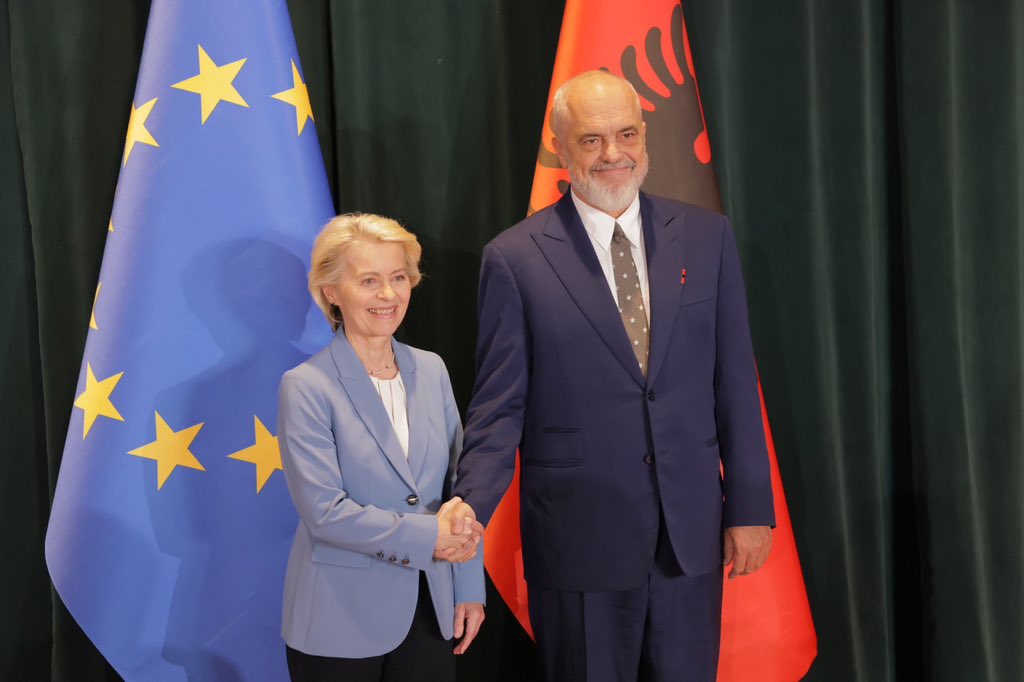
Standing alongside Prime Minister Edi Rama in Tirana, von der Leyen described Albania as one of the countries making the strongest progress towards EU membership and said its accession would strengthen both Albania and the European Union.
But the praise came with a qualification.
Albania must continue reforms across the negotiating chapters it has opened, von der Leyen said, singling out the judiciary, the electoral framework and environmental protection.
Adopting reforms was important, she said, but implementing them fully so that citizens could experience real change was equally important.
That distinction — between laws adopted on paper and standards delivered in practice — emerged as one of the central messages of a visit that triggered sharply different interpretations across Albania’s politically divided public sphere.
Justice reform: success or evidence of a deeper problem?
Nowhere was that debate more visible than over Albania’s justice system.
The country has undergone an extensive EU- and U.S.-backed justice overhaul over the past decade, including the creation of the Special Prosecution against Corruption and Organised Crime, known as SPAK.
Investigations have since reached ministers, former ministers, mayors and other senior officials, turning the institution into one of the most consequential — and politically sensitive — products of the reform.
Asked about investigations involving senior officials, von der Leyen presented the existence of such cases as evidence that institutions were functioning.
“When we see cases that are being investigated, they are proof that the system is working,” she said.
Rama used the same argument to defend the reform.
He said developments portrayed by some critics in Albania as evidence of institutional failure were regarded by the European Commission as signs that the country had developed mechanisms capable of correcting abuses.
Rama also sought to separate individual criminal responsibility from political responsibility, saying prosecutors and courts should be allowed to do their work while his responsibility was to ensure that justice reform continued.
The interpretation is contested.
Analyst Flogert Muça said on public broadcaster RTSH that von der Leyen’s message strengthened Rama’s argument that investigations of senior officials demonstrate that the system created under his government is functioning rather than proving that the government itself is responsible for alleged wrongdoing.
Lawyer Rezart Kthupi offered a different distinction during the same programme: Albania, he said, has rarely had difficulty drafting legislation compatible with EU requirements. The more difficult question is whether European standards are actually being achieved in practice.
The competing interpretations capture a broader question surrounding Albania’s accession process: whether the growing number of investigations demonstrates the success of anti-corruption institutions, the depth of corruption they are confronting, or elements of both.
Von der Leyen’s message concentrated on institutional performance rather than Albania’s domestic political argument over who should receive credit or blame.
‘There is still work to do’
The Commission president nevertheless delivered one of her strongest endorsements yet of Albania’s accession trajectory.
She said the country had made “fantastic” progress over the past year and urged Tirana to maintain its focus because significant work remained.
Albania has also emerged as one of the strongest performers under the EU’s Growth Plan for the Western Balkans.
Von der Leyen said Tirana had completed more than 80% of the required steps and received more than 213 million euros in EU funding.
Albania has joined the Single Euro Payments Area, or SEPA, a step intended to reduce the cost and complexity of euro-denominated transactions between Albania and participating European economies.
The EU is also working towards reducing roaming charges further, with the longer-term goal of eliminating them.
The economic incentives are part of a broader EU strategy of gradually integrating Western Balkan economies into parts of the single market before formal membership, while linking financial support to reforms.
For Albania, that means accession is increasingly becoming a transaction based on measurable benchmarks: reforms unlock integration and EU funding, while failure to deliver can delay both.
Brussels wants implementation
The tone of the Tirana visit therefore contained two messages that are not necessarily contradictory.
The first was political: Albania is advancing rapidly and Brussels sees it among the leading EU candidates.
The second was institutional: progress on legislation must now translate into standards visible in courts, elections, public administration, environmental protection and citizens’ everyday lives.
President Bajram Begaj echoed that distinction after meeting von der Leyen.
Albania’s ambition was to maintain momentum and move towards closing all negotiating chapters by the end of 2027, Begaj said, while stressing that integration could not be reduced to writing legislation.
The objective, he said, was to raise standards to European levels and implement them.
That point matters because accession negotiations become increasingly demanding as candidate countries move from formally aligning legislation with EU rules to demonstrating a sustainable record of enforcement.
Rule of law is particularly important because weaknesses in judicial independence, anti-corruption enforcement and democratic institutions can affect the entire accession process.
Opposition sees a different Albania
Von der Leyen’s positive assessment drew criticism from opponents of Rama.
Edith Harxhi, a senior figure in the opposition Democratic Party, accused the Commission president of overlooking allegations involving corruption, organised crime, elections, environmental policy and media freedom.
Harxhi portrayed Brussels’ approach as driven partly by geopolitical pressure to expand the EU rather than by Albania’s domestic record.
Those were opposition claims, not conclusions endorsed by the Commission.
Von der Leyen did not adopt the opposition’s description of Albania. Instead, she explicitly praised the country’s progress while simultaneously demanding further reforms and their full implementation.
Protesters also gathered outside the prime minister’s office during the visit. Demonstrations that initially focused on a controversial development project in the Zvërnec area have expanded to include broader political demands against Rama’s government.
The project has raised environmental and land-ownership concerns, adding another layer to von der Leyen’s emphasis on environmental standards and dialogue with society.
Rama said he had briefed her on the project and that the government was awaiting a detailed environmental study and would increase public transparency.
Albania advances as the EU changes too
Von der Leyen’s visit also pointed to another transformation taking place beyond Albania: the European Union itself is preparing for enlargement.
She said the Commission would review EU institutions, policies and finances to ensure the bloc can function after admitting new members.
Brussels is also considering mechanisms designed to ensure that commitments to democratic values and the rule of law continue after accession.
That debate could have major implications not only for Albania but for the entire Western Balkans, where enlargement has been stalled for years by bilateral disputes, vetoes and concerns about democratic governance.
Rama criticised the veto system, saying Albania had itself suffered from the ability of individual EU members to block progress.
For Tirana, however, the immediate political signal from von der Leyen was unusually positive.
Albania is no longer being discussed simply as a country waiting indefinitely outside the European Union. Brussels is increasingly talking about concrete accession steps, integration into European systems and preparations for eventual membership.
But the closer Albania gets, the harder the test becomes.
The central question is shifting from how many European laws Tirana can adopt to whether Albania can make those laws work.
And that may ultimately be the most consequential message von der Leyen left behind.