


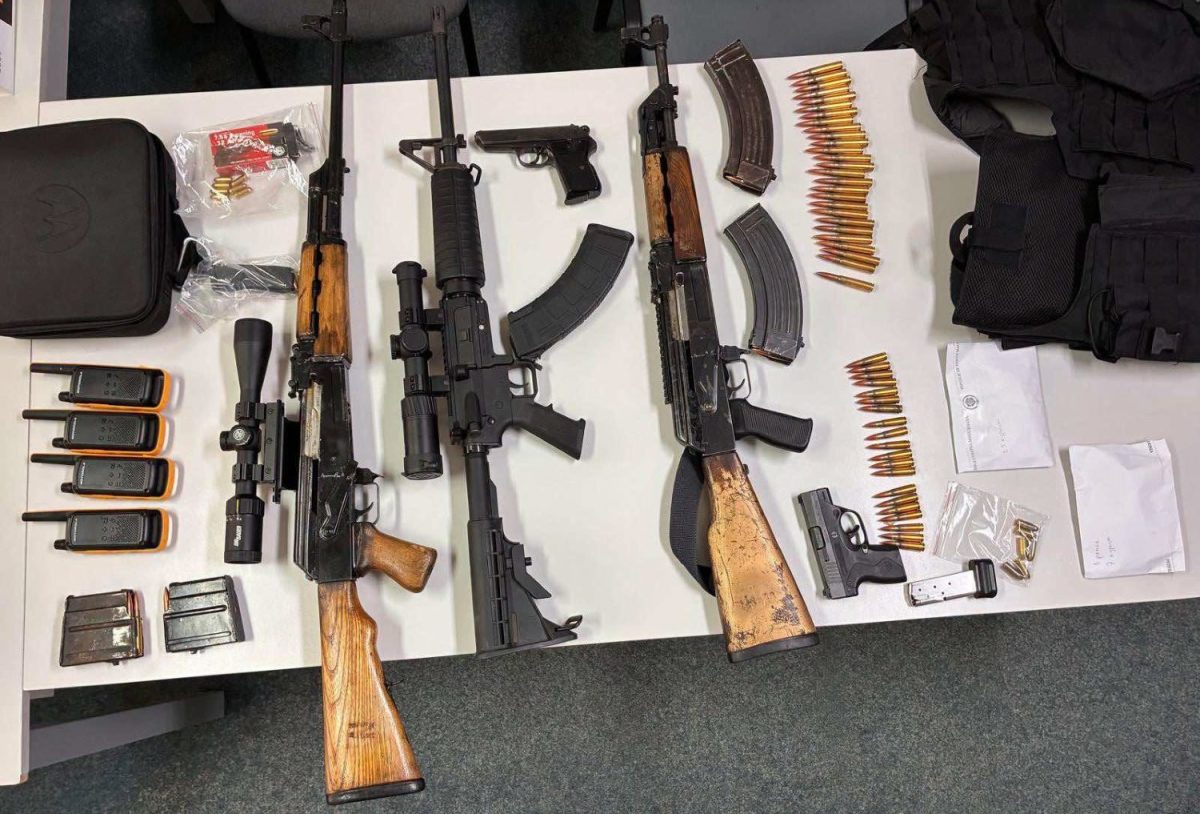
Police raids across Skopje uncovered automatic rifles, a sniper rifle, ammunition and Islamic State propaganda, while security authorities said the suspects had links to radical networks and foreign fighters. Three people are under formal investigation, including one on suspicion of terrorism.
SKOPJE, Sept 29 (BalkanView) – North Macedonian authorities detained five people in a counter-terrorism operation in and around Skopje and opened an investigation against three suspects after raids uncovered firearms, ammunition and material linked to Islamic State, authorities said.
Police searched 12 locations associated with six people in the Skopje areas of Singelić, Čair and Brest on Sept. 28, according to statements from the Interior Ministry, the Prosecutor’s Office for Organised Crime and Corruption and the National Security Agency.
Authorities said they seized automatic rifles, a sniper rifle, handguns, ammunition of various calibres, tactical equipment, radio communications devices, mobile phones, electronic equipment, cash and a flag and propaganda material associated with Islamic State.
Five people were detained. Prosecutors have opened an investigation against three of them and requested 30 days of pre-trial detention.
The allegations have not been tested in court.
Main suspect investigated for terrorism
The principal suspect, identified by authorities by the initials K.I., 34, is being investigated on suspicion of terrorism as well as the illegal manufacture, possession, brokering and trafficking of weapons or explosives.
The Interior Ministry said K.I. had operated since 2023 within a group influenced by Islamic State ideology.
Police allege he indoctrinated young people, distributed extremist material and acquired and handled firearms.
Two other suspects, identified as B.A., 24, and E.S., 30, are being investigated over suspected illegal possession and trafficking of weapons and ammunition.
Authorities allege the three were part of a group involved in the illegal possession, brokering and trade of firearms and ammunition.
No conviction has been reached and the investigation is continuing.
Security agency alleges links to foreign fighters
North Macedonia’s National Security Agency, known by its Macedonian acronym ANB, described those targeted in the operation as belonging to a “religious-radical group” with alleged connections to transnational criminal structures.
The agency said the network was associated with violence, extortion, kidnapping, loan-sharking and trafficking in drugs and weapons.
It also alleged that some of those detained followed radical preachers and maintained close contacts with foreign terrorist fighters from North Macedonia and elsewhere in the region.
“Indoctrination of young people by prominent members of the group is a modus operandi that has been continuously applied,” the agency said.
According to the ANB, religious sites where radical interpretations of Islam were promoted, together with online radicalisation, were used as initial points of contact for recruiting young people.
The agency said some recruits were subsequently drawn into criminal activity.
The authorities have not publicly detailed the identities of the alleged foreign fighters, the nature of those contacts or whether investigators believe the group was preparing a specific attack.
That distinction is significant: while one suspect is being investigated for terrorism, the official statements cited so far do not establish that an imminent terrorist attack had been planned.
Investigation emerged from another court case
Authorities said the investigation developed partly from documents and information obtained during an ongoing criminal trial, as well as evidence secured through international legal assistance.
The Sept. 28 operation was conducted under the supervision of a prosecutor from the Prosecutor’s Office for Organised Crime and Corruption.
Police searched 12 locations connected to six people and detained five.
Initial media reports had referred to six arrests, but authorities subsequently said five people had been detained and that three were formally under investigation at this stage.
The difference is important because being detained during an operation does not necessarily mean that a person has been formally charged or placed under investigation.
Sniper rifle, automatic weapons and Islamic State flag seized
The weapons recovered during the searches form one of the central elements of the investigation.
Authorities reported finding automatic rifles and magazines, a sniper rifle, handguns and ammunition of different calibres.
Tactical equipment and radio communications devices were also seized.
Investigators additionally recovered what authorities described as an Islamic State flag and propaganda material, along with mobile phones and other electronic devices that could become important to determining the nature and extent of the suspects’ alleged contacts.
Police also seized cash in Macedonian denars and foreign currencies.
Investigators will now have to establish the origin of the weapons, whether they were intended for sale or operational use and whether they can be connected to other criminal activity.
Cryptocurrency mining equipment also found
The raids produced an apparently separate line of investigation.
Authorities said they discovered cryptocurrency-mining equipment and evidence suggesting electricity had been used illegally to power the operation.
Additional proceedings are being conducted over the suspected unauthorised use of electricity.
The discovery adds a financial and conventional criminal dimension to an investigation already involving allegations of weapons trafficking, extremist activity and links to organised crime.
It remains unclear whether investigators believe the cryptocurrency operation was connected to the alleged extremist network or was a separate illegal activity uncovered during the searches.
Investigators now face a broader question
The case brings together several issues that security agencies across the Western Balkans have monitored for years: violent extremism, online radicalisation, returning or regionally connected foreign fighters, illegal weapons and organised crime.
But the evidence disclosed publicly remains at an early stage.
Authorities have alleged ideological links to Islamic State and contacts with foreign fighters, while investigators have recovered weapons and extremist material.
They have not yet publicly established whether the suspects were preparing an attack, whether they received instructions from an organisation abroad or whether the alleged network operated primarily as a criminal group whose members also held extremist views.
Those questions could determine whether the Skopje raids develop into a broader terrorism case or remain centred largely on weapons trafficking and other alleged criminal activity.
For now, three suspects face an investigation, including one on suspicion of terrorism, while prosecutors and security agencies examine the weapons, electronic devices and communications seized during the operation.