


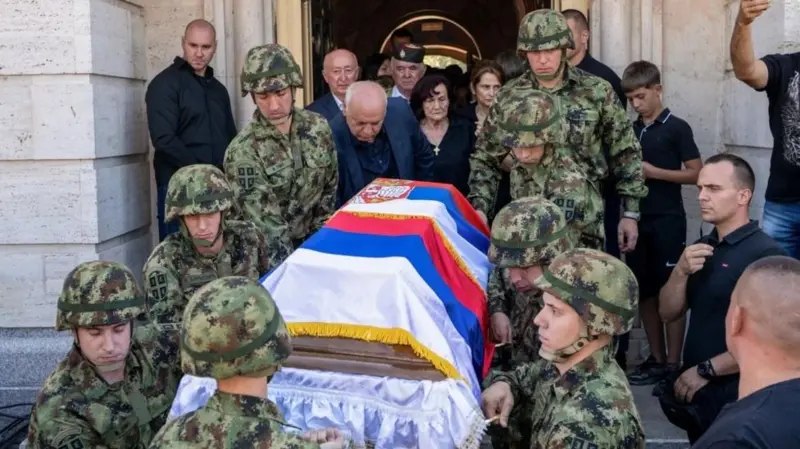
Thousands gathered in Belgrade as soldiers carried Ratko Mladić’s flag-draped coffin and senior Serbian officials paid their respects, turning the burial of the convicted Bosnian Serb commander into a new test of Serbia’s relations with its neighbours and the European Union three decades after the Srebrenica genocide.
BELGRADE/SARAJEVO, Sept 7 (BalkanView) – Thousands of people attended the funeral of convicted Bosnian Serb military commander Ratko Mladić in Belgrade on Monday, reopening some of the deepest wounds of the Yugoslav wars and triggering a diplomatic confrontation between Serbia, Bosnia and the European Union.
Mladić, who died in The Hague on Aug. 27 aged 84 while serving a life sentence, was convicted of genocide, crimes against humanity and war crimes for atrocities committed during the 1992-95 Bosnian war, including the killing of more than 8,000 Bosniak men and boys after Bosnian Serb forces captured Srebrenica in July 1995.
His funeral illustrated the gulf that remains between international court judgments and the way the former commander is remembered by many Serbs.
Members of the Serbian military carried Mladić’s coffin, which was draped in the Serbian flag, while a gun salute was fired and a military orchestra played. Serbian ministers, senior Bosnian Serb politicians, Russian diplomats and President Aleksandar Vučić’s son Danilo were among those attending.
The ceremony came despite earlier indications that serving Serbian officials would not participate and that Mladić would not receive official state or military honours.
Vučić himself did not attend.
But the presence of serving ministers and soldiers, together with the use of state resources surrounding Mladić’s return from The Hague, blurred the distinction between a private funeral and an official commemoration.
Serbia had sent a government aircraft to the Netherlands to return Mladić’s body to Belgrade.
The funeral was attended by Defence Minister Bratislav Gašić, Justice Minister Nenad Vujić, Culture Minister Nikola Selaković and Public Investment Minister Darko Glišić, among other government representatives.
Bosnian Serb political leaders, including Milorad Dodik and Željka Cvijanović, also attended, as did Russian Ambassador Alexander Botsan-Kharchenko.
Serbian Orthodox Patriarch Porfirije led the religious ceremony.
BOSNIA RETALIATES DIPLOMATICALLY
The consequences quickly moved beyond symbolism.
Bosnian Foreign Minister Elmedin Konaković announced that most personnel from Bosnia and Herzegovina’s embassy in Belgrade would be recalled, leaving only the ambassador and consul, in what amounted to a sharp diplomatic downgrade.
Konaković linked the move to developments surrounding Mladić’s death, commemoration and funeral and said he would reduce relations with Serbia to the minimum level within his authority.
The reaction demonstrated how Mladić’s legacy remains intertwined with relations between Sarajevo and Belgrade more than three decades after the war.
For survivors and relatives of the victims, the images from Belgrade were particularly painful.
Mladić commanded the Bosnian Serb Army during the conflict and was convicted over the Srebrenica genocide as well as the years-long siege of Sarajevo and other crimes against Bosniak and Croat civilians.
The war killed more than 100,000 people and displaced around two million.
For many Bosniaks, honouring Mladić is therefore not merely a dispute over historical interpretation but the glorification of a man judicially established to have played a central role in genocide.
For many Serbian nationalists, however, Mladić continues to be portrayed as a wartime commander who defended the Serbian people.
That collision of narratives remains one of the biggest obstacles to post-war reconciliation in the Western Balkans.
BRUSSELS FACES A SERBIAN DILEMMA
The funeral also created another confrontation between Belgrade and Brussels at a sensitive moment for Serbia’s European ambitions.
The European Union has repeatedly said that glorification of convicted war criminals, denial of genocide and historical revisionism are incompatible with European values.
EU Enlargement Commissioner Marta Kos postponed a planned visit to Serbia after controversy surrounding the treatment of Mladić following his death.
Brussels said the glorification of convicted war criminals had no place either inside the European Union or in countries seeking membership.
The dispute goes to the heart of an increasingly difficult question for EU enlargement policy: how far can Serbia move towards membership while senior officials participate in commemorations of a commander convicted of genocide by an international tribunal?
Serbia has been an EU candidate since 2012 and began accession negotiations in 2014, but progress has been slow amid disputes over rule of law, foreign policy alignment, relations with Kosovo and democratic standards.
The Mladić controversy adds reconciliation and the interpretation of the Yugoslav wars back to that list.
WASHINGTON SENDS A WARNING
Concern was not confined to Brussels.
Ahead of the funeral, U.S. lawmakers called on the governments of Serbia and Bosnia’s Republika Srpska entity to distance themselves from ceremonies honouring Mladić.
They described the response to his death as a test of whether Serbia and Republika Srpska were prepared to break with the past and move towards European and Euro-Atlantic integration.
At the same time, two U.S. lawmakers travelled to Srebrenica to honour victims of the 1995 genocide.
The contrasting images carried a powerful message: while thousands were honouring Mladić in Belgrade, American representatives were paying tribute to his victims in Srebrenica.
RUSSIA’S PRESENCE ADDS ANOTHER DIMENSION
The attendance of Russia’s ambassador also underlined Serbia’s wider geopolitical balancing act.
Russia has traditionally presented itself as a defender of Serbian interests on Kosovo, Bosnia and other regional issues, while Serbia simultaneously maintains that EU membership remains its strategic objective.
Moscow and Belgrade also share close historical, cultural, religious and political ties.
That makes disputes over the 1990s wars part of a much wider geopolitical contest over Serbia’s orientation.
For Brussels and Washington, reconciliation, acceptance of international court judgments and good-neighbourly relations form part of the Western Balkans’ European future.
Russia has fewer incentives to push Belgrade towards the same historical and political alignment with the West.
The funeral therefore became another stage on which Serbia’s unresolved strategic position – between European integration and traditional ties with Moscow – was visible.
SREBRENICA STILL DIVIDES THE REGION
The International Criminal Tribunal for the former Yugoslavia and its successor mechanism convicted Mladić of genocide at Srebrenica, persecution, extermination, murder, deportation, forcible transfer and terror, among other crimes.
International courts have repeatedly classified the Srebrenica killings as genocide.
Serbian governments have acknowledged that a grave crime took place but have resisted describing it as genocide.
That dispute has repeatedly returned to international diplomacy.
The United Nations General Assembly’s decision in 2024 to establish July 11 as the International Day of Reflection and Commemoration of the 1995 Genocide in Srebrenica triggered fierce opposition from Serbia and Republika Srpska.
Belgrade argued that the resolution risked collectively branding Serbs as a genocidal people, something its sponsors denied, saying responsibility for genocide is individual rather than collective.
The same argument over individual guilt and national identity resurfaced after Mladić’s death.
CROATIA AND ALBANIA SEE A TEST FOR SERBIA
The controversy has also reverberated elsewhere in the Western Balkans.
Albanian Prime Minister Edi Rama and Croatian Prime Minister Andrej Plenković had sharply criticised the prospect of state honours for Mladić, highlighting how the issue reaches beyond Bosnia-Serbia relations.
For Croatia, the memory of the wars of Yugoslav dissolution remains deeply connected to relations with Serbia and the unresolved fate of missing people.
For Albania and Kosovo, Serbia’s treatment of convicted wartime figures is also viewed through the experience of the 1998-99 Kosovo war.
The political cost of glorifying wartime commanders can therefore spread across almost every major bilateral relationship Serbia has in the Western Balkans.
KOSOVO WATCHES BELGRADE’S MESSAGE
Kosovo provides another layer.
Although Mladić’s convictions relate principally to Bosnia, his funeral inevitably resonates in Kosovo, where the legacy of Serbian forces’ actions during the 1998-99 war remains central to relations with Belgrade.
Another former senior Yugoslav military commander, Nebojša Pavković, who was convicted by the Hague tribunal of crimes against humanity and war crimes in Kosovo, was buried in Serbia with military honours in 2025.
For Kosovo’s political leadership, such ceremonies reinforce arguments that Serbia has failed to confront the legacy of the wars of the 1990s.
That could further complicate the already stalled EU-mediated process to normalise relations between Belgrade and Pristina.
REPUBLIKA SRPSKA AND THE POLITICS OF MEMORY
Perhaps nowhere outside Serbia is Mladić’s legacy more politically potent than in Republika Srpska.
The Bosnian Serb entity’s political leadership has repeatedly challenged descriptions of Srebrenica as genocide despite international court rulings.
The presence of senior Republika Srpska representatives at the funeral reinforced the political and symbolic links between Belgrade and Banja Luka.
It also deepened Bosnia’s internal divide.
More than three decades after the Dayton Peace Agreement ended the war, Bosnia remains divided into the Bosniak-Croat Federation and Serb-dominated Republika Srpska, connected through weak central institutions.
Competing versions of wartime history continue to shape education, monuments, political rhetoric and elections.
Mladić’s death has exposed how little convergence has taken place.
A FUNERAL THAT BECAME A GEOPOLITICAL EVENT
The dispute ultimately goes far beyond the burial of one former general.
It raises a fundamental question about what reconciliation in the Western Balkans means three decades after the wars.
For the EU, reconciliation requires acceptance of international judgments, rejection of genocide denial and an end to the glorification of convicted war criminals.
For Serbian nationalists, pressure to abandon figures such as Mladić is often portrayed as an attempt to impose collective guilt on the Serbian people.
Vučić described the public response surrounding the funeral as an emotional reaction and accused Western countries of treating Serbia unfairly.
That narrative has domestic political power.
But it carries an international price.
Serbia is simultaneously trying to maintain relations with Russia, preserve its position on Kosovo, strengthen ties with Republika Srpska and keep alive its ambition to join the European Union.
The funeral showed how increasingly difficult those objectives can be to reconcile.
Three decades after Srebrenica and the Dayton agreement, the Western Balkans are no longer at war.
But the crowds in Belgrade, the anger in Sarajevo, the diplomatic reaction from Brussels and Washington and the presence of Russian officials showed that the political battle over what those wars mean is far from over.