



SKOPJE, Sept. 2 (Balkan View) – Free public transport, subsidised meals, scholarships and state-supported accommodation are among the measures Balkan governments use to reduce the cost of higher education, but the level and structure of support vary widely across the region.
North Macedonia offers students a combination of transport, food subsidies, scholarships and dormitory support, although access is uneven. Some benefits are national, while others are concentrated in Skopje.
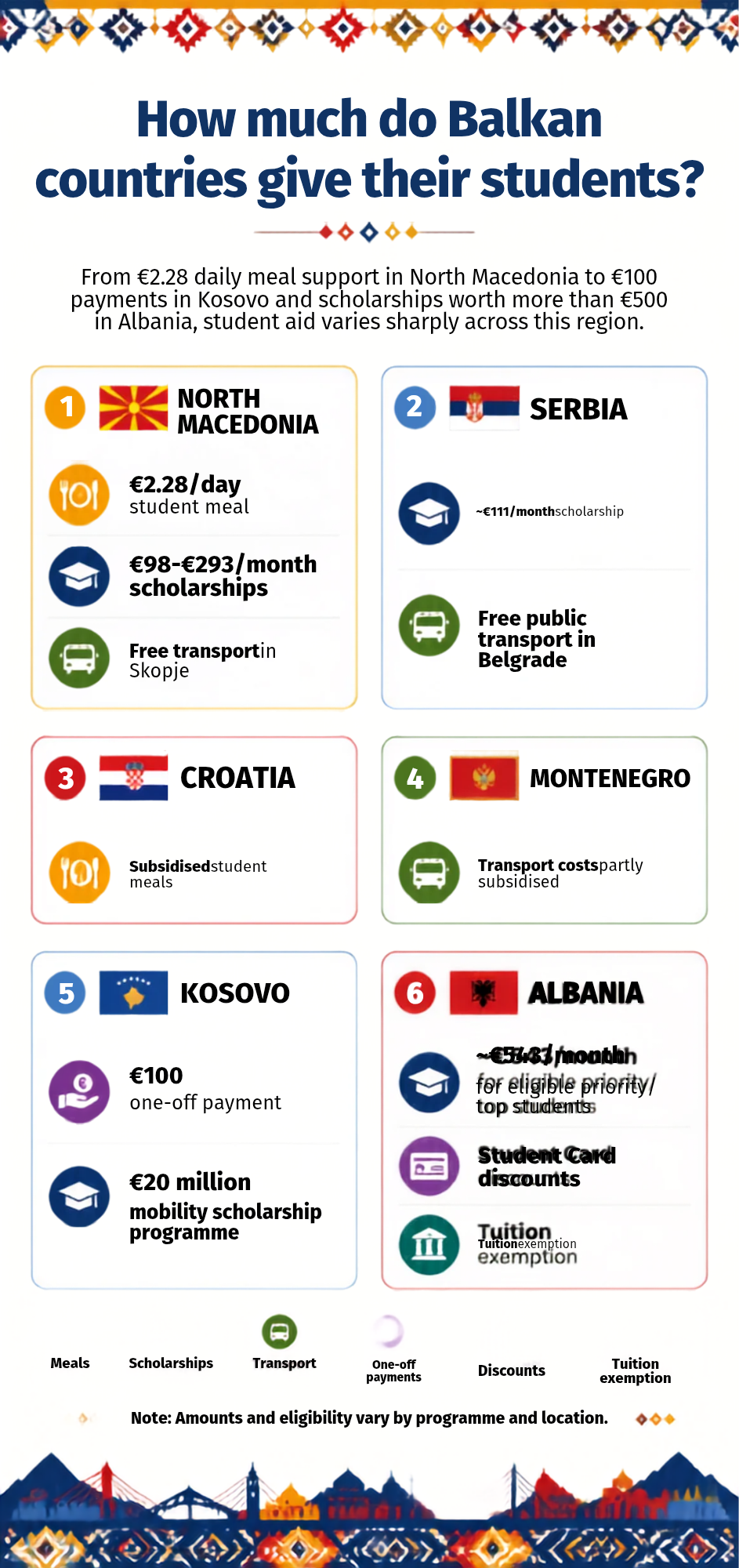
Elsewhere in the region, Croatia has built an extensive subsidised student-meal system, Kosovo has introduced mobility scholarships linked to travel costs, Montenegro subsidises transport expenses and Albania uses a student card to provide discounts across a range of services.
The comparison shows that the most generous-looking benefit is not always the broadest one. In some countries, support is universal or national; in others, it depends heavily on where a student lives and studies.
Skopje offers free public transport to eligible students
One of the most visible student benefits in North Macedonia is free public transport in Skopje.
According to the Skopje Public Transport Company, full-time undergraduate students enrolled at state faculties in the capital are entitled to an annual free public transport pass, without an age limit.
The pass allows unlimited travel on city and suburban routes, excluding night services.
The measure continued in 2026, with the transport company confirming that the annual student pass remained valid throughout the year.
But the benefit is not automatically available to every student in North Macedonia.
It applies to students who meet the Skopje public transport eligibility requirements, meaning that a student studying in another city, or commuting between cities, does not necessarily receive the same level of transport support.
Subsidised meals worth 140 denars a day
North Macedonia also operates a subsidised student meal scheme.
Eligible students receive 140 denars per day for food from Monday to Saturday during the academic year, with the money available through a dedicated payment card.
The benefit is not limited solely to students at public universities.
For the 2025/2026 academic year, the scheme covered eligible full-time undergraduate students whose income was below a defined threshold, as well as certain postgraduate and integrated-study students at both public and private universities.
According to Sparkasse Bank data cited in the original report, the maximum weekly amount available on the card is 840 denars, equivalent to six days of support.
Scholarships range from 6,050 to 18,000 denars
The government also provides several categories of student scholarships.
For the 2025/2026 academic year, scholarships of 6,050 denars per month were available for nine months.
For selected programmes in chemistry, physics, mathematics, agriculture, veterinary science and forestry, scholarships rose to 18,000 denars per month, also for nine months.
For second-cycle studies, the Education Ministry introduced scholarships of 9,000 denars per month for nine months in 2025, while selected third-cycle programmes were eligible for 18,000 denars per month for 12 months.
State-supported student accommodation remains another pillar of the student-standard system.
North Macedonia’s Education Ministry said reconstruction of state student dormitories continued in 2025, when the student-standard budget was planned at around €30 million.
Serbia combines scholarships, dormitories and subsidised meals
Serbia has a relatively developed system of scholarships, student loans, dormitories and subsidised meals.
According to Serbia’s Education Ministry, the student scholarship for the 2026/2027 academic year amounts to 13,000 dinars per month.
Scholarships are non-repayable, while student loans are subject to repayment rules set out in the relevant public calls.
Serbia also maintains a system of student accommodation and subsidised food through its student-standard institutions.
Transport works differently.
Belgrade has introduced free public transport for residents generally, meaning students benefit from free travel as part of a broader city policy rather than through a separate student-only programme.
That makes Belgrade and Skopje an interesting contrast: in Skopje, free transport is tied specifically to student status, while in Belgrade it is part of a wider municipal policy.
Croatia has one of the region’s strongest subsidised meal systems
Croatia stands out for its extensive subsidised student-food network.
Students studying in the country can use subsidised meals in student restaurants, with support linked to the national student-standard system.
Zagreb has a broad network of student cafeterias and restaurants, while the student card is also used for access to other services.
In 2025, the Zagreb Student Centre introduced a system allowing students to monitor their subsidised food spending in real time through an electronic account.
Unlike North Macedonia, where the benefit is structured as a fixed daily amount, Croatia’s system is more closely tied to a network of subsidised student restaurants.
Montenegro contributes to transport costs
Montenegro introduced a specific regulation in 2026 governing participation in transport costs for pupils and university students.
The country’s Ministry of Education, Science and Innovation published criteria setting out who qualifies and how much of the transport expense can be covered.
The model differs from Skopje’s.
Rather than offering fully free urban and suburban transport to a specific category of students, Montenegro uses a cost-sharing or reimbursement model based on defined conditions.
Kosovo turns travel costs into a mobility scholarship
Kosovo has taken a different approach by directly targeting the cost of reaching university.
In October 2025, the government approved a Student Mobility Scholarship with a budget of €20 million.
Under the measure, students with below-average incomes receive mobility support calculated partly according to the distance between their place of residence and their university.
The government also approved a one-off payment of €100 for eligible students, with a total value of €6 million.
The mobility scholarship was later presented as a measure designed to ensure that financial circumstances and geographic distance do not become barriers to access to higher education.
For North Macedonia, the Kosovo model is notable because it addresses transport nationally through direct financial support rather than through one city’s public transport system.
Albania relies on a student card and targeted financial support
Albania uses another model: a student card providing discounts across a range of services.
According to the Albanian Education Ministry, the card can provide reduced prices for transport, culture, healthcare, sport, tourism, education and other services.
Private companies can also participate through agreements with the ministry.
Albania also offers targeted financial support for high-performing students and those enrolled in nationally prioritised study programmes.
For the 2025/2026 academic year, the support included a scholarship equivalent to one monthly minimum wage and exemption from annual tuition fees for students who met the required criteria.
North Macedonia strong on transport, but coverage remains uneven
The regional comparison shows that North Macedonia offers one of the most direct transport benefits in the region through free annual public transport for eligible students in Skopje.
It also combines that support with subsidised meals, scholarships, dormitories and targeted programmes.
But the system remains fragmented.
The free transport benefit is not nationwide and depends heavily on whether a student lives and studies in Skopje.
That creates a significant difference between a student in the capital and someone who studies elsewhere or commutes between cities.
Croatia shows how subsidised food can be organised through a wide network of student restaurants. Kosovo directly subsidises travel to university. Albania uses a broader discount-card model. Montenegro shares transport costs rather than eliminating them entirely.
The broader lesson is that student support in the Balkans is becoming more diverse, but access remains highly uneven.
For North Macedonia, the biggest room for expansion appears to be in benefits that do not depend on geography — particularly intercity transport, accommodation and access to subsidised food.