


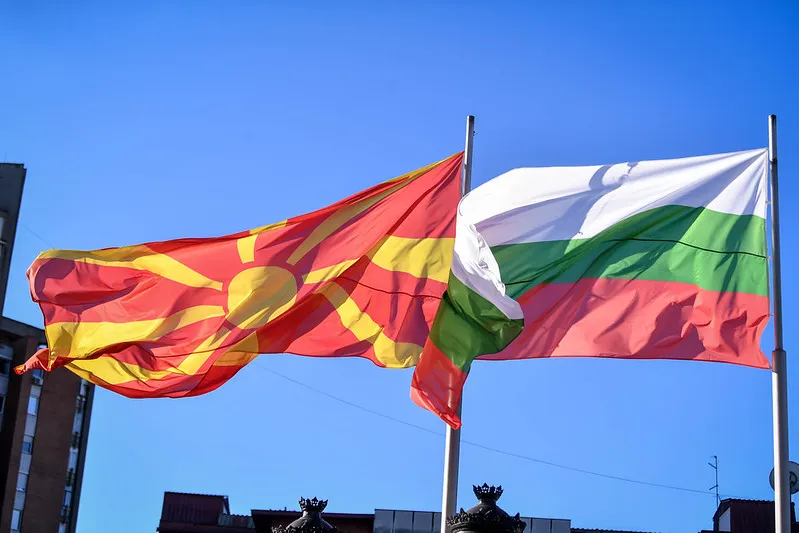
SKOPJE/SOFIA, Sept. 3 (Balkan View) – A criminal case involving a young dual Bulgarian-North Macedonian citizen has spilled into an increasingly sensitive diplomatic dispute after North Macedonia demanded that Bulgaria extradite her father, a convicted fugitive who has appeared publicly in Bulgarian media while campaigning on his daughter’s behalf.
North Macedonian Prime Minister Hristijan Mickoski said Sofia should hand over Simeon Mihaylov, who North Macedonian authorities are seeking to serve a prison sentence of 12 years and six months for attempted murder and criminal association.
“We are looking for this person and I expect our partners to act in accordance with the partnership,” Mickoski said on Wednesday, referring to Bulgaria as North Macedonia’s eastern neighbour and fellow NATO member.
“We expect people who are wanted, who have committed a crime, to be extradited in the spirit of partnership so that they can face the law and justice.”
The demand adds another layer of tension to already strained relations between Sofia and Skopje, this time linking a humanitarian and judicial controversy involving Mihaylov’s daughter, Iva Mihaylova, with the criminal record of her father.
Who is Simeon Mihaylov?
According to North Macedonian media reports cited by the Bulgarian News Agency, Mihaylov was sentenced in a final ruling to 12 years and six months in prison for attempted murder and criminal association in a case known as “Detonator”.
He was convicted over an attempted killing of Daco Belski, a bodyguard of former North Macedonian security and counterintelligence chief Saso Mijalkov.
Media reports say two attempts were made to kill Belski using an explosive device placed in a rubbish container. He was injured in the second explosion and taken to hospital.
Mihaylov’s whereabouts became a politically charged issue after he appeared on Bulgarian television and at a protest outside North Macedonia’s embassy in Sofia.
He and his daughter hold both Bulgarian and North Macedonian citizenship.
That dual citizenship could complicate any extradition procedure. Bulgarian media have cited legal experts as saying that his Bulgarian citizenship may prevent or restrict extradition, though any decision would depend on Bulgarian law, applicable international agreements and the judicial process.
Daughter’s case became a Bulgarian political issue
The controversy initially centred not on Mihaylov but on his 23-year-old daughter.
Iva Mihaylova is facing criminal proceedings in Kocani over an alleged serious road-traffic offence connected with a fatal accident. She was herself seriously injured and suffered spinal damage.
Her family says she requires treatment in Bulgaria because of the nature of her injuries.
North Macedonian courts have, however, refused to allow her to leave the country while the proceedings are underway, according to Bulgarian media reports.
The case prompted intervention from senior Bulgarian officials, turning what began as a criminal proceeding into an issue in the already difficult relationship between the two countries.
Bulgarian President Iliana Iotova said she would raise the case with the secretary general of the Council of Europe, while Prime Minister Rumen Radev said Sofia was preparing a diplomatic protest note to North Macedonia.
Bulgarian media have increasingly portrayed the case through the prism of the rights of Bulgarian citizens in North Macedonia.
Then attention shifted to her father
The emergence of information about Simeon Mihaylov’s conviction dramatically changed the political narrative.
Bulgarian commentator Petar Kolev argued that Sofia had walked into a potential “diplomatic trap” by allowing Mihaylov to become a prominent public advocate in his daughter’s case without adequately assessing his own legal background.
Kolev stressed that the two cases should remain legally separate.
Iva Mihaylova, he argued, cannot be held responsible for her father’s criminal record, and his conviction cannot be used to determine whether her procedural, medical or consular rights have been respected.
But the political consequences are harder to separate.
What had been framed in Bulgaria as a question of why a seriously injured Bulgarian citizen was prevented from receiving treatment abroad can now be countered in North Macedonia by questions about why a convicted man wanted by Skopje was able to appear publicly in Bulgaria.
That shift risks pushing Iva Mihaylova’s medical condition and judicial rights out of the centre of the debate.
A new test for Sofia and Skopje
The affair comes at a particularly sensitive moment in Bulgarian-North Macedonian relations.
Disputes over history, identity, the status of the Bulgarian community in North Macedonia and constitutional changes demanded as part of Skopje’s EU accession process have repeatedly strained relations between the neighbours.
The Mihaylova case adds an unusually personal judicial dimension.
For Sofia, there are now effectively two separate questions: whether Iva Mihaylova’s rights and access to medical treatment are being properly protected, and how Bulgarian authorities should respond to North Macedonia’s pursuit of her father.
For Skopje, Mickoski’s demand places the emphasis on judicial cooperation between two NATO allies.
The legal questions may ultimately be settled by courts and extradition procedures. Politically, however, the case has already become something larger: another test of whether Bulgaria and North Macedonia can keep individual criminal proceedings separate from their increasingly contentious bilateral relationship.