


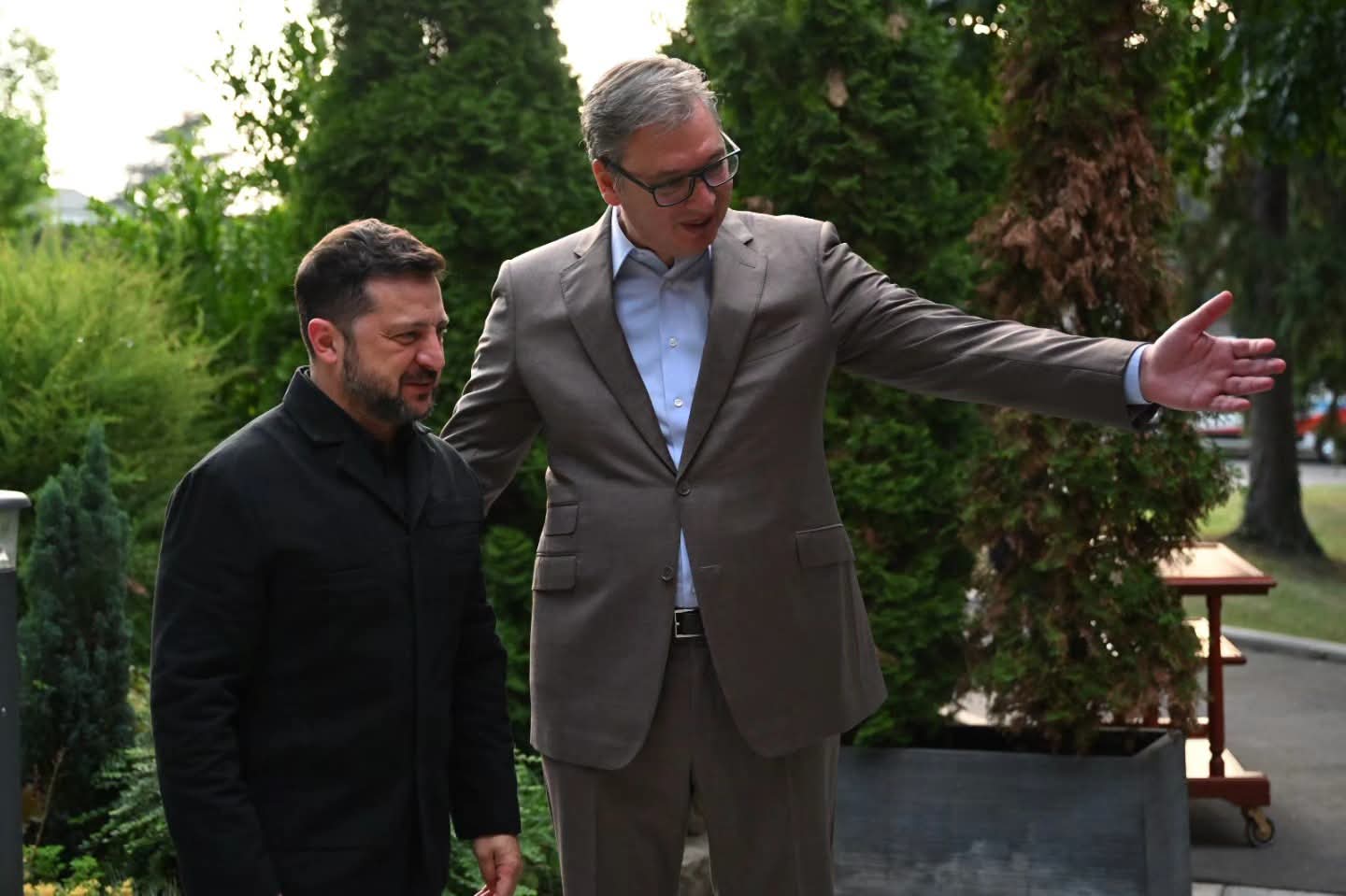
PRISTINA/BELGRADE/SKOPJE, Aug. 26 (Balkan View) – Ukrainian President Volodymyr Zelenskyy thanked Serbian President Aleksandar Vučić for his Independence Day message, praising Serbia’s support for Ukraine’s territorial integrity just days after his refusal to recognise Kosovo triggered political backlash among Albanian politicians across the Balkans.
“I thank President of Serbia Aleksandar Vučić for his Independence Day greetings and his wishes for peace and recovery for Ukraine,” Zelenskyy wrote on X.
“I appreciate Serbia’s support for Ukraine’s territorial integrity and its commitment to the principles of the UN Charter. I am grateful to Serbia and the Serbian people for their humanitarian support for Ukraine during this difficult time.”
Zelenskyy added that he looked forward to continuing dialogue and further developing Ukrainian-Serbian relations.
The message reinforces a diplomatic rapprochement between Kyiv and Belgrade following Zelenskyy’s first official visit to Serbia earlier this month, but it also sharpens a politically sensitive contrast with Kosovo.
Kosovo’s acting Prime Minister Albin Kurti marked Ukraine’s 35th Independence Day by reaffirming Pristina’s support for Kyiv while directly challenging Ukraine’s refusal to recognise Kosovo.
Kurti said Kosovo had sheltered Ukrainian journalists, provided military assistance, joined sanctions against Russia and supported Ukraine in other ways.
But he argued that Kyiv’s position on Kosovo “does not withstand either the historical facts or the principles of international law”.
“Ukraine’s recognition of Kosova would, in fact, strengthen the very principles for which Ukraine is fighting today,” Kurti said.
For Kurti, recognition would reinforce an international order in which larger states cannot change the borders of smaller neighbours by force.
Zelenskyy’s Belgrade position triggered backlash
The controversy began when Zelenskyy, during his visit to Belgrade, reaffirmed that Ukraine had not changed its position on Kosovo and continued to respect Serbia’s territorial integrity.
Ukraine is among the countries that do not recognise Kosovo, which declared independence from Serbia in 2008.
The statement generated criticism in Kosovo despite Pristina’s strong support for Ukraine since Russia’s full-scale invasion.
Authorities in Pristina subsequently removed a large Ukrainian flag that had been displayed in the capital as a symbol of solidarity with Ukraine.
The dispute also spilled into North Macedonia.
Albanian MPs were absent from a parliamentary session marking Ukraine’s 35th anniversary of independence, with at least one lawmaker explicitly saying he had boycotted the event because of Zelenskyy’s Kosovo position.
Alliance for Albanians MP Riyad Shaqiri told Sloboden Pechat that once Zelenskyy had reaffirmed Serbia’s territorial claim over Kosovo, Ukraine could no longer count on his political support.
Other Albanian MPs said their absence was unrelated to a boycott, citing holidays or lack of notification.
North Macedonia’s parliament nevertheless reaffirmed support for Ukraine, with Deputy Speaker Antonio Miloshoski saying Skopje’s backing was political, humanitarian, material and moral.
Rama rejects transactional support for Ukraine
Albanian Prime Minister Edi Rama has taken a different approach.
Rama has criticised Ukraine’s position on Kosovo but rejected calls to reduce support for Kyiv in response.
In his most recent X statement on the issue, posted on Aug. 13, Rama said Ukraine was “wrong about Kosovo” but argued that its right to freedom remained unquestionable.
“Freedom does not work on cashback,” Rama wrote, arguing that opposition to Russia’s war of aggression should not depend on whether Ukraine recognises Kosovo.
“So yes: FREE UKRAINE. Today, tomorrow and always,” he said.
Rama had not published a separate Ukraine Independence Day congratulatory message on X as of Aug. 26.
Belgrade and Kyiv deepen ties
Zelenskyy’s latest message to Vučić also points to increasingly pragmatic relations between Serbia and Ukraine.
During their August talks in Belgrade, the two presidents discussed trade, energy, infrastructure, reconstruction and a potential free-trade agreement.
Serbia supports Ukraine’s territorial integrity but has maintained relations with Moscow and has not joined EU sanctions against Russia.
Ukraine, in turn, supports Serbia’s territorial integrity and continues not to recognise Kosovo.
That mutual position has provided an important diplomatic foundation for closer Serbian-Ukrainian relations, even as Belgrade attempts to balance its traditional relationship with Moscow against its EU ambitions.
For Kosovo, however, the emerging partnership creates an uncomfortable diplomatic equation.
Pristina strongly supports Ukraine against Russian aggression but is simultaneously asking Kyiv to abandon a position on Kosovo that Ukraine and Serbia increasingly present as part of their mutual respect for territorial integrity.
Kurti’s message suggests Kosovo intends to maintain both positions: backing Ukraine’s sovereignty while continuing to press Kyiv for recognition.