


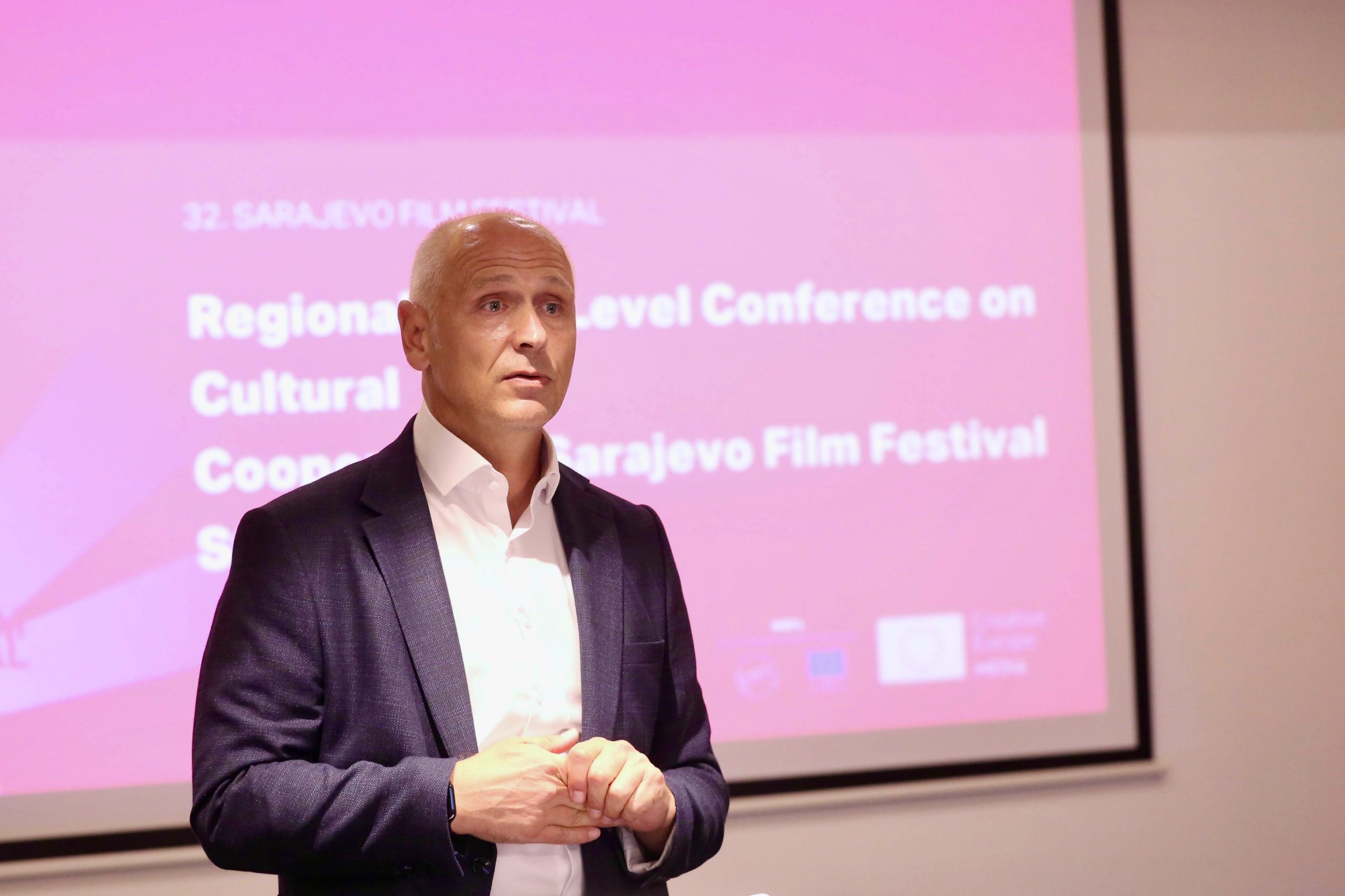
SARAJEVO, Aug. 21 (Balkan View) – Film and the wider creative industries could become an increasingly important source of jobs and economic growth in the Western Balkans, where youth unemployment remains high and many young professionals seek opportunities abroad, Regional Cooperation Council Secretary General Amer Kapetanović said.
Speaking during the Second Regional Conference on Youth Cultural Cooperation in Sarajevo, held in cooperation with the Sarajevo Film Festival, Kapetanović said creative industries already account for roughly 3% to 5% of GDP and around 3.5% of employment across Southeast Europe.
“This is not a marginal sector. It already has a real economic impact, and that is what makes it important for regional cooperation,” Kapetanović said.
The economic potential is particularly significant for a region where youth unemployment remains at around 25% to 30%, according to figures cited by the RCC chief.
“Film and the wider creative industries can give young people careers built on their own skills and ideas, but only if those careers are viable,” he said. “That is why we do not treat culture as decoration.”
Kapetanović made the remarks during a discussion titled “What Do We Ask of the Next Generation? Film, Democracy and Regional Competitiveness”, part of the regional conference organised by the RCC’s EU-funded Western Balkans Youth Lab together with the Sarajevo Film Festival.
EU calls for investment in young filmmakers
Luigi Soreca, head of the European Union Delegation to Bosnia and Herzegovina, said institutions cannot expect young filmmakers to promote democratic values and challenge established narratives without providing them with opportunities to build sustainable careers.
“If we expect young filmmakers to defend democratic values and challenge established narratives, we must also create the conditions that allow them to do so,” Soreca said.
He cited access to skills, financing and regional mobility as essential elements.
Young people, Soreca said, should not simply be invited to listen to decisions but should have the power to help shape their own European future.
He pointed to Creative Europe and Erasmus+ as programmes through which the EU is investing in younger generations.
Western Balkan talent meets in Sarajevo
The conference brought 25 young filmmakers and artists from across the Western Balkans Six to Sarajevo for several days of professional exchange, learning and networking around the 32nd Sarajevo Film Festival.
Participants had an opportunity to present their work, learn from internationally recognised filmmakers and actors, exchange experiences with other young artists and industry professionals, and participate in selected Sarajevo Film Festival and Talents Sarajevo activities.
Young artists from regional art academies and participants in Talents Sarajevo were also brought into discussions with policymakers and representatives of the film industry.
The aim went beyond providing young professionals with access to established institutions. Organisers stressed that young people should increasingly be treated as partners in shaping cultural policies and the future of the creative sector, rather than simply as beneficiaries of programmes designed by others.
From filmmaking to regional competitiveness
The discussion brought together Tobias Flessenkemper, head of the Youth Department at the Council of Europe; Maja Vukić, deputy chief executive officer of the Croatian Audiovisual Centre; film director Tamara Todorović; and Čarna Vučinić, producer and founder of Naked.
It was moderated by Stefan Prohorov, an international relations expert at the Bulgarian Film Centre.
Their discussion linked filmmaking with broader questions facing the Western Balkans: democracy, employment, regional mobility and economic competitiveness.
The underlying message was that the creative sector should no longer be viewed solely through the prism of cultural policy.
If creative industries already generate as much as 5% of economic output in parts of Southeast Europe, developing the sector could also provide young people with another route into entrepreneurship and employment while strengthening links among Western Balkan economies.
For a region struggling to create enough opportunities for its younger generation, the debate in Sarajevo posed a broader question: Can the Western Balkans transform its cultural talent into an industry strong enough to persuade more young people to build their futures at home?