


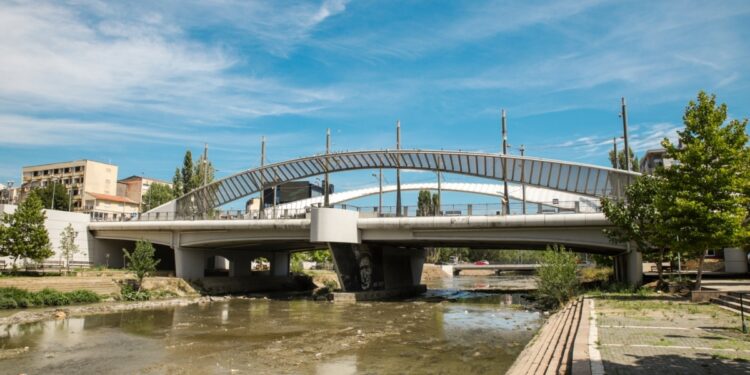
MITROVICA, Aug. 19 (Balkan View) – A gradual withdrawal of NATO-led KFOR troops from the main bridge over the Ibar River in Mitrovica has reignited political and security tensions in northern Kosovo, with Serbian representatives warning that opening the crossing to vehicles could destabilise the area while Kosovo officials and some security analysts see the move as a step towards normalising movement between the divided parts of the city.
The bridge links predominantly Serb-populated North Mitrovica with the Albanian-majority southern part of the city and has for years been one of the most politically sensitive locations in Kosovo.
KFOR has maintained a visible presence around the bridge for years. Recent reports that Kosovo Police is gradually assuming a larger security role have prompted sharp reactions from Belgrade and local Serb officials.
North Mitrovica Mayor Milan Radojević said KFOR appeared to have based its decision to withdraw from the bridge primarily on assessments provided by Kosovo Police.
He argued that the security situation in northern Kosovo remained unstable and questioned whether conditions existed for opening the bridge to road traffic.
Radojević warned that the move could deepen insecurity among Serbs in the north and said memories of previous ethnic violence continued to shape local attitudes towards the bridge.
Serbian media have repeatedly linked the issue to the March 2004 violence in Kosovo, arguing that the crossing remains more than a transport question for local Serbs.
EU says bridge should connect communities
The European Commission has taken a more cautious position, saying the bridge should ultimately serve all communities but stressing that any further steps should involve consultation and coordination.
The Commission said it expected “effective coordination and meaningful consultations between the affected municipalities and Kosovo’s central institutions” regarding the possible opening of the bridge.
EU foreign policy representatives have also underlined that the bridge should function as a connection rather than a symbol of division.
The main bridge remains closed to ordinary vehicle traffic, although pedestrians have long been able to cross it.
The dispute is therefore not over whether people can physically move between the two parts of Mitrovica, but whether the bridge should return fully to normal road use and under what security arrangements.
Vučić seeks NATO intervention
Serbian President Aleksandar Vučić has said he intends to write to NATO Secretary General Mark Rutte asking that the bridge not be opened.
Vučić sharply criticised KFOR’s handling of the issue and singled out KFOR commander Major General Özkan Ulutaş, a Turkish officer, accusing him of pushing the process forward.
The Serbian president said the decision was being taken without sufficient consideration of the security concerns of the Serb population.
Belgrade has for years argued that KFOR should remain the principal security presence around the bridge and has opposed unilateral steps by Pristina affecting northern Kosovo.
The Kosovo government, by contrast, has repeatedly argued that bridges and roads inside Kosovo should be open and governed by the same rules as infrastructure elsewhere in the country.
From barricade to political symbol
The Ibar bridge became a symbol of Kosovo’s post-war ethnic division after the 1998-99 conflict.
North Mitrovica developed as the main urban centre of Kosovo’s Serb community, while South Mitrovica remained overwhelmingly Albanian.
The bridge subsequently became a recurring flashpoint involving local residents, Kosovo institutions, KFOR and international diplomats.
Successive attempts to fully reopen it have therefore carried political significance far beyond transport policy.
For Pristina, restoring normal vehicle traffic is often presented as part of extending ordinary institutional life throughout Kosovo.
For many Serbs in the north, the bridge has come to represent a security buffer in a region where trust in Kosovo institutions, particularly Kosovo Police, remains low.
That difference in perception explains why a relatively small stretch of road continues to generate reactions from NATO, the European Union, Belgrade and Pristina.
Kosovo Police takes a larger role
The latest change comes as KFOR gradually transfers more day-to-day responsibilities in some locations to Kosovo Police.
Supporters of the transition argue that continued permanent military control of an urban bridge more than two decades after the war is difficult to reconcile with the objective of normalising life in Mitrovica.
Critics counter that normalisation cannot be imposed simply by changing security arrangements while political trust remains weak.
Radojević said international missions should take into account allegations concerning Kosovo Police conduct and concerns over the protection of Serb property and rights before assessing the environment as safe.
Kosovo authorities reject broader Serbian claims that the police systematically target the Serb population and say security institutions operate throughout the country under Kosovo law.
Another test for Kosovo-Serbia normalisation
The controversy comes at a sensitive moment in relations between Kosovo and Serbia.
The European Union continues to insist that progress in their EU paths depends on the normalisation process and implementation of agreements reached through the Brussels dialogue.
That makes the Ibar bridge more than a municipal issue.
A poorly coordinated opening risks creating another confrontation between Belgrade and Pristina, while an indefinite closure would reinforce the very ethnic division that international actors have spent years trying to overcome.
KFOR’s changing role therefore places increasing responsibility on Kosovo institutions, local authorities and the EU-facilitated dialogue to ensure that the bridge shifts from being a security frontier to an ordinary piece of urban infrastructure.
Whether that can happen without increasing fear among northern Kosovo’s Serb population is now the central question.