


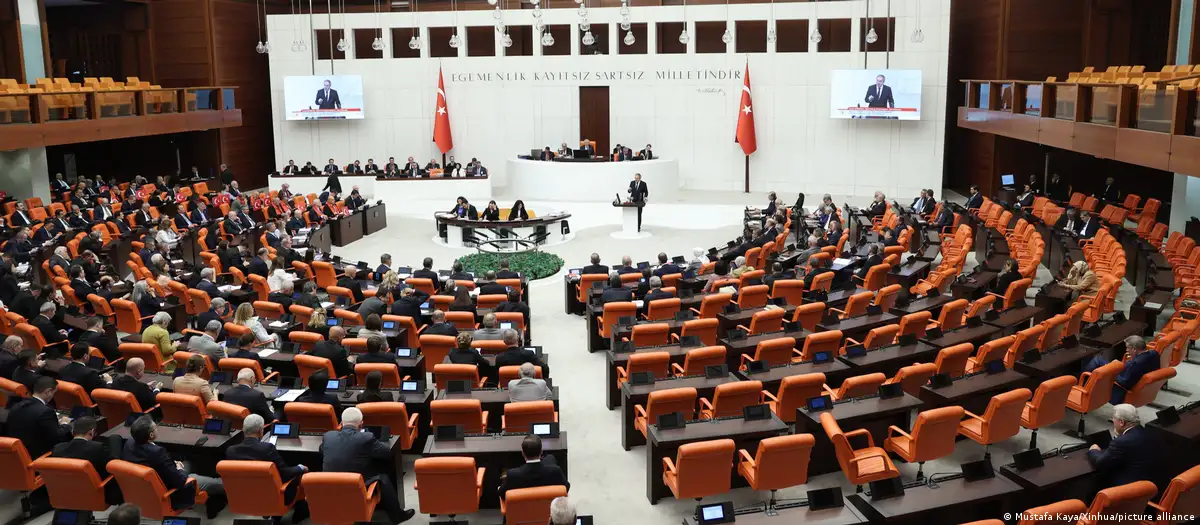
Turkey’s parliament has overwhelmingly approved legislation establishing a legal framework for the disarmament of the outlawed Kurdistan Workers’ Party, or PKK, in a major step towards ending a conflict that has killed tens of thousands of people since 1984.
The bill was approved by 468 lawmakers, while 88 voted against it and six abstained.
The legislation allows prison sentences for PKK members to be deferred under certain conditions, potentially clearing the way for fighters who surrender their weapons to return to Turkey.
Its provisions will take effect only after Turkish security agencies confirm that the PKK and its affiliated groups have disbanded and surrendered their weapons. The finding must then be approved by the National Security Council and published in the Official Gazette.
The initiative was launched with the support of Devlet Bahçeli, leader of the ultranationalist Nationalist Movement Party, or MHP, and a key ally of President Recep Tayyip Erdoğan. Bahçeli had previously been regarded as one of the strongest opponents of negotiations with the PKK.
Political analysts say Erdoğan may also be seeking support from the pro-Kurdish DEM Party for constitutional changes that could allow him to seek another presidential term.
The initiative follows years of Turkish military operations against PKK positions in Iraq and the weakening of Kurdish autonomy in neighbouring Syria.
However, significant obstacles remain. The PKK warned before the vote that the legislation did not go far enough and said its imprisoned founder, Abdullah Öcalan, should be allowed to participate freely and personally in the negotiations.
Öcalan, who has been imprisoned since 1999, called on the PKK to abandon its armed campaign. The organisation subsequently announced that it would disband, while groups of fighters began symbolically surrendering their weapons.
Parts of Turkey’s opposition have criticised the peace initiative as opaque and said any settlement of the Kurdish question must be accompanied by broader democratic reforms.
Opposition leader Özgür Özel described the legislation as insufficient, saying Turkey’s political system continued to imprison government opponents, journalists, academics and elected mayors. He nevertheless supported the bill, arguing that he did not want to obstruct the peace process or prolong the bloodshed.
DEM Party co-chair Tuncer Bakırhan described the legislation as a first step and called for democratic reforms, stronger rule of law and a comprehensive political settlement of the Kurdish question.
The PKK began its insurgency in southeastern Turkey in 1984, initially seeking an independent Kurdish state before shifting its demands towards autonomy and expanded political and cultural rights.
The conflict later spread into Iraq and Syria. Turkey, the European Union and the United States classify the PKK as a terrorist organisation.