


BELGRADE/PRISTINA/TIRANA, Aug. 10 (Balkan View) – Serbian President Aleksandar Vučić has revived the idea of changing the course of the Ibar River, triggering sharp reactions in Kosovo and Albania and raising questions over whether such a move is technically realistic or compatible with international water law.
Vučić said Serbia had already contacted engineers and construction experts to examine possible changes to the river’s course, linking the idea to what he described as pressure by Pristina on Serbs around the Gazivode reservoir.
“We have already called experts, people from the construction sector, engineers and others. Since they are harassing our people so much, we have different reasons for changing the course of the Ibar, and then we will see what the Albanians will do and how they will behave,” Vučić said.
He later said he was not threatening anyone and that Serbia was considering water-management issues on what it regards as its own territory.
The remarks came after Kosovo authorities demolished structures owned by Serbs near the Gazivode reservoir.
Why the Ibar Matters
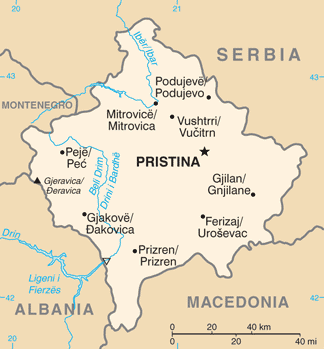
The Ibar rises in Montenegro, flows through Kosovo and then enters central Serbia. In Kosovo, it feeds the Gazivode reservoir and the Ibar-Lepenac system, which are central to water supply, irrigation, industry and energy production.
That makes any sustained reduction in water flow potentially significant for both households and critical infrastructure.
Kosovo water expert Mumin Morina said the issue should be treated seriously even though there is no public evidence that Serbia has begun such a project.
“The Ibar is not simply a river. Through Gazivode and the Ibar-Lepenac system, it is directly linked to Kosovo’s water security, energy, industry and agriculture,” Morina said.
He argued that the key question was not only whether diversion was technically possible, but whether Serbia could legally undertake a measure affecting a transboundary watercourse.
Serbian Engineer Calls Idea ‘Nonsense’
Jovan Despotović, a civil engineer and professor at the University of Belgrade’s Faculty of Civil Engineering, dismissed the proposal as unrealistic and contrary to established water-management practice.
“It has nothing to do with common sense. Whatever you say is too little to describe how nonsensical it is in hydrotechnical and water-management terms,” Despotović told Vreme.
He also said such a move would be unacceptable under European water-law principles applying to the Danube basin, to which the Ibar belongs.
According to Despotović, diverting the river would affect the entire local population in Kosovo, including Serbs.
Kosovo Serb politician Rada Trajković also criticised the proposal, describing it as election propaganda and warning that a diversion could jeopardise water supplies for around 800,000 people, including residents of northern Kosovo, Gračanica, Čaglavica and Pristina.
She said the Gazivode system also supports irrigation and cooling at the Obilić thermal power plant, meaning a serious reduction in flows could have consequences for electricity production.
Kosovo Calls Remarks ‘Unacceptable’
Kosovo’s acting Environment Minister Fitore Pacolli called Vučić’s statements “deeply concerning and unacceptable”.
She said transboundary water resources could not be used as an “instrument of threat, pressure or destabilisation” and called on the European Union, United States, United Nations and other international partners to treat the issue seriously.
Pacolli said Kosovo would defend its water resources and critical infrastructure in line with its constitution, domestic law and principles of international law.
Acting Prime Minister Albin Kurti also used the controversy to warn that Serbia’s growing military capacity reflected what he described as broader hegemonic ambitions toward Kosovo and the region.
Albania Steps In
Albania’s Foreign Minister Ferit Hoxha also criticised the idea, saying a river forming part of a transboundary water system could not be treated as a purely internal matter.
“Changing the course of a river that forms part of a transboundary water system is not simply an internal issue or a decision that can be taken unilaterally,” Hoxha said.
He referred to Serbia’s obligations under the UNECE Convention on the Protection and Use of Transboundary Watercourses and International Lakes, which Serbia joined in 2010.
Hoxha said any measure affecting the flow, quantity or quality of waters reaching Kosovo should be handled transparently, based on scientific assessment and through consultation with the affected side.
“Water cannot be used as an instrument of political pressure or as a means to punish another country or population,” he said.
International Law Could Be Central
The legal issue could prove as important as the engineering one.
Serbia and Montenegro are parties to the UNECE Water Convention, which requires cooperation over transboundary waters and includes obligations related to reasonable use, prevention of significant harm and consultation over measures with cross-border effects.
Because the Ibar crosses multiple jurisdictions before flowing onward, any major intervention would likely raise questions under international water law regardless of where construction physically took place.
Vučić has not explained where a diversion might occur, how much water would be redirected or what environmental and hydrological effects would be expected.
Political Threat or Real Project?
This is not the first time Vučić has floated the idea. He made similar remarks in 2024 but later distanced himself from using natural resources for political purposes.
The return of the proposal has therefore raised doubts over whether it represents an actual infrastructure plan or political signalling aimed at Pristina and domestic audiences.
For now, there is no public evidence that Serbia has started works or approved a formal project.
But the dispute has already transformed the Ibar from a water-management issue into another point of tension between Belgrade and Pristina — one touching directly on water security, energy security and the wider political confrontation over Kosovo.