


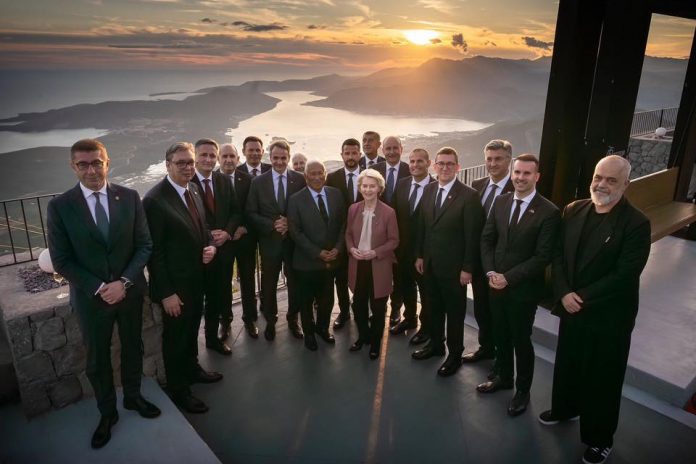
TIVAT, Montenegro, June 5 (BV) – European Union leaders and their counterparts from the six Western Balkan countries gathered in Montenegro on Friday amid growing debate over whether Brussels is preparing a new model of enlargement that could allow candidates to access some benefits of membership before formally joining the bloc.
The summit, attended by European Council President António Costa, European Commission President Ursula von der Leyen, French President Emmanuel Macron, German Chancellor Friedrich Merz and leaders from Albania, Bosnia and Herzegovina, Kosovo, Montenegro, North Macedonia and Serbia, comes at a pivotal moment for the EU’s enlargement policy.
For the first time in years, enlargement has returned to the top of the European agenda. However, Russia’s invasion of Ukraine has fundamentally changed the political logic behind the process.
What was once viewed largely as a technical exercise based on reforms and compliance with EU standards is increasingly being seen as a geopolitical tool aimed at strengthening Europe’s security and stability.
“The European Union’s commitment to the Western Balkans is real, just as real as the prospect of enlargement,” Costa said ahead of the summit, describing expansion as a strategic investment in peace, security and stability.
Ukraine changes the equation
The debate over enlargement has accelerated following the decision by EU member states to move forward with opening the first negotiation cluster with Ukraine.
Ukraine’s rapid progress has triggered concerns across the Western Balkans that countries which have spent years or even decades waiting in the accession queue could be overtaken by newer candidates.
European officials reject suggestions that the region is being sidelined. Yet behind closed doors, discussions have intensified over how to make enlargement more flexible and politically attractive.
The challenge facing Brussels is clear: maintaining momentum in candidate countries while full membership remains years away.
A new model takes shape
One idea increasingly discussed in European capitals is a phased or gradual accession model.
Under concepts supported by several EU leaders, candidate countries could gain access to selected EU policies, programmes, institutions and funding mechanisms before becoming full members.
The approach would allow countries to participate more deeply in the European project while continuing reforms required for accession.
German Chancellor Friedrich Merz recently proposed a form of associate membership that would give candidate countries greater involvement in EU decision-making structures without granting full voting rights.
Supporters argue that such a model would make enlargement more credible and deliver tangible benefits to citizens much earlier.
Critics warn that it could create a permanent category of second-tier members trapped in a grey zone between candidate status and full membership.
Integration before membership
Signs of this gradual integration strategy are already visible.
The EU has begun negotiations to extend its “Roam Like at Home” system to the Western Balkans, potentially allowing citizens to use mobile services across Europe without additional roaming charges.
The region is also being integrated into the Single Euro Payments Area (SEPA), enabling cheaper and faster cross-border financial transactions.
Western Balkan countries are increasingly participating in EU programmes, energy markets, transport networks and digital initiatives.
For Brussels, these measures are intended to demonstrate that European integration can produce concrete benefits before formal accession.
Different speeds across the region
The summit also highlighted the increasingly uneven pace of enlargement.
Montenegro remains the frontrunner and is already working with EU institutions on preparations for a future accession treaty.
Albania has gained praise from Brussels after meeting key benchmarks in the “Fundamentals” cluster covering rule of law, democratic institutions and judicial reform.
Bosnia and Herzegovina faces a more difficult path. European officials have warned that political deadlock has already cost the country €108 million in EU funding, while a further €373 million remains at risk if reforms continue to stall.
Serbia continues accession negotiations but faces criticism over democratic standards and its refusal to align fully with EU sanctions against Russia.
Kosovo’s European path remains closely linked to the normalization dialogue with Serbia, which Brussels continues to view as a prerequisite for further progress.
North Macedonia remains blocked
Among all Western Balkan candidates, North Macedonia remains in the most politically complex position.
During his visit to Skopje this week, Costa reiterated that constitutional amendments incorporating the Bulgarian minority remain the necessary next step before accession negotiations can formally advance.
The government of Prime Minister Hristijan Mickoski continues to insist on guarantees that no additional bilateral conditions will emerge after the constitutional changes are adopted.
Brussels, however, maintains that the negotiating framework agreed in 2022 remains unchanged and that implementation of existing commitments is the only path forward.
The disagreement leaves North Macedonia caught between domestic political realities and European expectations at a moment when the EU is actively searching for ways to accelerate enlargement elsewhere.
A strategic turning point
The Tivat summit is unlikely to produce dramatic breakthroughs or immediate accession decisions.
Its significance lies elsewhere.
For the first time since the major enlargement rounds of the 2000s, the EU is openly discussing how to adapt its enlargement model to a rapidly changing geopolitical environment.
Whether this results in a phased accession system, associate membership, or deeper sectoral integration remains unclear.
What is becoming increasingly evident is that Brussels no longer views enlargement solely as a bureaucratic process.
It is now a strategic instrument of European security.
For the Western Balkans, the question is no longer whether enlargement remains on the agenda.
The question is whether the region will enter the European Union as a full member in a single step, or through a new model of membership in stages.