


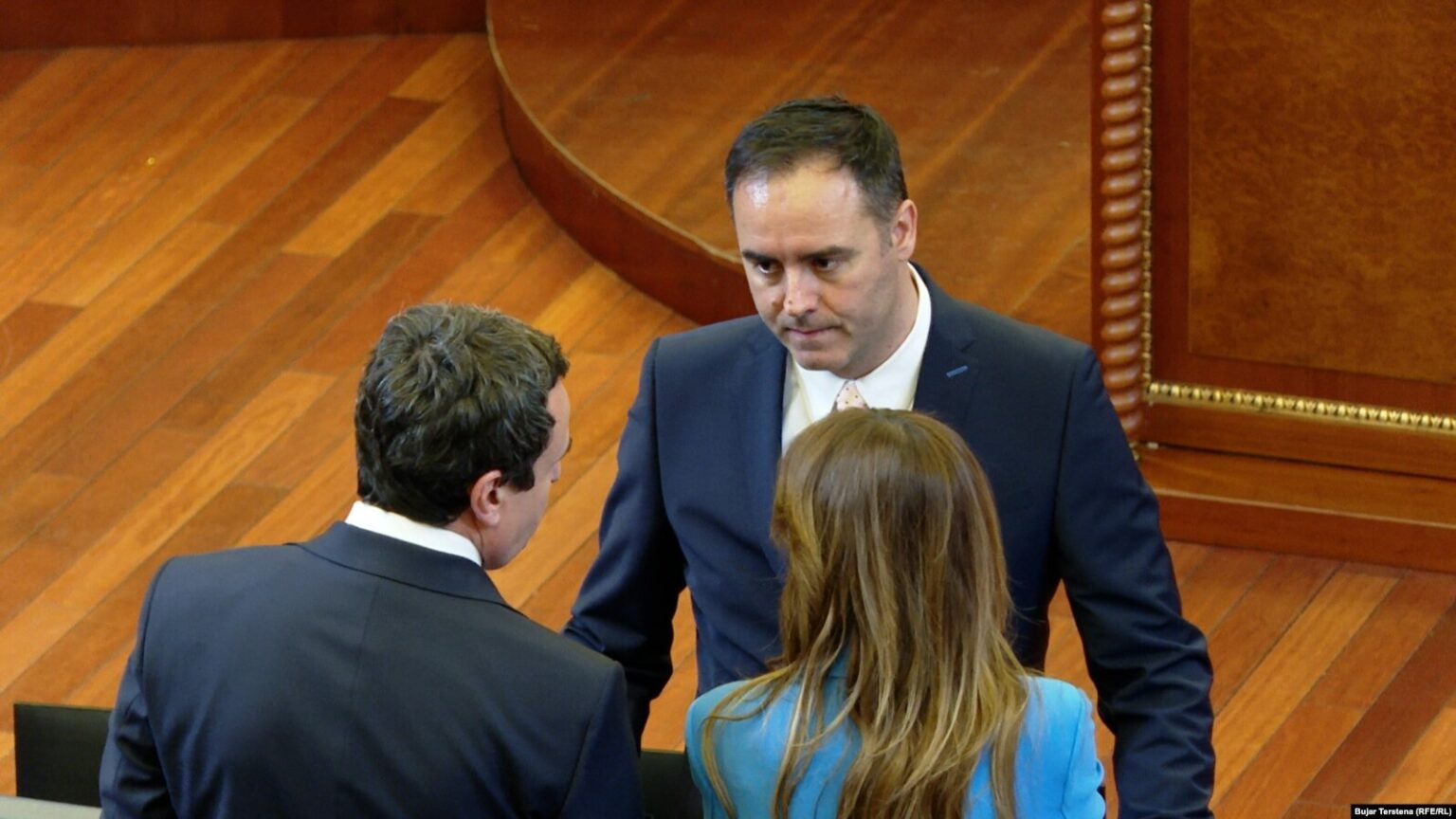
Prime Minister Albin Kurti urged opposition lawmakers on Tuesday to participate in the parliamentary vote to elect Kosovo’s president, as a prolonged political impasse threatens to escalate into a broader institutional crisis.
Speaking to reporters ahead of a parliamentary session, Kurti said the ruling Vetëvendosje movement was making “maximum efforts” to secure the election, but warned that the process ultimately depends on whether opposition deputies fulfill their constitutional role and attend the vote.
“We are making maximum efforts. Now we will see whether opposition deputies, who have a constitutional obligation to represent the people, will take part in the vote,” Kurti said.
Stalemate over quorum and voting rounds
The election of Kosovo’s president requires a qualified quorum and a defined number of votes across multiple rounds, making opposition participation essential. Previous sessions have failed due to insufficient attendance, leaving the process incomplete.
Vetëvendosje lawmaker Vigan Qorolli said the first round of voting could not be considered concluded, arguing that the required number of ballots had not been cast.
“The first round has not been exhausted because 80 votes were not submitted in the ballot box,” he said, adding that the process has yet to produce a valid outcome.
The uncertainty over procedural interpretation reflects broader disagreements between the ruling party and opposition blocs, which have repeatedly clashed over both candidates and the legitimacy of the process.
The deadlock highlights entrenched divisions in Kosovo’s political landscape, where opposition parties have so far resisted compromise proposals from the ruling party.
Political analysts say the lack of consensus signals a wider breakdown in inter-party cooperation, raising concerns about governance and institutional functionality.
According to observers, the main political actors have not demonstrated sufficient willingness to reach a compromise, despite the growing urgency of the situation.
Risk of early elections
Kosovo faces a constitutional deadline to elect a president, failing which the country could be forced into early parliamentary elections — a scenario increasingly seen as likely.
Analysts warn, however, that elections may not necessarily resolve the crisis.
“Early elections appear possible, but they do not guarantee a solution,” political observers have noted, pointing to persistent fragmentation and competing political interests.
Some analysts argue that the ruling party may be willing to risk elections despite uncertain outcomes, while opposition parties could see an opportunity to strengthen their parliamentary position.
At the same time, shifts within the political landscape — including tensions between Vetëvendosje and former allies — may further complicate any post-election coalition-building.
Institutional paralysis concerns
The inability to elect a president risks prolonging institutional paralysis in Kosovo, with potential knock-on effects for governance, reforms, and international engagement.
Experts stress that even a strong electoral mandate may not be sufficient to break the cycle of political deadlock without a broader willingness among parties to cooperate.
“Without compromise, the country risks entering repeated cycles of elections without resolving the core institutional issues,” analysts warn.
As the deadline approaches, pressure is mounting on all political actors to find a workable solution.
The outcome of the current standoff is likely to shape Kosovo’s political trajectory in the coming months, determining whether the country moves toward renewed elections or manages to restore institutional stability through consensus.
For now, the focus remains on whether opposition lawmakers will attend the vote — a decision that could determine not only the fate of the presidency, but also the direction of Kosovo’s political future.