


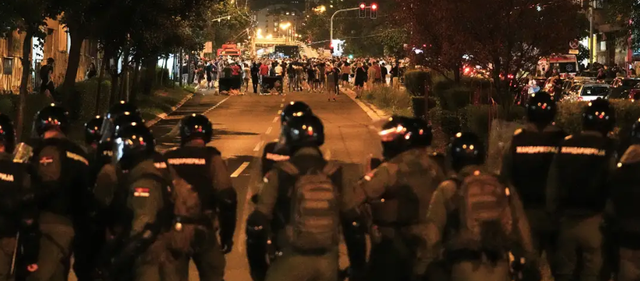
One year after a powerful, unexplained sound disrupted a major anti-government protest in Belgrade, Serbian authorities have yet to explain what triggered the event, leaving demonstrators and witnesses frustrated.
Thousands of protesters, including students, were attending a demonstration marking victims of the Novi Sad canopy collapse when an intense noise—described as a suction-like roar—caused panic and forced people to flee the streets.
“It was something I, as a father, can never forgive whoever ordered it, because my children were there,” said Miloš Blanuša, who attended the protest with his wife and two sons, aged six and 14. “It sounded like someone was vacuuming the air, and I felt as if something was about to strike—a train, a plane, flying objects.”
Authorities have denied using any banned weapons, including long-range acoustic devices, commonly referred to as “sonic weapons” or LRADs. They cited a report by Russia’s Federal Security Service (FSB) to support this claim, but neither Serbian institutions nor the FSB have clarified what caused the mass panic.
Sonic weapons are classified as non-lethal tools designed for crowd control, deterring attacks, or long-distance communication.
Investigation Stalled
The case remains in preliminary investigation at Belgrade’s First Basic Public Prosecutor’s Office. Approximately 170 witness statements have been collected, but no official determination has been made about the source of the sound, which left many with symptoms including dizziness, fainting, nausea, high blood pressure, and hearing problems.
Tatjana Rosić, who attended the protest, told RFE/RL she experienced pressure in her eardrums, blackouts, mood swings, and depressive episodes for days after the event. Video footage from the protest shows thousands scattering in panic, reacting to unusual sounds and vibrations.
“I first thought horses had been released because there was a thumping like tectonic vibrations,” Rosić said. “Then I heard a noise that was completely unknown and eerie. I experienced a blackout that didn’t last long, but it was intense.”
Blanuša recalled that the psychological impact of the protest surpassed a later traumatic car accident involving his family.
Calls for Accountability
Human rights groups, including the Committee of Lawyers for Human Rights (YUCOM) and the Belgrade Center for Security Policy (BCBP), have criticized the lack of progress. The European Court of Human Rights has issued interim measures obliging Serbian authorities to prevent the use of sonic devices at protests and to conduct an effective investigation.
Some NGOs have also filed criminal complaints alleging terrorism and misuse of state authority. In August, the Organized Crime Prosecutor returned the case to the First Basic Public Prosecutor’s Office, effectively closing their investigation into possible sonic weapon use.
“The FSB report seems intended to absolve the Serbian regime of responsibility and place blame on the demonstrators,” said Maja Bjeloš of BCBP. The report, published anonymously on the website of Serbia’s Security-Information Agency (BIA), claimed that biological test subjects experienced no adverse effects during experiments with Serbian police acoustic devices.
Conflicting Official Statements
Initially, Serbian authorities denied possessing sonic weapons, later acknowledging LRAD devices but insisting they were never used. Police publicly demonstrated the devices four days after the protest to show they caused no harm. Minister of Internal Affairs Ivica Dačić confirmed the device was present near the National Assembly on March 15 but maintained it was not activated.
U.S. manufacturer Genesis (Genasys), whose LRAD equipment was displayed by Serbian police, also stated that video and audio evidence showed no use of the device during the protest.
Protests Continue
Despite the official denials, citizens who were exposed to the unidentified sound continue to demand answers. Student and civic anti-government demonstrations persist, pressing not only for accountability over the Novi Sad tragedy but also for early parliamentary elections. President Aleksandar Vučić has suggested the end of the year as a possible date.
“Authorities must clarify what happened, and I believe this will be addressed when things are reset and brought into order,” Blanuša said.