




PARIS/SKOPJE/TIRANA, Sept 9 (BalkanView) – Albania outperformed Serbia, Montenegro, North Macedonia and Kosovo in mathematics in the latest PISA international education assessment, while Kosovo and North Macedonia remained well behind most of their regional peers, according to results published by the OECD.
The 2025 Programme for International Student Assessment, known as PISA, tested more than 760,000 15-year-olds across 91 countries and economies, representing about 33 million students worldwide. The assessment covered science, mathematics and reading and introduced a new test of computational problem solving.
Among the Western Balkan countries participating, Albania scored 433 points in mathematics, 408 in reading and 435 in science.
Montenegro recorded 411 in mathematics, 418 in reading and 435 in science, while Serbia scored 417, 415 and 429 respectively.
North Macedonia was considerably further behind, with 380 points in mathematics, 357 in reading and 378 in science.
Kosovo recorded the lowest results among the five, scoring 350 in mathematics, 340 in reading and 357 in science.
Bosnia and Herzegovina did not participate in PISA 2025. Its most recent participation was in 2018, meaning that a direct comparison with its neighbours in the latest cycle is not possible.
Albania moves ahead in mathematics
The results give Albania an unexpectedly strong regional position.
With 433 points in mathematics, Albania was ahead of Greece on 424, Romania on 419, Serbia on 417, Montenegro on 411 and Bulgaria on 405.
Its 435-point science result was also level with Montenegro and slightly above Greece’s 434.
Reading remains Albania’s weaker area, however. Its score of 408 was below Greece, Montenegro, Serbia and Romania, though above Bulgaria, North Macedonia and Kosovo.
The OECD nevertheless cautioned that Albania remained below the OECD average in all three traditional PISA subjects.
Only 55% of Albanian students reached at least the basic Level 2 proficiency in mathematics, compared with 65% across the OECD. In reading, just half reached Level 2 or above, compared with an OECD average of 69%, while 61% reached that threshold in science compared with 74% across the OECD.
The gap at the top was also significant. Only about 2% of Albanian students were high performers in mathematics, and about 1% reached the top levels in science. Almost none reached Level 5 or above in reading.
Serbia and Montenegro occupy the middle ground
Serbia and Montenegro form a second group in the Western Balkans.
Serbia performed slightly better than Montenegro in mathematics, 417 against 411, while Montenegro was ahead in reading, 418 against Serbia’s 415.
In science, Montenegro scored 435 compared with Serbia’s 429.
The figures put both countries well ahead of North Macedonia and Kosovo but still substantially below Europe’s strongest education systems.
For policymakers, that gap is significant because PISA is designed not principally to test whether students can reproduce curriculum content, but whether they can apply knowledge to problems they could encounter outside school.
That makes the results relevant not just to education ministries, but to long-term productivity, labour-market competitiveness and the ability of economies to adapt to technological change.
North Macedonia and Kosovo face the biggest challenge
North Macedonia’s results place it in the lower part of the international table.
Its science score was 378, mathematics 380 and reading 357.
Kosovo performed even lower, with 357 in science, 350 in mathematics and 340 in reading.
The difference between Albania and Kosovo is particularly striking.
Albanian students scored 83 points more in mathematics, 68 points more in reading and 78 points more in science than students in Kosovo.
North Macedonia also trailed Albania by 53 points in mathematics, 51 in reading and 57 in science.
Those are large gaps in PISA terms and point to sharply different outcomes between education systems that share geography, migration patterns and many of the economic challenges associated with the Western Balkans.
The figures also pose a difficult question for governments in Skopje and Pristina: whether years of curriculum reform, digitalisation programmes, teacher training and infrastructure investment are translating into measurable learning outcomes.
Croatia and Slovenia show another Balkan reality
Looking at the wider region changes the picture further.
Croatia and Slovenia remain substantially ahead of the Western Balkan economies.
Croatia recorded scores around the mid-to-high 470s, while Slovenia also performed significantly above Serbia, Montenegro, Albania, North Macedonia and Kosovo.
That places the EU members of the former Yugoslav region closer to the European mainstream and highlights an educational divide that broadly overlaps with differences in income, institutional capacity and EU integration.
Greece and Romania, despite performing below the OECD average, also remained ahead of most Western Balkan systems in several areas.
Bulgaria was an exception in reading, scoring 387, below Albania, Serbia and Montenegro.
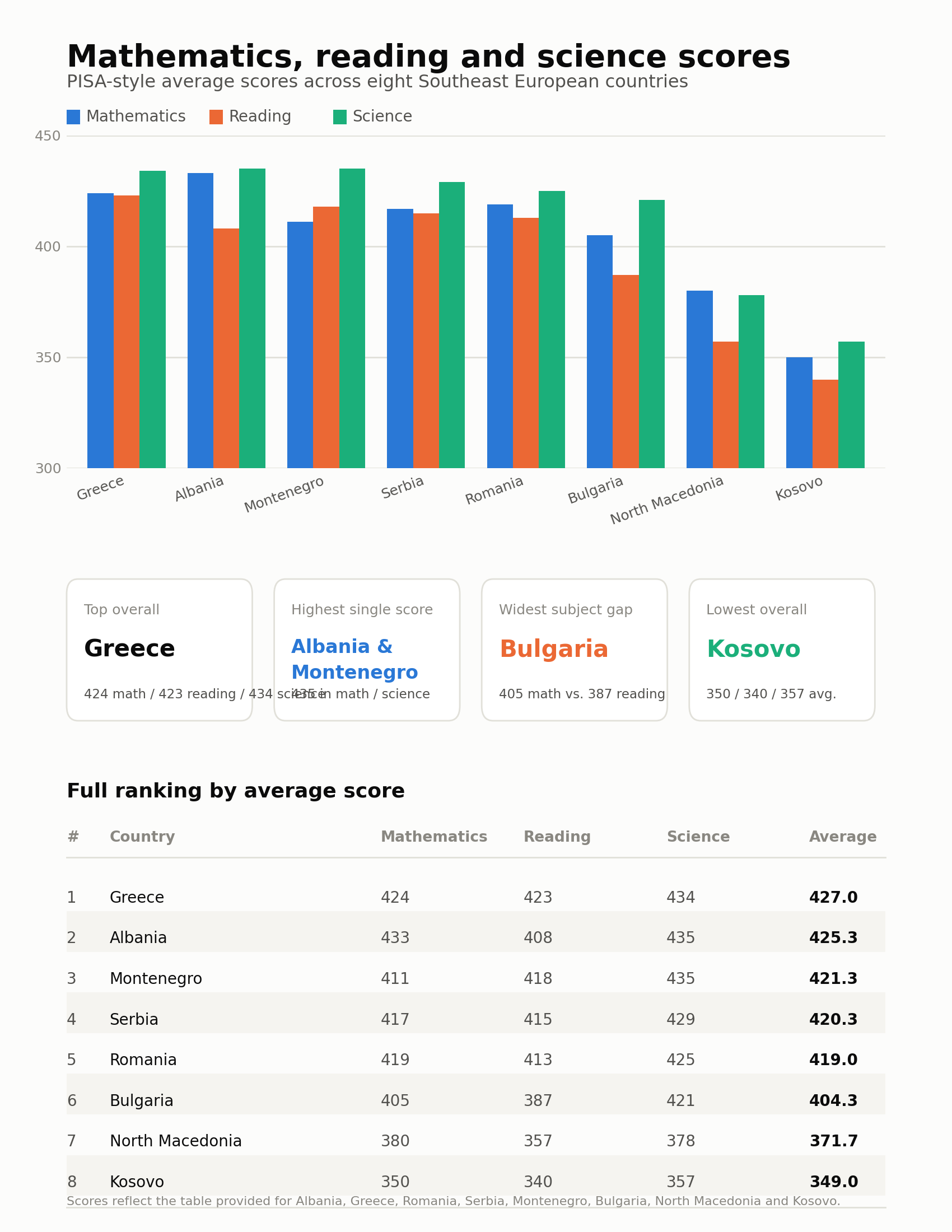
The figures confirm the broad pattern shown in the graphic accompanying this article. Albania leads this group in mathematics, Greece in reading, while Albania and Montenegro share the highest science score.
But the global story is darker
The Western Balkan rankings tell only part of the story.
PISA 2025 delivered a much broader warning about education globally.
The OECD said average performance among its member countries fell to the lowest levels ever recorded in science, reading and mathematics.
Reading saw particularly sharp deterioration between 2022 and 2025.
That decline is important because the skills weakening fastest are increasingly important in an AI-driven information environment.
The OECD highlighted students’ ability to evaluate information, connect different sources and think critically about what they read.
It also found that so-called “hasty reading”, where students move through material quickly but inaccurately, almost doubled from 2018 to 2025, reaching 9%.
This means PISA’s warning is no longer merely about whether students can read, calculate or understand basic scientific concepts.
It increasingly concerns whether young people can distinguish evidence from assertion, navigate large quantities of information and resist manipulation.
More than half may struggle with misinformation
That concern becomes even more significant as generative artificial intelligence transforms how students search for information, produce text and solve problems.
The OECD devoted part of the 2025 assessment to how students operate in a digital environment and warned that large numbers may be vulnerable to misinformation and disinformation.
The central challenge is not simply whether young people know that information should be checked, the OECD said, but whether they know how to assess evidence, challenge intuitive claims and judge which sources deserve trust.
For the Balkans, where social media is a major source of political and public information and disinformation has become a persistent democratic challenge, those skills have implications well beyond the classroom.
They affect the quality of future voters, employees, journalists, entrepreneurs and public officials.
AI changes what education must measure
PISA 2025 also introduced a new assessment of computational problem solving.
It examined whether students could use modelling and programming tools, experiment with solutions and design digital products.
About two-thirds of students across OECD countries reached Level 3 or higher, which the OECD describes as the level where students begin to demonstrate sufficiently solid knowledge and skills to advance quickly.
Around one quarter reached the two highest levels.
Macao, Singapore and the Chinese jurisdictions of Beijing, Shanghai, Jiangsu and Zhejiang were the strongest performers in this new field, while the OECD average was set at 500 points.
The addition marks a fundamental evolution in what education systems are expected to deliver.
A generation ago, access to information itself was an advantage.
With AI able to produce an answer to almost any routine question within seconds, the scarce skill is increasingly the ability to formulate the right question, test an answer and recognise when an apparently convincing response is wrong.
Asia retains the lead
At the global level, East Asian education systems again dominated.
The Chinese jurisdictions of Beijing, Shanghai, Jiangsu and Zhejiang and Singapore were the strongest performers across the three core subjects.
Estonia, Japan, South Korea, Macao, Chinese Taipei and Britain were also among the 10 leading education systems.
The results reinforce a long-running pattern in PISA: several East Asian systems combine high average performance with large numbers of students capable of solving complex problems.
But the inclusion of Estonia and Britain among the strongest systems also shows that exceptional results are not confined to one educational or cultural model.
Europe’s post-pandemic problem did not disappear
PISA 2022 had already revealed a historic fall in achievement after the COVID-19 pandemic disrupted schooling around the world.
The 2025 figures suggest the problem cannot simply be explained by school closures.
In many countries, performance has not rebounded.
The OECD said some countries did improve, including Costa Rica, Slovakia, Türkiye and Britain in science, but the aggregate direction across OECD members remained downward.
That shifts the debate from recovering lost pandemic learning towards a deeper question about whether education systems themselves are adapting quickly enough to changing student behaviour, technology and social conditions.
A development issue for the Western Balkans
For the Western Balkans, poor PISA results have consequences extending into economic development.
The region is already dealing with population decline, youth emigration and shortages of skilled workers.
If a smaller generation of young people is entering adulthood with comparatively weak literacy, numeracy and science skills, the demographic problem becomes a productivity problem as well.
Countries seeking to attract high-value technology, manufacturing and service investment require workers able not merely to perform routine tasks but to learn, adapt and solve unfamiliar problems.
Those are precisely the abilities PISA attempts to measure.
The gap separating North Macedonia and Kosovo from European and Asian leaders therefore risks becoming a wider competitiveness gap unless learning outcomes improve.
Albania’s results offer a different lesson
Albania’s stronger regional performance complicates any argument that relatively low income inevitably produces weak educational outcomes.
Its mathematics score exceeded those of several EU member states in southeastern Europe, while its science performance matched Montenegro’s and narrowly surpassed Greece’s.
But Albania’s reading performance and its limited share of top-performing students show that the picture is not one of an education system having solved its problems.
Instead, its results suggest that substantial differences in outcomes are possible even among neighbouring states with comparable economic constraints.
That makes policy, school quality, teaching, curriculum design, family background and how education systems use resources central to the regional debate.
PISA is not a school league table
The OECD also cautions against treating small score differences as definitive rankings.
PISA is a sample-based assessment and its country scores carry statistical uncertainty.
It measures the performance of 15-year-olds at system level rather than rating individual schools or pupils.
Nor does a PISA score alone explain why one country performs better than another.
Socio-economic inequality, school attendance, teacher quality, migration, language, resources and student motivation can all shape outcomes.
The results are therefore best read as a diagnostic tool rather than a simple international competition.
The real warning may be reading
For policymakers fixated on rankings, the most consequential finding from PISA 2025 may not be whether Albania is 16 points ahead of Serbia in mathematics or whether Montenegro edges Greece in science.
It may be the global decline in reading.
In a world where machines can increasingly calculate, translate, summarise and generate text, students need greater rather than lesser capacity to understand arguments, compare sources and identify unreliable claims.
The OECD’s results suggest those abilities are weakening at exactly the moment they are becoming more valuable.
For North Macedonia and Kosovo, the immediate challenge is catching up with their neighbours.
For Albania, Serbia and Montenegro, it is moving closer to stronger European systems.
But PISA 2025 delivers the same warning to all of them: the future education race will not be won by teaching young people to reproduce answers that artificial intelligence can already provide. It will depend increasingly on whether they can question, verify and understand those answers.