


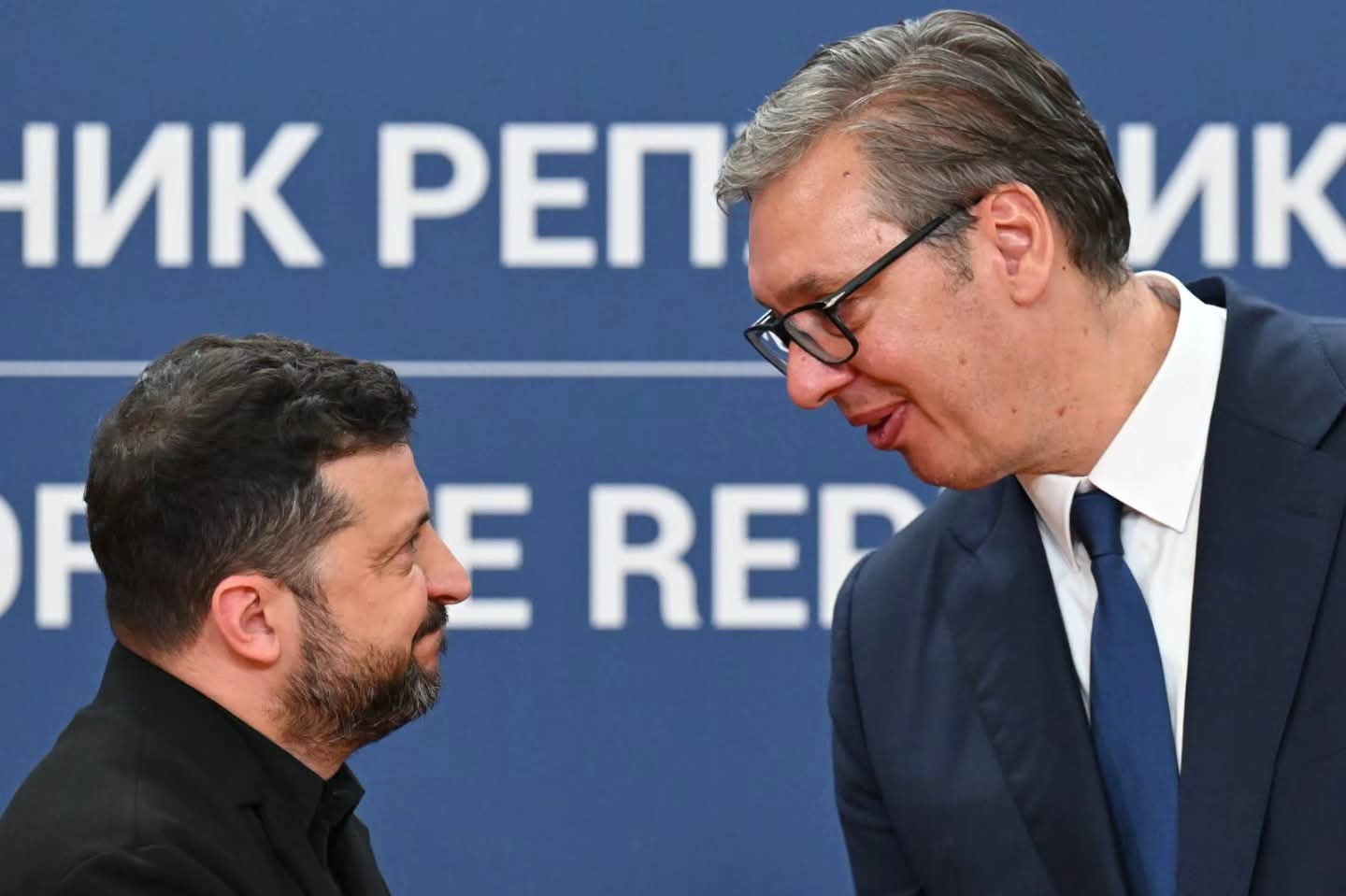
BELGRADE, Aug 8 (Balkan View) – Ukrainian President Volodymyr Zelenski used his first official visit to Serbia to push for deeper economic and energy cooperation with Belgrade, while Serbian President Aleksandar Vučić reaffirmed support for Ukraine’s territorial integrity, highlighting Serbia’s increasingly delicate balancing act between Kyiv, Moscow and the European Union.
The visit is politically significant for Serbia, which has traditionally maintained close relations with Russia and has resisted joining EU sanctions against Moscow, while at the same time supporting Ukraine’s territorial integrity and pursuing membership of the European Union.
Zelenski arrived in Belgrade on Friday and was formally welcomed by Vučić at the Palace of Serbia on Saturday. The two leaders held one-on-one talks followed by meetings between their delegations.
“Serbia and I, as its president, support the UN Charter and UN resolutions, which means the territorial integrity of all UN member states, including the territorial integrity of Ukraine,” Vučić said after the talks.
He also thanked Kyiv for supporting Serbia’s territorial integrity regarding Kosovo, whose independence Belgrade does not recognise.
“We will continue to pursue such a principled policy, and on this issue there is no ‘but’,” Vučić said.
Trade rises, free-trade agreement on the table
Economic cooperation featured prominently in the talks.
Vučić said bilateral trade reached about $450 million in 2025, while trade in the first six months of 2026 had already climbed to about $321 million.
Serbia’s main imports from Ukraine include iron ore, soy products and flax seed, while Serbian exports include fruit seedlings, sunflower seeds and baby food, Vučić said.
The two sides also discussed agriculture, mining, energy, railway infrastructure and the possible involvement of Ukrainian companies in projects in Serbia.
Zelenski said negotiations were under way on a Serbia-Ukraine free-trade agreement, with the aim of completing preparations by the end of 2026.
“We are working to have everything ready by the end of this year for the conclusion of a free-trade agreement,” Zelenski said in a statement after the talks.
He also said the two governments discussed ports and railways, reconstruction and projects that could create jobs in both countries.
The two countries signed a memorandum on cooperation in animal health and food safety during the visit.
Serbia promises more humanitarian support
Energy cooperation has gained urgency as Ukraine prepares for another winter after sustained Russian attacks on its infrastructure.
Zelenski said practically none of Ukraine’s thermal power plants had escaped attack and described Serbian cooperation in the energy sector as particularly important.
Vučić said Belgrade had prepared additional humanitarian assistance, including medicines and potential energy-related equipment needed during winter.
Zelenski thanked Serbia for what he described as its support for the Ukrainian people, sovereignty and territorial integrity.
He also backed Serbia’s EU aspirations.
“We would be glad if Serbia’s path towards EU membership accelerated,” Zelenski said.
Vučić reciprocated, saying Serbia would support Ukraine’s European integration and would not seek to obstruct Kyiv because of delays on Belgrade’s own accession path.
The sensitive issue behind the visit: Serbian arms
Behind the public emphasis on trade, reconstruction and European integration lies a far more sensitive dimension of Serbia-Ukraine relations: weapons and ammunition.
German newspaper Frankfurter Allgemeine Zeitung, as reported by Beta, said Ukraine has long been interested in Serbia’s defence industry and that possible cooperation could include joint drone production involving Ukraine, production facilities in Serbia and financing from the United Arab Emirates.
No such drone agreement was announced following Saturday’s presidential talks.
Former U.S. ambassador to Serbia Christopher Hill also told the German newspaper that Washington had previously helped facilitate purchases of Serbian ammunition that was urgently needed by Ukraine.
According to Hill, during his 2022-2025 posting in Belgrade, the Ukrainian ambassador approached the U.S. embassy with a list of military equipment Kyiv needed.
Hill said his embassy determined that Serbian manufacturers could supply some of those requirements and that Washington subsequently supported purchases of significant quantities of Serbian ammunition.
Serbia has repeatedly stressed that it does not sell weapons directly to Ukraine. But Serbian ammunition has reportedly reached Kyiv through intermediary countries such as Poland and the Czech Republic.
Hill said officials involved in Belgrade understood that those countries were not necessarily the final users.
The issue has caused friction with Moscow, which has publicly warned Serbia over Serbian-made weapons reaching Ukraine.
Hill said the United States had also closely monitored whether Serbia was supplying Russia and concluded there were no Serbian arms sales to Moscow on a scale worth mentioning.
A political signal to Moscow – but not a break
Zelenski’s reception in Belgrade therefore carries symbolism extending beyond bilateral relations.
Serbia remains dependent on Russian energy and has historically cultivated close political ties with Moscow. Public attitudes towards Russia also make any sharp foreign-policy shift politically sensitive for Vučić.
Yet Belgrade has simultaneously maintained relations with Kyiv, condemned violations of Ukraine’s territorial integrity and provided humanitarian assistance.
The visit demonstrates that Serbia is prepared to deepen those relations further.
That does not necessarily signal a Serbian break with Russia.
Rather, Belgrade appears to be widening its room for manoeuvre: maintaining Russian ties while expanding cooperation with Ukraine and attempting to demonstrate to Brussels that Serbia remains anchored to the European political space.
The strategy carries risks.
Closer relations with Zelenski could irritate Moscow and pro-Russian sections of the Serbian electorate. Failure to align with EU sanctions against Russia, meanwhile, continues to complicate Serbia’s credibility as an EU candidate.
For Vučić, the challenge is to move closer to Kyiv and Brussels without crossing a line that would fundamentally rupture relations with Moscow.
Zelenski’s visit suggests that line is moving.