


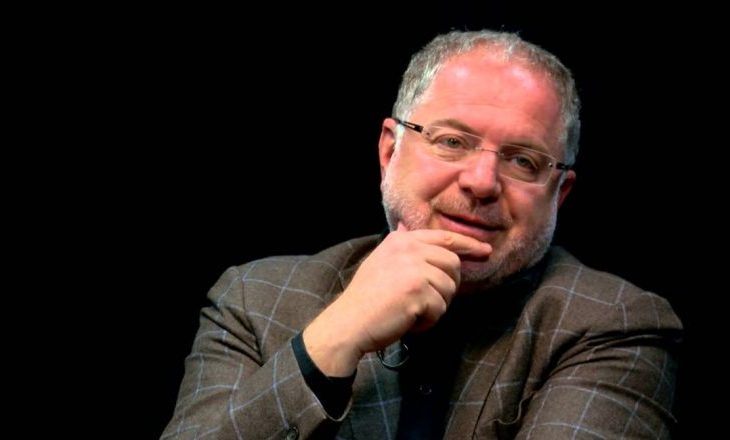
From Lubonja to Qori, from Fred Abrahams to environmental activists, from opponents of Trumpism to disillusioned young people: in front of the Prime Minister’s Office, grievances that normally would never share the same square came together.
By Baton Haxhiu
I watched yesterday’s protest up close and even spotted myself on one of the placards. The longer I stood there observing it, the more convinced I became that people were making a mistake in the way they were interpreting what was happening.
Some were focused on the numbers, others on the organizers, while another group was trying to present it as the beginning of a revolution against Edi Rama. None of these explanations seemed to capture what was actually unfolding in front of the Prime Minister’s Office.
What struck me from the very first minutes was the absence of homogeneity. I was not looking at a crowd gathered around a single idea, a political program, or a leader capable of giving direction to its anger. On the contrary, I was looking at people who had come there for entirely different reasons—people who, under normal circumstances, you would never find in the same square, much less at the same protest.
In one corner, you could hear the language of environmental activists speaking about Zvërnec and the threat they believe hangs over one of the most sensitive areas of Albania’s coastline. A few meters away, you heard the vocabulary of the radical left—talk of capital, oligarchy, and the concentration of wealth.
Further on stood civil society activists who viewed the issue primarily as one of democracy and transparency. Among them were people close to Arlind Qori, people who for years have shared many of the same concerns as Fatos Lubonja, and young people who had not come because of either of those causes but because they felt the country was no longer offering the future they had hoped for.
The longer I stayed, the more I realized that I was not watching one protest, but several protests that had decided to share the same square.
There was Fatos Lubonja with his long-standing battle against the concentration of power. If you have listened to him over the years, you understand that he is not protesting because of Zvërnec. He is protesting against a model of governance that, in his view, has shifted Albania away from democracy and toward the domination of a single man and a small circle of power. For Lubonja, Zvërnec is merely the latest episode in a much longer story.
There was also the shadow of Fred Abrahams, if not necessarily his physical presence. Because when someone like him publicly calls for a protest, he is not simply speaking about a construction project or a local dispute. He comes from a political and intellectual tradition deeply rooted in liberal democracy, human rights, and that segment of the Western establishment that today finds itself in open conflict with Trumpism.
In that sense, his presence in the debate also reflects the dissatisfaction of parts of the American and European democratic circles, as well as of that broader world often associated with international liberal foundations and networks that have spent years confronting the rise of populism and the new nationalism in the West.
There was Arlind Qori with his familiar rhetoric against capital, oligarchy, and social inequality. He, too, was not protesting a resort. He was protesting an economic model that, in his view, creates wealth for a few and insecurity for the many. For Qori, Kushner is a symbol—just as, for Lubonja, the concentration of power is a symbol.
There were the environmental activists, perhaps the most authentic group at the protest, because they are the only ones whose cause is directly tied to the territory itself. They speak about the lagoon, the ecosystem, the coastline, and the right of future generations to inherit a natural environment that has not been sacrificed to short-term economic interests.
You could also see individuals coming from more conservative religious and Islamic circles, some of whom have long been part of broader international networks opposing Israel and American policies in the Middle East. For them, the protest is neither about Zvërnec nor about Rama. It is part of a much larger ideological and geopolitical conflict that extends far beyond Albania.
And this is precisely where the paradox begins.
Each of these people arrived at the protest with a different story, a different adversary, and a different vision of the future. If they were to sit around the same table and discuss tomorrow’s Albania, there is a good chance they would agree on almost nothing. Yet for a few hours they agreed on one thing alone: opposition.
At first glance, everything seems to revolve around Zvërnec. It appears as though the protest emerged from opposition to an investment linked to Jared Kushner and Ivanka Trump. But the longer you observe it, the more you understand that Zvërnec is merely the gateway to a much larger story. It is the symbol through which conflicts, grievances, and ideological battles that did not originate in Albania have entered the same debate.
That is why I do not read this protest merely as an Albanian story. In it, I also see the local reflection of a global conflict that has been unfolding for years in the United States and Europe.
In this sense, I believe many people are mistaken when they assume that Edi Rama is the central figure of the protest. Rama is the local object of opposition. The larger symbol that unites a considerable portion of this heterogeneous world is Donald Trump and everything he represents in the political imagination of his opponents.
This explains why the protest included people who have no connection whatsoever to Zvërnec, tourism, or coastal development. You find individuals and networks that have for years been part of a broader anti-Trump front. You find activists who see the Rama–Kushner relationship as the local manifestation of a political and economic model they have opposed for a long time.
And this is precisely where another figure enters the picture—someone who was not physically present at the protest, yet who, in a certain sense, was present in every discussion: Sali Berisha.
Because many of the people I see within this front no longer regard Berisha as an alternative. On the contrary, many of them believe that both the Rama era and the Berisha era must come to an end. In this sense, their political struggle is not only against Rama. It is also against the political survival of Berisha as the sole opposition pole. They understand that as long as Albanian politics continues to be organized around the Rama-versus-Berisha conflict, the game will continue to be played according to familiar rules.
For this reason, a large segment of this front seeks, directly or indirectly, Berisha’s political end—not because they support Rama, but because they believe that only after Berisha’s departure can a genuinely new political contest begin.
Edi Rama’s reaction is equally interesting. In his recent meetings with Socialist Party supporters, he has not behaved like a politician who senses electoral danger. He has behaved like a leader who believes he is facing a vague, contradictory coalition incapable of transforming itself into a political alternative. That is why he mocks the protest, minimizes its numbers, and attempts to portray it as a temporary convergence of grievances without a political project.
And this is where the most important question arises:
What if Rama is right?
Perhaps, for the first time in many years, we are not witnessing the birth of an alternative, but the simultaneous exhaustion of several old alternatives. That is why this protest is more important than it appears—and also more fragile than its organizers may think.
Because if this protest fails to generate continuity, organization, and a shared narrative, the outcome could be the opposite of what its organizers intend. Instead of weakening Rama, it could strengthen him. It could hand him precisely the argument he seeks: that there is no alternative to him, only a temporary alliance of opponents who agree on nothing except their opposition.
For that reason, the real test is not the first protest.
The real test begins now, once the emotion fades and public attention disperses. Once the World Cup begins. Because modern politics is measured by its ability to hold the public’s attention.
If people are still talking about the protest a week from now, then we may be witnessing the beginning of a political phenomenon.
If, a week from now, they are talking only about matches, results, and football, then we will understand that what we saw in front of the Prime Minister’s Office was not the birth of a movement, but the temporary meeting point of many grievances that, for a brief moment, found a common square. (AlbanianPost)