



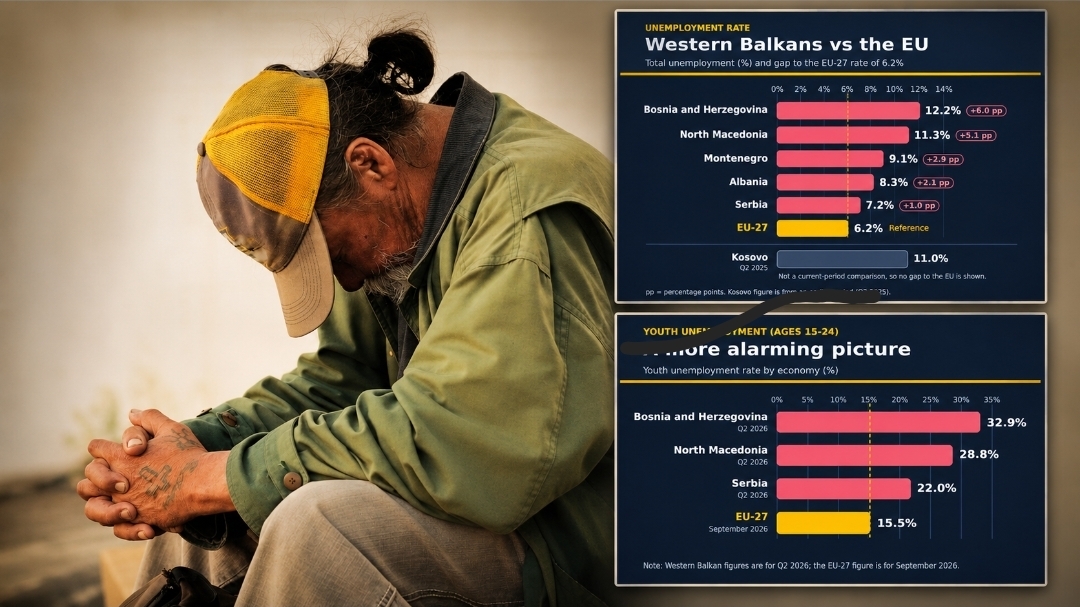
Unemployment in Bosnia and Herzegovina and North Macedonia is approaching twice the EU average, while youth joblessness exposes a deeper economic divide between the Western Balkans and the European Union.
Western Balkans, Nov. 7, 2026 (BalkanView) – Unemployment across much of the Western Balkans remains significantly higher than in the European Union, with Bosnia and Herzegovina and North Macedonia facing some of the region’s toughest labour market conditions despite years of economic reforms and efforts to join the bloc.
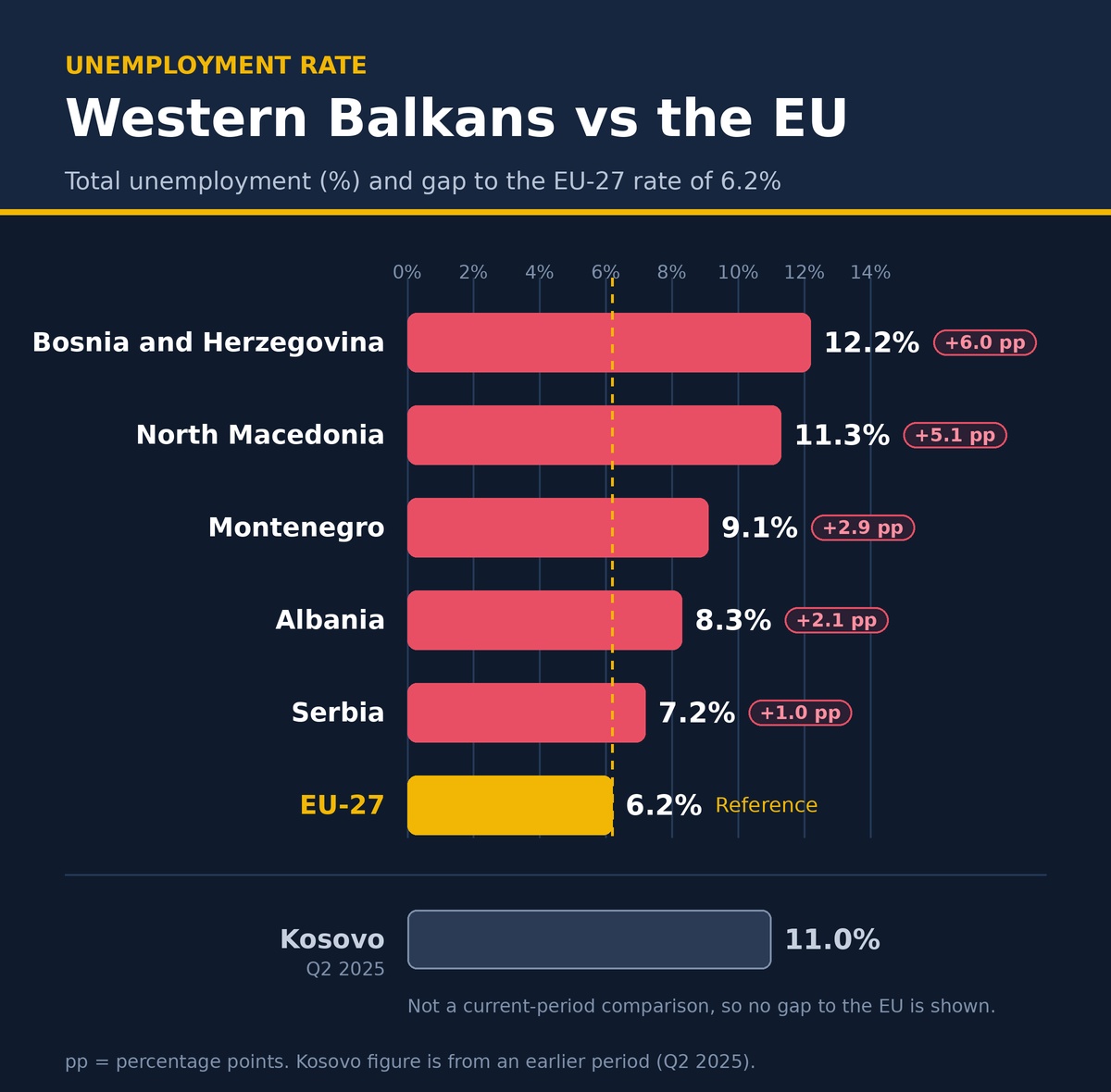
The latest available labour force surveys show unemployment at 12.2% in Bosnia and Herzegovina and 11.3% in North Macedonia in the second quarter of 2026, compared with an EU average of 6.2% in September, according to national statistical agencies and Eurostat.
Montenegro recorded unemployment of 9.1%, Albania 8.3% and Serbia 7.2% in the second quarter, placing all five economies above the EU benchmark.
Kosovo’s most recently verified figure was 11.0% in the second quarter of 2025, making a direct comparison with the other economies’ 2026 performance inappropriate.
The figures, although drawn from different reporting periods and not fully harmonised, highlight the employment challenges confronting a region seeking closer economic integration with the EU.
A region divided by job opportunities

The difference between the Western Balkans and the EU is particularly pronounced in Bosnia and Herzegovina, where the unemployment rate was six percentage points above the EU’s September level.
North Macedonia followed with a gap of 5.1 percentage points, while Montenegro stood 2.9 points above the EU benchmark.
Albania and Serbia recorded smaller differences of 2.1 and 1.0 percentage points respectively.
The regional figures contrast with several neighbouring EU member states.
Croatia, which joined the EU in 2013, recorded unemployment of 4.3% in September 2026. Bulgaria stood at 3.4%, Slovenia at 3.6% and Romania at 6.3%.
Germany, Europe’s largest economy and a major destination for Western Balkan workers, reported unemployment of 4.1%.
However, EU membership does not guarantee low unemployment. Spain recorded 10.3%, Finland 10.5% and Greece 7.6%, demonstrating that labour market performance varies considerably within the bloc.
The figures suggest that the Western Balkans’ employment difficulties reflect not only the region’s position outside the EU but also domestic economic conditions, workforce skills and the ability of businesses to create sustainable jobs.
Young people face the greatest obstacles
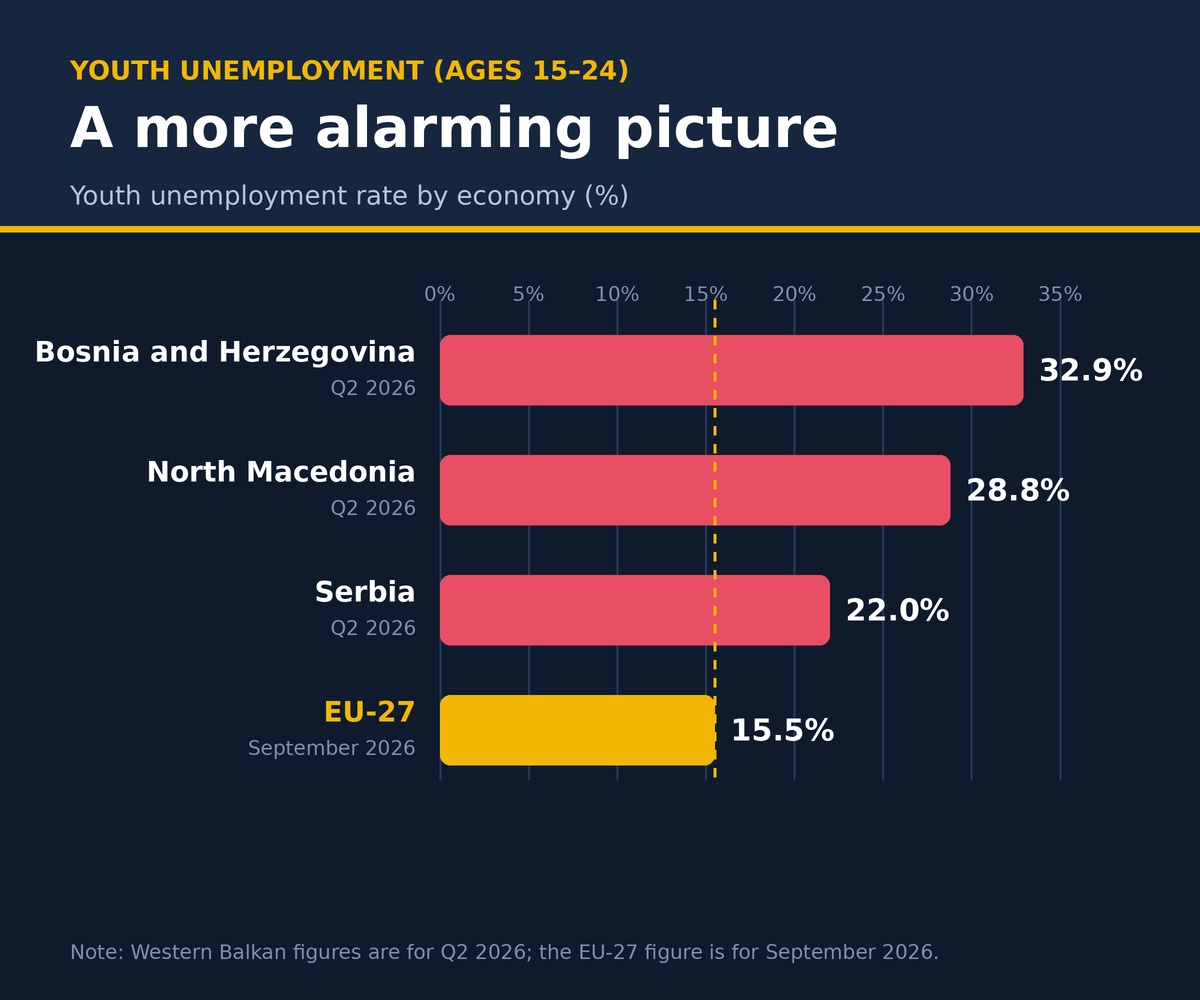
The divide becomes more pronounced when unemployment among young people is considered.
Across the EU, unemployment among people aged 15 to 24 reached 15.5% in September 2026, representing approximately 3.02 million young people.
In Bosnia and Herzegovina, the youth unemployment rate was 32.9% in the second quarter, more than double the EU benchmark.
North Macedonia recorded 28.8%, while Serbia stood at 22.0%.
These figures indicate that young people entering the labour market in parts of the Western Balkans face substantially greater difficulties finding work than their counterparts across the EU.
Youth unemployment rates measure the proportion of unemployed people within the economically active population aged 15 to 24, rather than the share of all young people without jobs. Students and other young people not actively seeking work are generally excluded.
The distinction is important in the Western Balkans, where participation in education, economic inactivity and informal employment can influence the interpretation of unemployment statistics.
High youth unemployment also raises questions about whether regional economies can retain skilled workers and offer sufficient opportunities to younger generations.
Serbia and Albania perform better, but challenges remain
Serbia’s unemployment rate of 7.2% was the lowest among the five Western Balkan economies with verified second-quarter 2026 data.
Albania followed at 8.3%, suggesting a relatively stronger employment position than Bosnia and Herzegovina, North Macedonia and Montenegro.
Yet the headline figures do not provide a complete picture of labour market conditions.
Unemployment measures only people who are without work, actively seeking employment and available to start. It does not capture those who have stopped looking for jobs, people working fewer hours than they would like or the quality and security of employment.
North Macedonia, for example, reported approximately 90,020 unemployed people in the second quarter of 2026, alongside 101,022 informally employed people.
The figures illustrate why falling unemployment does not necessarily mean that every worker has access to stable, adequately paid or formally registered employment.
Differences in labour force participation, migration and demographic trends can also affect unemployment rates.
EU unemployment rises despite relative stability
The latest Eurostat figures show that the EU’s seasonally adjusted unemployment rate stood at 6.2% in September 2026, unchanged from August but higher than the 6.0% recorded a year earlier.
The euro area’s unemployment rate was 6.5%, compared with 6.3% in September 2025.
Eurostat estimated that 13.773 million people were unemployed across the EU, including 11.555 million in the euro area.
Compared with September 2025, the number of unemployed people increased by 471,000 across the EU and by 420,000 in the euro area.
Youth unemployment also edged higher, reaching 15.5% across the EU from 15.4% in August.
Among the bloc’s largest economies, Germany recorded unemployment of 4.1%, Italy 6.3%, France 8.5% and Spain 10.3%.
The figures suggest that while the EU labour market remains relatively resilient, it is not immune to rising unemployment.
The economic challenge behind EU enlargement
The unemployment gap raises broader questions about the Western Balkans’ ability to converge economically with the European Union.
For countries pursuing EU membership, economic convergence involves more than adopting European legislation or meeting institutional benchmarks.
It also requires the development of competitive businesses, productive employment, stronger education and training systems, and labour markets capable of offering opportunities comparable to those available within the EU.
The EU’s Growth Plan for the Western Balkans is intended to support economic convergence through reforms, investment and gradual integration into parts of the EU single market.
However, the latest unemployment figures underline the scale of the employment challenge facing the region.
North Macedonia and Bosnia and Herzegovina remain particularly exposed, while Serbia and Albania appear better positioned on the headline unemployment measure.
The differences also suggest that regional economic integration alone may not be sufficient without domestic policies that encourage investment, improve workforce skills and expand formal employment.
A generation waiting for economic convergence
For the Western Balkans, the most significant warning may lie in youth unemployment.
While political leaders continue to debate the pace of EU accession, large numbers of young people face limited opportunities in their domestic labour markets.
The contrast is particularly striking between Bosnia and Herzegovina’s youth unemployment rate of 32.9% and the EU average of 15.5%.
North Macedonia’s 28.8% rate points to a similar challenge.
These disparities could reinforce incentives for young people to seek employment abroad, although unemployment statistics alone cannot establish the scale or causes of migration.
The region’s long-term economic prospects will depend partly on whether governments can turn reform commitments and investment into productive jobs.
For Western Balkan countries seeking EU membership, the figures highlight a central test of economic convergence: not merely bringing their legislation closer to European standards, but bringing their citizens’ employment prospects closer to those enjoyed across the bloc.
Data note: Western Balkan unemployment figures refer to the second quarter of 2026, except Kosovo’s second-quarter 2025 observation. EU and member-state figures refer to September 2026. The comparison combines national Labour Force Survey estimates and Eurostat seasonally adjusted monthly data, which are not fully equivalent. Figures should therefore be interpreted as indicative rather than strictly harmonised.