


SKOPJE/PRISTINA, Sept 14 (BalkanView) – North Macedonia’s Justice Minister Jeton Shasivari has triggered strong reactions in Kosovo, Albania and among ethnic Albanian political circles in North Macedonia after urging Kosovo to respect the Sept. 16 judgment against former Kosovo Liberation Army leaders regardless of the outcome.
Shasivari said in a Facebook post titled “Message for Kosovo: Justice Has No Political Side” that neither “the street, politics nor emotions” should judge the case and that the decision should be left to the court.
“Whatever the decision, it must be respected,” he wrote, adding that the parties retain the right to appeal.
He said the process should place both alleged victims and defendants’ rights at its centre, regardless of ethnicity, and that only judges could determine facts, responsibility and guilt on the basis of evidence and law.
“A Kosovo that aspires to European standards cannot choose which victims it will listen to and which it will forget,” Shasivari wrote. “Justice must be equal for everyone.”
His comments came three days before the Kosovo Specialist Chambers in The Hague is due to pronounce its trial judgment against former Kosovo president Hashim Thaçi and former senior KLA figures Kadri Veseli, Rexhep Selimi and Jakup Krasniqi.
All four have pleaded not guilty to charges of crimes against humanity and war crimes. Prosecutors are seeking sentences of 45 years for each defendant. The verdict is scheduled for Sept. 16.
A legal message becomes a political storm
Shasivari presented his position as a defence of judicial independence and the rule of law.
He said Kosovo needed confidence in justice rather than political pressure on judges and called on institutions to approach the verdict with “calm, responsibility and statesmanship”.
“In a functioning democracy, the strength of the state is not measured by its reaction to one decision, but by its ability to respect the law and institutions precisely when that is most difficult,” he said.
But critics interpreted the statement very differently.
Some accused him of hiding behind legal neutrality at a moment when, in their view, political leaders should explicitly defend the legitimacy of the KLA’s liberation struggle.
Others accused him of creating a false equivalence between allegations against individual KLA leaders and crimes committed by Serbian forces during the 1998-99 war.
The controversy quickly spread beyond North Macedonia. Albanian-language media in Kosovo and Albania picked up the comments, turning what began as a legalistic statement into a wider debate over how Albanian politicians should speak about the Specialist Chambers.
Shasivari says his words were distorted
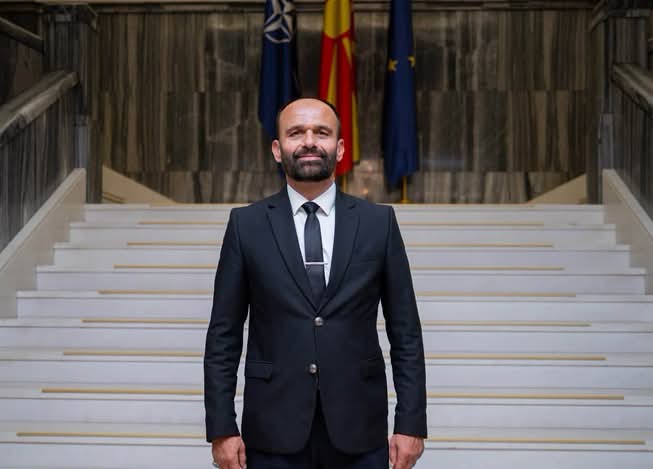
Facing the backlash, Shasivari issued a second statement denying that he had expressed support for the Specialist Chambers.
“Do not attribute to me a position I did not express,” he said.
He said he had neither supported the court nor helped secure votes for its creation, and argued that the institution was now an established reality whose consequences had to be dealt with.
Shasivari said his appeal had been made “in the interest of the Republic of Kosovo, the clean image of the KLA and Albanians in general”.
He accused critics of deliberately distorting his remarks for political purposes.
His clarification did little to end the dispute.
VLEN moves to distance itself
The political pressure became more significant when VLEN, the ethnic Albanian coalition in North Macedonia’s government from which Shasivari comes, issued a statement that appeared to distance the coalition from the minister’s formulation.
VLEN said the KLA’s war had been “just, clean and liberating” and described Kosovo’s independence as the result of sacrifice and resistance against repression.
The coalition nevertheless also invoked the presumption of innocence.
“An indictment is not a judgment,” VLEN said, adding that Thaçi, Veseli, Selimi and Krasniqi should be considered innocent unless and until a court decides otherwise.
VLEN said it stood with Kosovo, its people and the values of the KLA’s struggle, and expressed hope that the four former leaders would return free to their families.
The statement highlighted the political sensitivity of Shasivari’s position: a justice minister was emphasising institutional respect for a court, while his own coalition was placing greater emphasis on the legitimacy of the KLA’s war and explicitly hoping for acquittal.
Critics accuse him of ‘political neutrality’
Analyst Gazmend Aydini said the presumption of innocence was a legal obligation but argued that a politician also carried responsibility for taking a position on the broader historical context.
He said neutrality towards the court process should not translate into neutrality towards the nature of the KLA’s struggle.
His criticism reflected a wider argument heard across Albanian political circles: that individual criminal responsibility can and should be adjudicated, but that politicians should resist any interpretation that transforms a case against four individuals into a judgment on the KLA as a whole.
That distinction has become one of the central political questions surrounding the Hague proceedings.
The Specialist Chambers is formally trying four individuals, not the KLA. But both supporters and critics of the court acknowledge that the verdict could have much wider political and historical consequences.
Reuters reported on Sunday that the judgment is widely seen as potentially “tectonic” for Kosovo, affecting domestic politics, relations with Serbia and the country’s relationship with Western allies.
Kosovo journalists join attack
The reaction in Kosovo became highly personal.
Journalist Berat Buzhala condemned Shasivari in unusually harsh language and characterised his position as essentially aligned with Serbia’s view of the case.
Journalist Shkodran Ramadani linked Shasivari’s comments to the broader political position of Kosovo Prime Minister Albin Kurti and members of his government, arguing that they reflected longstanding scepticism towards former KLA leaders.
Lirim Mehmetaj also accused Shasivari of interfering in Kosovo’s internal affairs and suggested that his position reflected political thinking within Kurti’s Vetëvendosje movement.
Those claims were political accusations and were not accompanied by evidence showing that Shasivari’s statement had been coordinated with Kosovo’s government.
Shasivari rejected the broader interpretation of his remarks.
Albanian criticism focuses on Mladić contrast
Albanian journalist Esmeralda Mulaj raised a different issue.
She questioned why Shasivari had spoken so strongly about respecting the Hague judgment in the KLA case while, she said, he had not reacted similarly to the public glorification and funeral honours in Serbia for Ratko Mladić.
Mladić, the former Bosnian Serb military commander, was convicted of genocide at Srebrenica and other crimes.
His funeral in Belgrade this month, attended by senior officials and accompanied by military honours, triggered condemnation from Bosnia and senior European officials.
The comparison has become politically potent because it highlights two very different debates over international justice unfolding almost simultaneously in the region.
In Serbia, criticism has centred on the glorification of a man already finally convicted.
In Kosovo, the dispute concerns men who remain legally innocent unless and until judges convict them.
Kurti openly hopes for acquittal
The controversy around Shasivari also stood in contrast to the position taken by Kosovo Prime Minister Albin Kurti.
Kurti said on Monday that Kosovo’s war had clearly been a liberation struggle against an occupier responsible for war crimes and crimes against humanity.
He said he hoped the Sept. 16 judgment would be consistent with that reality and that Thaçi, Veseli, Selimi and Krasniqi would return home free.
That position places Kurti politically closer to VLEN’s subsequent statement than to the original tone of Shasivari’s appeal for strict institutional neutrality.
It also shows the difficult line facing Kosovo’s leadership: defending the KLA’s historical legitimacy while avoiding direct interference with judicial proceedings.
Protest planned in Skopje
The controversy is no longer confined to statements.
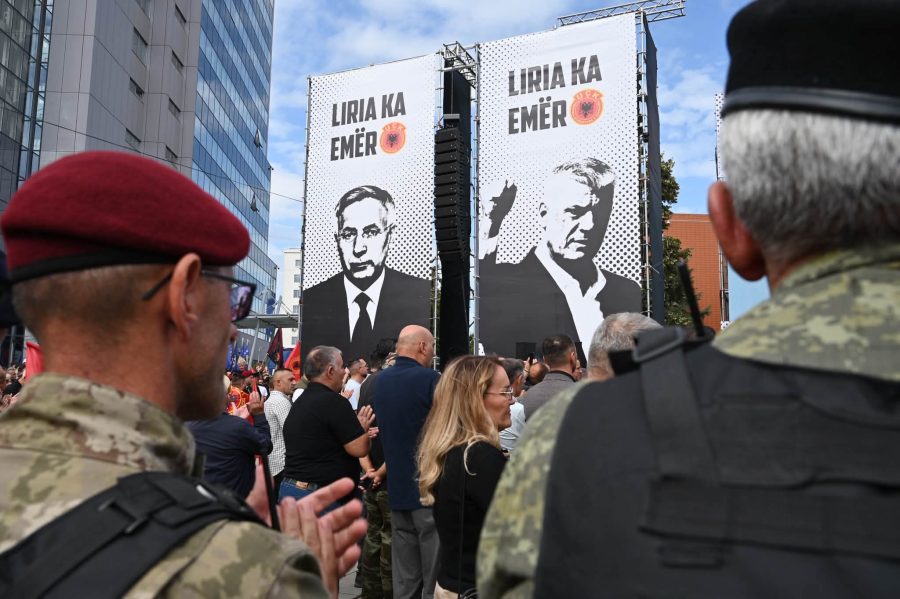
An Albanian youth organisation has called for a rally in Skopje’s Skanderbeg Square on Sept. 15 in support of the four former KLA leaders.
Organisers said the KLA formed part of the history and freedom of Albanians and called for mass participation.
The demonstration will take place just one day before the verdict.
That means the political mobilisation surrounding the case is now crossing Kosovo’s borders and becoming an Albanian regional issue.
Pristina prepares for major demonstrations
Kosovo itself is preparing for significant public gatherings on judgment day.
The U.S. Embassy has warned American citizens that large demonstrations are expected in central Pristina and other major cities on Sept. 16.
It advised U.S. personnel to avoid unnecessary travel around demonstrations and warned that large crowds, road closures and severe traffic disruptions were possible.
Kosovo police said security planning for major gatherings was standard procedure and urged the public not to rely on unconfirmed reports suggesting that the country was being “locked down”.
The warning followed a large Sept. 12 march in Pristina where thousands rallied in support of the former KLA leaders.
Veterans warn against first-instance convictions
The Organisation of KLA War Veterans has gone further, accusing international actors of preparing public opinion for possible convictions at first instance followed by acquittals on appeal.
Veterans’ leader Hysni Gucati said a conviction could immediately be used by Serbia in diplomacy, at the United Nations and in campaigns challenging Kosovo’s international recognition.
Those claims reflect the profound distrust parts of Kosovo society feel towards the Specialist Chambers.
They do not establish that international diplomats or judges are coordinating the outcome of the case.
The court has repeatedly maintained that its judges act independently and decide cases on the evidence and applicable law.
One verdict, two competing principles
The controversy surrounding Shasivari has exposed two principles that supporters on each side insist are compatible but which become politically difficult to reconcile.
The first is the rule of law: accused persons are presumed innocent, courts must be independent, victims must be heard and judgments must be respected through lawful procedures, including appeals.
The second is the political and historical defence of the KLA as a liberation movement formed in response to Serbian repression.
Shasivari emphasised the first.
His critics say he insufficiently defended the second.
VLEN attempted to combine both: it affirmed the presumption of innocence while explicitly calling the KLA’s struggle just and expressing hope that the defendants would be freed.
That distinction could become even harder to maintain after Sept. 16.
The real battle begins after the judgment
The verdict itself will determine the individual legal responsibility of Thaçi, Veseli, Selimi and Krasniqi.
But the political battle will be over what that judgment means.
If the four are acquitted, supporters are likely to describe the outcome as vindication not merely of the defendants but of the KLA’s historical narrative.
If they are convicted, Serbian political actors could attempt to extend the judgment to the KLA as a whole, while many in Kosovo are likely to insist that criminal responsibility remains individual.
Either way, appeals are possible.
And that is precisely why Shasivari’s relatively conventional legal statement has generated such an unconventional political backlash.
Two days before the judgment, the argument is no longer merely about four defendants.
It is about who has the authority to define Kosovo’s war, whether legal neutrality is possible when history remains politically contested, and where the boundary lies between respecting a court and defending a national liberation narrative.
For North Macedonia’s Albanian political bloc, the controversy has also become an internal test.
Shasivari’s own coalition has now made clear that, while it accepts the principle of presumption of innocence, it wants no ambiguity over where it stands on the KLA.