


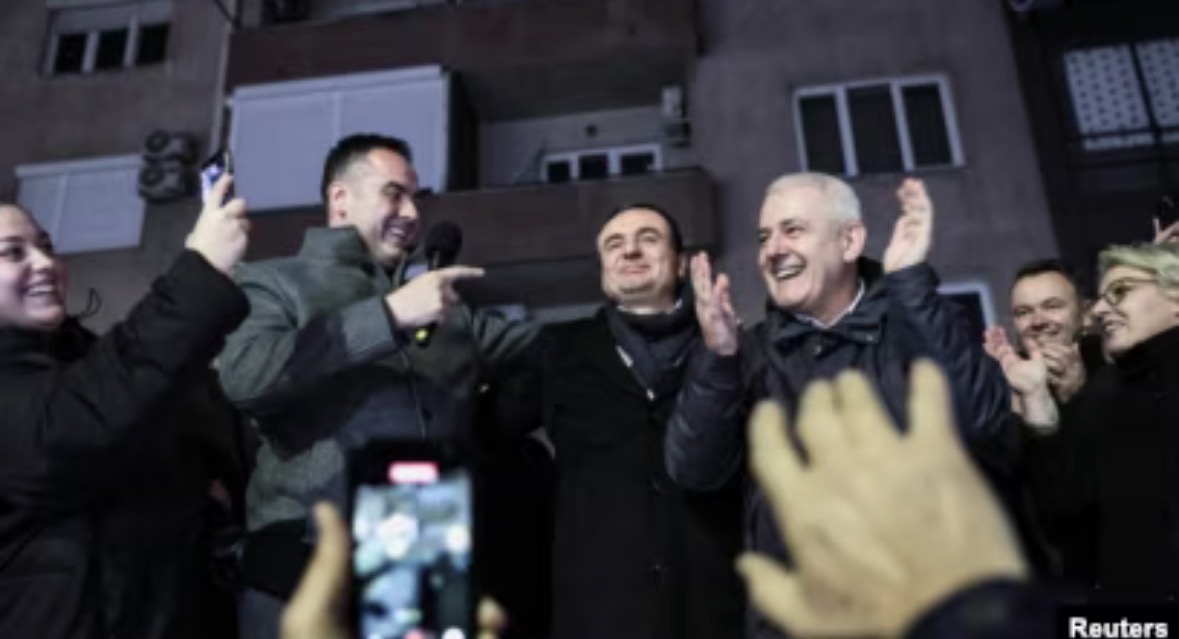
Kosovo Prime Minister Albin Kurti scored a decisive victory in snap parliamentary elections on Dec. 28, cementing his dominance over a fractured opposition and positioning his Self-Determination Movement (LVV) to form a new government with relative ease, analysts said.
Preliminary results from the Central Election Commission (CEC) show LVV winning 49.30% of the vote, excluding conditional ballots and votes from the diaspora, putting the party on track to replicate or surpass its 2021 landslide and secure around 56 seats in the 120-member parliament.
Political analysts say the scale of the victory reflects not only Kurti’s continued appeal to voters but also the inability of rival parties to present a credible alternative after months of institutional paralysis, polarising rhetoric and failed attempts to form a government following February elections.
“This is a spectacular victory for LVV, handed to it by an opposition that has shown a complete lack of ideas on how to confront Kurti’s powerful populism,” political analyst Artan Muhaxhiri told Radio Free Europe/Radio Liberty (RFE/RL).
Opposition left trailing
The main opposition Democratic Party of Kosovo (PDK) won 21.01% of the vote, while the Democratic League of Kosovo (LDK) secured 13.59% and the Alliance for the Future of Kosovo (AAK) 5.68%, according to preliminary data. The Social Democratic Initiative (Nisma) failed to cross the electoral threshold.
The results underscore the depth of the opposition’s crisis, analysts said, as voters appeared unconvinced by leadership figures who struggled to articulate clear policy alternatives or mobilise broader public support.
“Citizens have noticed the lack of leadership in opposition parties and the absence of a figure capable of changing the political dynamic,” political scientist Dritëro Arifi told RFE/RL.
Based on preliminary seat projections, LVV can form a majority with the support of non-Serb minority lawmakers, repeating its 2021 governing formula without the need for coalition partners from among Albanian opposition parties.
Serb representation and minority balance
Serb List, the main party representing Kosovo Serbs, won 4.74% of the vote and claims all 10 seats reserved for the Serb community, though final confirmation awaits the CEC’s certification. It remains unclear whether a rival Serb party led by Nenad Rašić will secure a seat.
The distribution of minority seats is expected to play a role in parliamentary arithmetic but is unlikely to threaten LVV’s ability to form a government.
A more measured Kurti
In contrast to his confrontational tone after earlier elections, Kurti struck a notably cautious note in his victory speech, calling for swift certification of results and cooperation with other parties on international agreements.
Observers interpreted the softer rhetoric as a tactical adjustment, reflecting the political challenges ahead – including the election of a new president in spring 2026, which requires a two-thirds quorum of lawmakers present in parliament.
“We are not used to seeing Kurti like this. It is positive,” Arifi said. “But while the language was that of a winner, the enthusiasm was restrained.”
Analysts say Kurti’s room for manoeuvre on the presidential vote will be limited by deep mistrust between LVV and the two largest opposition parties, PDK and LDK, both of which accuse President Vjosa Osmani of favouring Kurti during her term.
“It will be extremely difficult to convince PDK and LDK even to stay in the chamber to ensure the quorum needed to elect a president,” Muhaxhiri said, warning that failure could once again push Kosovo into early elections.
Risk of renewed deadlock
The snap election was triggered after months of political deadlock following the Feb. 9 vote, when parliament failed to constitute by an Oct. 10 deadline and neither Kurti nor a second LVV nominee managed to secure enough support to form a government.
Analysts say the opposition now faces a strategic dilemma: cooperate pragmatically to avoid another election, or risk further marginalisation if voters blame it for renewed instability.
“If the opposition is seen as obstructive, Kurti could win 60–70% in another election,” Arifi said.
For now, attention turns to the CEC’s final count, including diaspora and conditional votes, a process that could take several weeks and may be followed by legal challenges. Until then, Kosovo’s political future appears firmly in Kurti’s hands – but not without institutional tests that could yet reshape the balance of power.