


Kosovo entered a critical political day on Tuesday with parliament facing a deadline to elect a president, uncertainty over who can exercise presidential powers if it fails, and a bitter dispute over proposed changes to the Hague-based war crimes court that has already brought protesters and police into violent confrontation.
PRISTINA, Oct 6 (BalkanView) — Kosovo’s political crisis intensified on Tuesday as the deadline for electing a new president collided with a dispute over proposed changes to the law governing the country’s Hague-based war crimes court, leaving parliament confronting both a constitutional impasse and mounting pressure from the streets.
Acting President Albulena Haxhiu has asked Kosovo’s Constitutional Court to clarify who can exercise presidential powers after the expiration of the six-month period in which she has served as acting head of state if parliament fails to elect a new president.
Her office said the request was submitted on Oct. 5, one day before the deadline set for parliament to elect a president.
The issue has potentially far-reaching consequences.
The Constitutional Court has previously determined that if parliament fails to elect a president by Oct. 6, the Assembly is dissolved and Kosovo must hold an early parliamentary election within 45 days.
But the constitution gives the president responsibility for calling elections while also limiting the period during which an acting president can exercise the office to six months.
Haxhiu has served as acting president since the mandate of former President Vjosa Osmani ended on April 4.
That has produced an unusual constitutional question: if parliament fails to elect a president and must be dissolved, who has the authority to formally call the election?
Haxhiu’s office said it had asked the Constitutional Court to determine how and by whom essential presidential powers should be exercised once the six-month period has expired and no new president has been elected.
The court had not announced a ruling on the new referral by early Tuesday.
A second battle over the Hague court
The presidential crisis is unfolding alongside an increasingly heated confrontation over the Kosovo Specialist Chambers, the Hague-based court established under Kosovo law in 2015 to prosecute crimes connected with the 1998-99 Kosovo war.
The dispute intensified after former Kosovo President Hashim Thaçi and three other former senior Kosovo Liberation Army figures were convicted in September of war crimes.
Proposed amendments to the law governing the Specialist Chambers passed their first reading in parliament on Monday.
According to Reuters, the proposed changes include limiting prison terms to 15 years, allowing appeals to Kosovo’s Supreme Court, permitting sentences to be served in Kosovo and creating the possibility of presidential amnesty.
The proposals have become a major point of confrontation between Prime Minister Albin Kurti’s Vetëvendosje movement and the opposition Democratic Party of Kosovo, or PDK.
Kurti has criticised the legislation as rushed and said additional legal and financial assessments were needed.
Vetëvendosje lawmakers supported the proposals at first reading but did not back an immediate second vote.
The PDK has pushed for rapid approval.
‘Albin, come to parliament’
PDK lawmaker and Deputy Speaker Vlora Çitaku directly appealed to Kurti on Tuesday to come to parliament and vote for the amendments.
“Albin, come to the Assembly. Come and let us vote for the law,” Çitaku wrote on Facebook.
She urged Kurti to avoid further confrontation following the previous night’s clashes between protesters and police.
“Today we do not need clashes. We do not need tensions. We do not need violence. We need responsibility. We need calm. We need political courage,” she said.
Çitaku argued that Kurti had a responsibility to appear before parliament, listen to citizens and support the legislation, presenting the amendments as a measure to defend former KLA members prosecuted by the Specialist Chambers.
She also accused Kurti of ordering police to use force against protesters.
Çitaku provided no evidence supporting the allegation that the prime minister personally ordered police action against demonstrators.
The political dispute follows failed efforts to reach an agreement between Kurti and PDK leader Bedri Hamza.
The PDK has linked its willingness to help resolve the presidential impasse to passage of the Specialist Chambers legislation.
The party has said its 22 parliamentary votes could become available for resolving the presidential question once the amendments receive final approval.
Protest turns violent
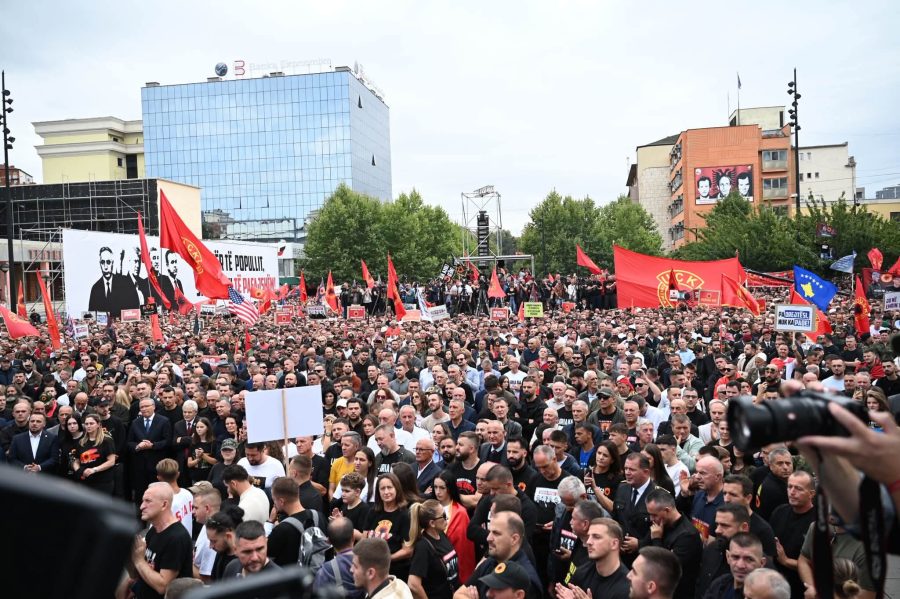
The political confrontation spilled onto the streets of Pristina on Monday.
Protesters demanding changes to the Specialist Chambers law clashed with police outside government and parliament buildings.
Police used tear gas and water cannon after demonstrators threw stones and firecrackers, Reuters reported.
At least 17 people were injured and three were arrested.
The demonstrations reflect the continuing sensitivity in Kosovo surrounding the prosecution of former KLA commanders.
The KLA fought Serbian forces during the 1998-99 Kosovo war and is widely regarded among Kosovo Albanians as the force that fought for the country’s liberation.
The Specialist Chambers, however, was established to prosecute individual crimes allegedly committed by KLA members during and immediately after the conflict.
Its creation and operation have remained deeply controversial in Kosovo.
Presidency and Specialist Court become intertwined
What began as two separate political questions — electing a president and changing the Specialist Chambers law — has increasingly developed into a single political confrontation.
The PDK wants the court amendments approved before helping resolve the presidency.
Kurti’s Vetëvendosje has argued that the proposed changes require further examination.
Meanwhile, the clock on the presidential process has continued to run.
That makes Oct. 6 potentially decisive.
If parliament elects a president, Kosovo can avoid the immediate constitutional consequence of dissolution.
If it fails, the Constitutional Court’s previous ruling points towards a snap parliamentary election within 45 days.
But Haxhiu’s referral has exposed an unresolved issue over who would exercise the presidential authority required during that transition.
Legal experts have described the situation as an unusual gap in Kosovo’s constitutional framework, with differing interpretations over whether the six-month limitation on an acting president can be extended or how continuity of the presidency should otherwise be guaranteed.
Kosovo waits for the court — and parliament
The Constitutional Court has therefore once again found itself at the centre of Kosovo’s political crisis.
Haxhiu’s office has argued that constitutional provisions should be interpreted together so that the expiration of one deadline does not make it impossible to fulfil other constitutional obligations.
Its position is that a constitutional solution must ensure that elections can be called and held within the required deadlines.
The court has yet to say how it will resolve that dilemma.
Meanwhile, parliament faces its own decision.
Lawmakers must determine whether they can overcome divisions over the presidency while simultaneously confronting demands for changes to one of the most politically sensitive laws adopted by Kosovo since independence.
The combination has produced an unusually volatile moment: a presidency without an agreed successor, a parliament potentially approaching automatic dissolution, a disputed war crimes court and protesters demanding action outside the legislature.
For Kosovo, the immediate questions are now intertwined:
Can parliament elect a president before the deadline? Can the parties reach agreement over the Specialist Chambers law? And if they cannot, who will exercise the presidential authority needed to take the country into another election?