


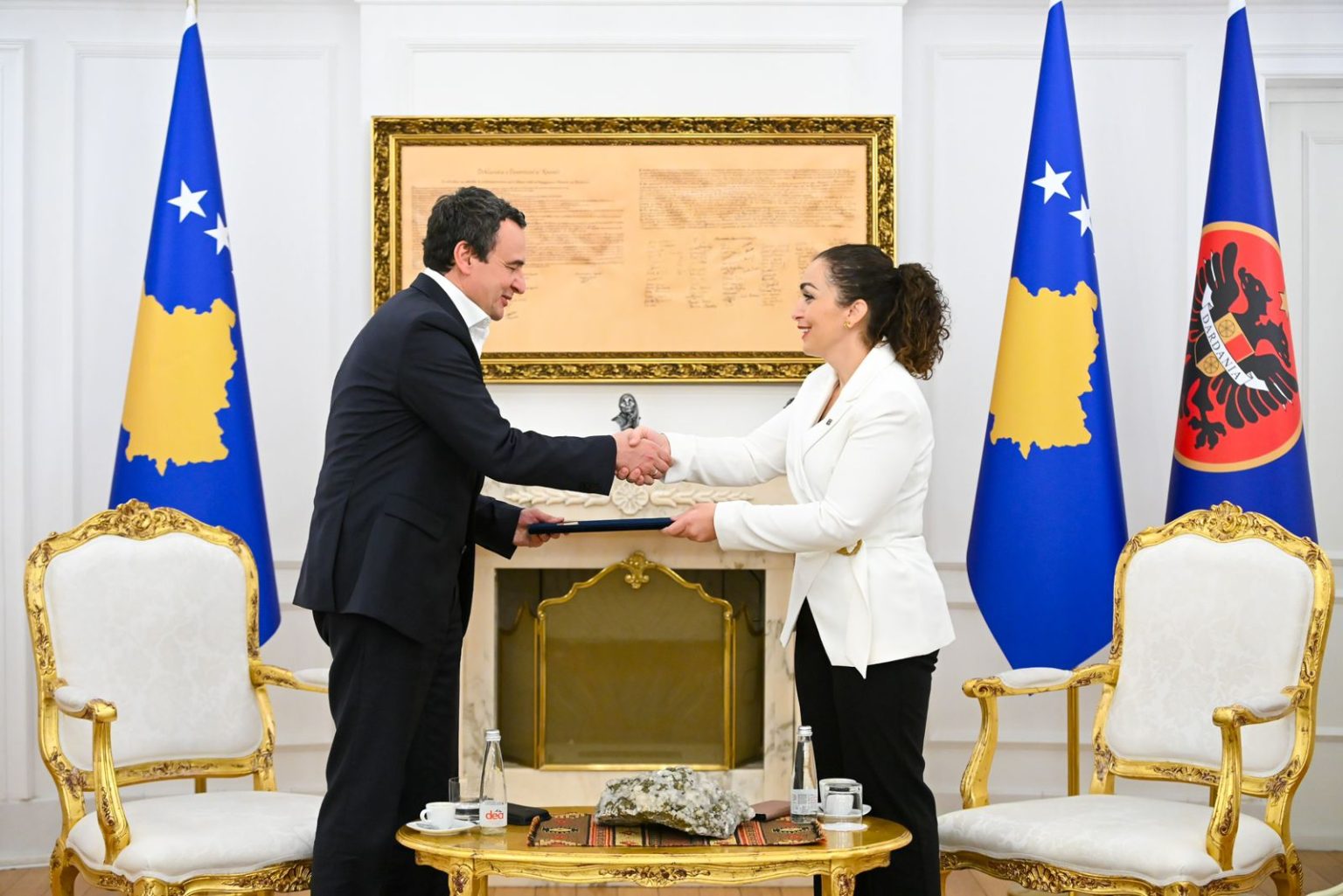
Office of the President of Kosovo said on Wednesday that a ruling by the Constitutional Court of Kosovo confirmed that President Vjosa Osmani did not violate the constitution with her decree to dissolve parliament, as political divisions deepened over the interpretation of the judgment.
In a statement, the presidency said the court had found “in no paragraph” that Osmani breached the constitution, adding that responsibility for developments that could lead to new elections lies with parliament.
“The court confirmed that it is not the decree that takes the country to new elections, but the failure of the Assembly to elect a new president,” the statement said.
The ruling follows requests filed by Prime Minister Albin Kurti and a group of lawmakers, including Arbërie Nagavci, regarding Osmani’s March 6 decree dissolving the Assembly.
The court ruled that the president’s decree produces no legal effect and gave lawmakers 34 days to complete the procedure for electing a new head of state. If they fail to do so, the country will automatically proceed to early parliamentary elections.
Call for swift action
The presidency urged lawmakers to convene a session as soon as possible to elect a new president, stressing that granting an additional deadline was not within the president’s powers but required judicial interpretation.
It also criticised political statements describing the decree as unconstitutional, calling them a “misreading” of the ruling and an “extreme politicisation” of a matter the court had clarified.
Split political reactions
The decision has triggered conflicting reactions across Kosovo’s political spectrum.
Nagavci, from the ruling Vetëvendosje party, said the judgment confirmed that the decree was unconstitutional and called for joint efforts to avoid a new political crisis.
“We must work to elect the president and avoid unnecessary elections,” she said.
Meanwhile, Lumir Abdixhiku, head of the Democratic League of Kosovo, said the ruling returns the process to parliament and gives no advantage to any side.
“The main responsibility lies with the parliamentary majority,” Abdixhiku said, adding that the president should be elected through political agreement rather than imposition.
The Democratic Party of Kosovo said it would convene its leadership to discuss next steps, adding that it respects the court’s decision.
Deadlines and election risk
In its ruling, the court clarified that the procedure to elect a president cannot last more than 60 days and must be completed no later than 30 days before the end of the incumbent’s mandate.
However, it found that the Assembly, constituted in February, had not had sufficient time to complete the process, justifying the additional 34-day deadline.
If lawmakers fail to elect a president within that period, parliament will be automatically dissolved and early elections must be held within 45 days, in line with the constitution.
The ruling takes immediate effect and is final, setting the legal framework for resolving one of Kosovo’s latest institutional disputes.