


Kosovo has publicly aligned itself with the United States in the early stages of its military operations against Iran, reaffirming its position in the Western alliance and condemning the Iranian regime, officials said.
Experts say Kosovo is not a likely target for Tehran, though the country is not entirely insulated from regional developments.
Hours after the first U.S.-led strikes on Iran, Kosovo authorities voiced support for Washington, condemning Tehran and reiterating backing for the Western alliance.
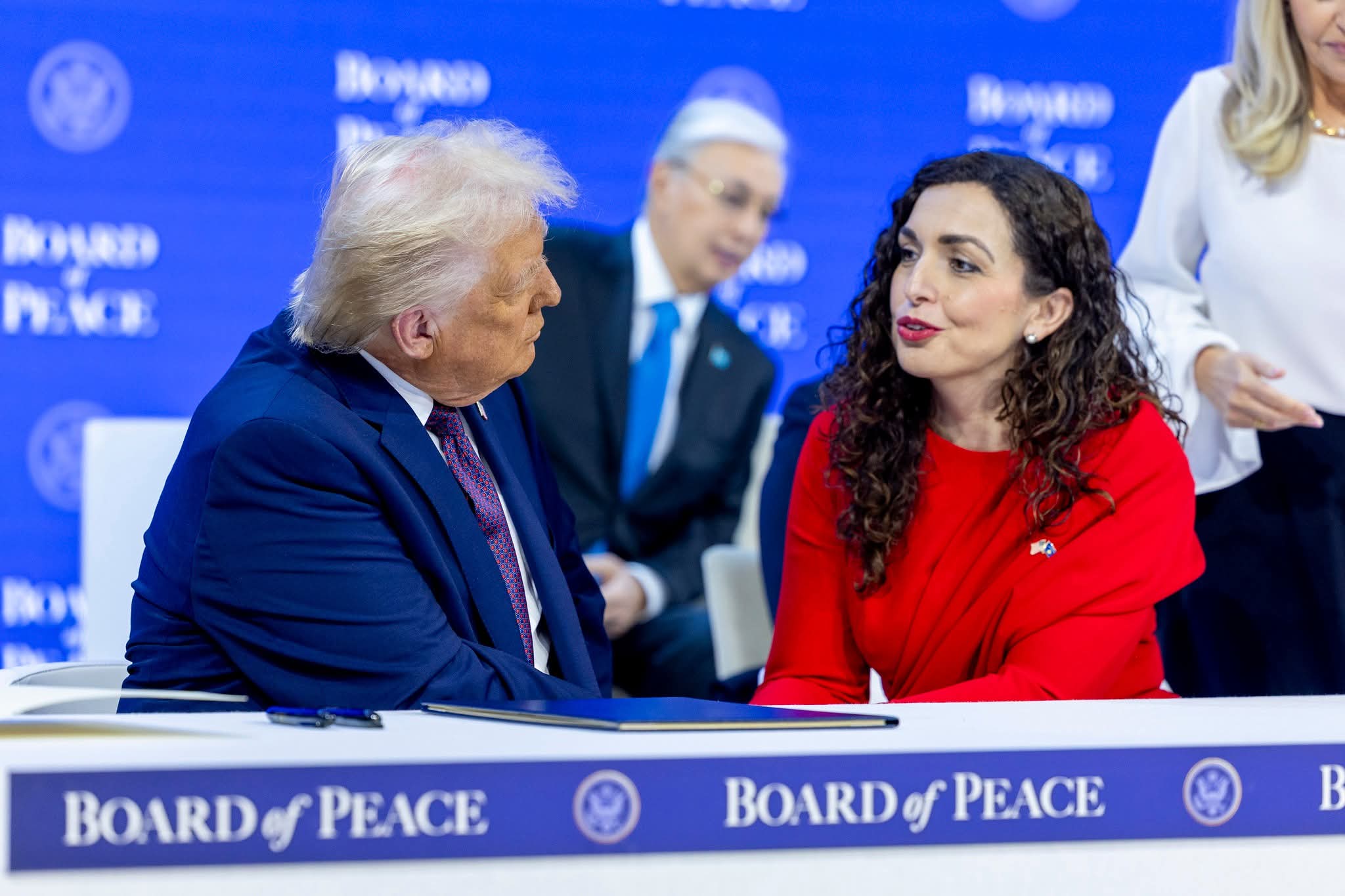
President Vjosa Osmani said that, thanks to U.S. leadership and President Donald Trump, the Iranian people were approaching “a time of freedom.” On X (formerly Twitter), she added that Kosovo would continue to support U.S. and allied actions aimed at ending the Iranian regime, while strongly condemning Iranian attacks on allies in the Middle East.
The U.S. and Israel launched joint strikes against Iran on February 28 to curb Tehran’s nuclear program. In retaliation, Iran and its proxies have targeted allied sites from Saudi Arabia to Cyprus, despite warnings from Trump.
“Better not do that, because if they do, we will hit them with a force the likes of which has never been seen,” Trump wrote on Truth Social.
Kosovo’s Prime Minister Albin Kurti convened the Security Council to discuss the situation, saying the country is closely monitoring potential regional implications, RFE/RL reported. The government, presidency, interior ministry, police, and the U.S. State Department did not provide further comment.
Kosovo hosts Camp Bondsteel, the largest U.S. military base in the Balkans, with around 600 American troops serving under NATO’s KFOR peacekeeping mission. A NATO official told RFE/RL that KFOR continues to fulfill its mandate to maintain a safe and secure environment for all citizens of Kosovo.
“Forces and positions are reviewed and adjusted periodically according to developments to ensure the mission remains effective. No major changes are currently under consideration,” the official said.
Former NATO official Jamie Shea told REL that while Bondsteel is a major U.S. installation, it is unlikely to be a high-priority target for Tehran, as it is not an air base nor directly involved in U.S. operations against Iran.
“From what I understand, Iran has a limited number of ballistic missiles. Since the U.S. and Israel are targeting launch platforms, Iran must use them wisely for maximum effect,” Shea said.
According to the U.S. Office of the Director of National Intelligence, Iran holds the largest stockpile of ballistic missiles in the Middle East, including long-range missiles capable of reaching Israel, Kh-55 cruise missiles with a 3,000 km range, and Shahed drones, reportedly used against a British base in Cyprus.
This arsenal does not put the Balkans within striking range.
Former U.S. Army Europe commander Ben Hodges warned that bases such as the U.S. naval facility on Crete could fall within Iran-inspired threats. While he did not cite specific threats to Bondsteel, he emphasized that the base should always be considered potentially at risk.
“There is always the possibility of terrorist organizations or individuals acting independently in retaliation for strikes against Iran or the killing of the Ayatollah. Security at Bondsteel must remain vigilant,” Hodges said to RFE/RL.
Shea highlighted that potential Iran-linked threats to Europe, including Kosovo, could include terrorist attacks, cyber operations, and lone actors motivated by ideology or extremist groups. He noted some Kosovars joined ISIS during the caliphate, with some possibly remaining radicalized.
Shea also warned of broader economic consequences, including rising oil and gas prices, inflation, and a potential global recession, which would affect Kosovo and the Western Balkans, a region economically dependent on foreign investment.
He suggested that Kosovo authorities strengthen border control, monitor potentially radicalized individuals, enhance security around U.S. and KFOR facilities, and reinforce operational and intelligence cooperation with NATO and the United States.
Hodges added that the conflict is putting pressure on U.S. military reserves and overall deterrence capacity, especially for sophisticated weapons systems requiring time to produce.
Trump said on March 4 that U.S. forces were in a “very strong position” in Iran and credited rebuilding the U.S. military during his first term for early operational successes.
In the Western Balkans, Bosnia’s Ministry of Security increased threat levels amid the Middle East escalation, while Serbian President Aleksandar Vučić compared the U.S. strike against Iran to NATO’s bombing campaign against Yugoslavia. Shea described this as a “completely false analogy” and noted Iran supports Serbia in opposing Kosovo’s independence.
Iran, with over 91 million people, does not recognize Kosovo and maintains no formal diplomatic relations.