


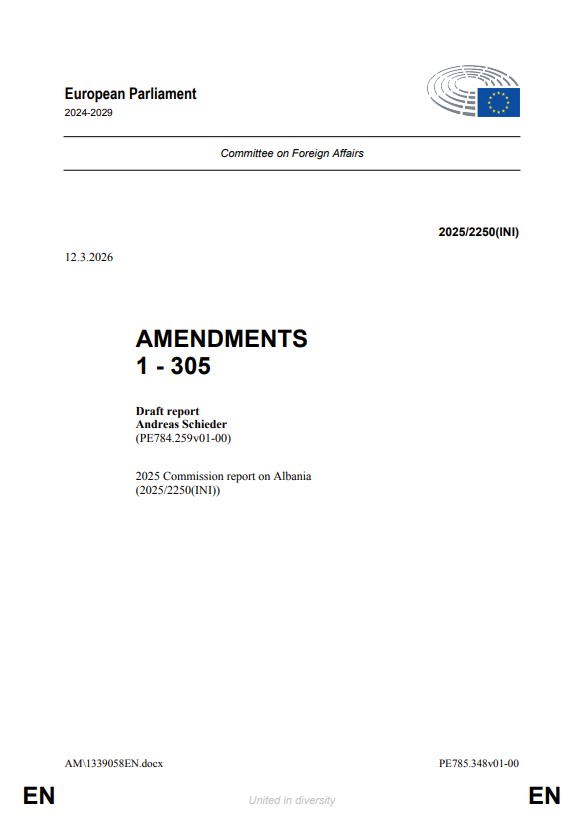
European Parliament members have submitted 305 amendments to the 2025 report on Albania, highlighting concerns over political polarization, judicial independence, corruption, and alleged irregularities in last year’s parliamentary elections.
The amendments, to be discussed in the upcoming plenary session, address a range of issues including the immunity of former Deputy Prime Minister Belinda Balluku, violent opposition protests, and the role of Albania’s Special Anti-Corruption and Organized Crime Structure (SPAK).
David McAllister, chair of the European Parliament’s Foreign Affairs Committee, submitted six amendments expressing concern over ongoing political polarization and confrontational discourse, which he said undermines parliamentary oversight, public trust, and the effective functioning of democratic institutions.
“The European Parliament encourages political actors to engage constructively in parliamentary dialogue, ensuring that parliament remains the central forum for debate and democratic oversight,” McAllister said.
Amendments by Marco Tarquino, chair of the Parliament’s delegation for Albania, condemned violent protests by opposition supporters, stating they have no place in a functional democracy.
Several amendments also focused on the delayed parliamentary vote on lifting Balluku’s immunity, emphasizing that parliamentary immunity should protect institutional function rather than shield public officials from judicial scrutiny. “The procedures for lifting immunity must be conducted transparently and in full compliance with the rule of law,” one amendment stated.
The European People’s Party (EPP), aligned with Albania’s Democratic Party, submitted 26 amendments strongly criticizing systemic deficiencies in the 2025 parliamentary elections, including the unequal playing field for opposition parties, widespread use of public resources by the governing party, and alleged vote-buying.
The amendments also call for comprehensive electoral reform in consultation with civil society and international partners, ensuring equal media access, prevention of administrative misuse, and effective law enforcement.
High-level corruption remains a central concern, and amendments emphasize strengthening SPAK to ensure clear records of investigations, prosecutions, and convictions. The report also highlights challenges within the judiciary, including case backlogs, undue influence, and the importance of upholding Constitutional Court decisions and judicial independence.
The report further criticizes informal economic practices and inefficient administration, particularly the lack of transparency in public procurement and digital infrastructure. Parliamentarians urged independent audits and comprehensive oversight mechanisms for investment and procurement.
Pressures on media freedom, centralized media ownership, and economic constraints on journalists were also noted.
Overall, the amendments reflect near-unanimous support among European lawmakers for anti-corruption measures and backing SPAK’s efforts, while warning that Albania’s EU integration prospects depend on deep reforms and tangible implementation of European standards. The draft report was discussed in the Foreign Affairs Committee in February and is expected to be voted on in the European Parliament plenary session in the coming weeks.