


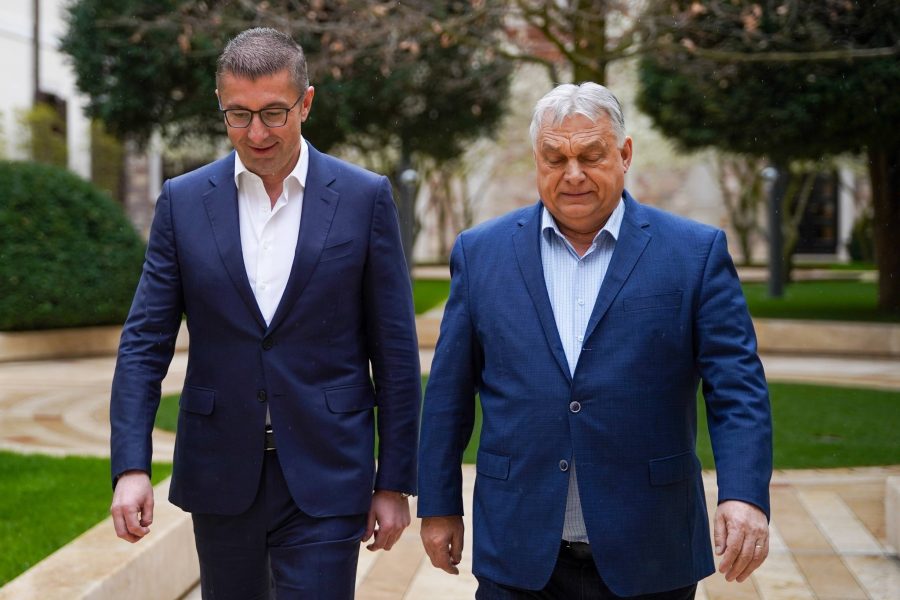
North Macedonia’s Prime Minister Hristijan Mickoski said on Monday that a business forum with Hungary could unlock new partnerships and investments, as he portrayed the Balkan country as one of Europe’s leading destinations for foreign direct investment per capita.
Speaking at the “Hungary–North Macedonia Business Cooperation Day” in Budapest, Mickoski said such forums go beyond idea-sharing and serve as a “practical mechanism” for strengthening economic ties.
“Direct communication between companies is key to creating new business models, opening markets and generating sustainable growth,” he said, adding that the event could lead to concrete deals and long-term partnerships.
Mickoski highlighted a newly launched direct flight between Skopje and Budapest as a boost for business links, investment flows and tourism, saying improved connectivity would accelerate bilateral economic activity.
On economic performance, he said government policies aimed at creating a stable and predictable business environment had helped the country reach a record level of foreign direct investment in 2024, estimated at around $1.25 billion.
“This places us among the leading destinations in Europe in terms of FDI per capita,” Mickoski said.
In a social media post following a meeting with Hungarian Prime Minister Viktor Orban, Mickoski said the two discussed deepening economic cooperation, new investments and specific joint projects.
“Hungary is a sincere and proven partner. Shared values, mutual respect and strong cooperation form the foundation of our strategic partnership,” he wrote, adding that “in times of challenges, strong friendships and a clear vision are key to stability and development.”
He also pointed to political stability as a factor supporting investor confidence, citing a stable parliamentary majority that allows continuity in reforms. The government, he said, remains focused on strengthening the rule of law, fighting corruption and advancing digital transformation.
Addressing the country’s European path, Mickoski said North Macedonia remains committed to reforms and meeting accession criteria for the European Union despite a lengthy and often challenging process.
“Progress should be assessed objectively and on merit, with the ultimate goal of improving citizens’ living standards,” he said.
Mickoski called on Hungarian companies to explore investment opportunities in North Macedonia, pointing to competitive conditions, a strategic geographic location and a skilled workforce. He added that Macedonian firms were also ready to expand into the Hungarian market.
🇭🇺🤝🇲🇰 Pleasure to meet with Prime Minister @MickoskiHM. Strong partnership, shared interests, more cooperation ahead. pic.twitter.com/7eMZHhML2F
— Orbán Viktor (@PM_ViktorOrban) March 30, 2026
Relations between North Macedonia and Hungary have strengthened in recent years through growing political alignment and economic cooperation. Hungary has been a vocal supporter of North Macedonia’s EU integration bid and has backed enlargement toward the Western Balkans. Bilateral ties have also been shaped by increased trade, infrastructure cooperation and Hungarian investments in sectors such as banking, energy and telecommunications.
The two countries have maintained close political contacts, with regular high-level visits and coordination within regional and European forums. Hungary has also positioned itself as an advocate for faster EU accession of Western Balkan states, including North Macedonia, at times diverging from more cautious positions within the bloc.
Dozens of Macedonian companies are taking part in the forum, engaging directly with Hungarian businesses in an effort to translate existing potential into tangible economic cooperation.
The event forms part of broader efforts by governments in Southeast Europe to attract foreign capital and deepen regional economic ties, as countries compete for investment and market access across the continent.